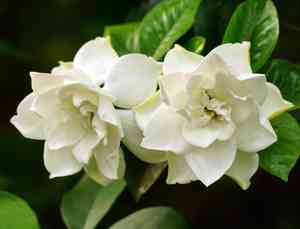
How Often Should You Water Your Cape jasmine?
1
To ensure your Cape jasmine flourishes, it's crucial to keep its soil consistently damp, yet prevent it from becoming waterlogged.
2
Assess the soil's dampness every week by touching the upper 2-3 cm (1 inch) of the substrate to ascertain if irrigation is necessary.
3
When Cape jasmine is actively blooming, it might require more frequent hydration to sustain its flower development.
Deciphering the Hydration Requirements of Gardenia
Elements Affecting Water Demand
The Gardenia, prized for its exquisite and fragrant blossoms, possesses specific hydration needs influenced by several elements. Firstly, the plant's dimensions impact its fluid intake—larger specimens with more foliage deplete moisture quicker and necessitate more frequent watering. Secondly, the container's volume and composition also play a role: plants in smaller vessels may desiccate faster. Furthermore, soil composition is vital: sandy substrates drain more rapidly than clayey ones, potentially requiring varied watering approaches. Lastly, atmospheric moisture levels can influence water requirements; lower humidity dictates more frequent irrigation, while elevated humidity can decrease watering regularity.
Seasonal Adjustments in Watering
Just as a Gardenia's needs transform with the seasons, so do its hydration demands. During the warmer periods of spring and summer, the plant's growth intensifies, and it may require more frequent irrigation to remain hydrated. Conversely, in the colder months, the plant's development typically decelerates, necessitating less water. It is essential to modify your watering regimen according to the season to prevent over or under-hydration. Remember, weekly evaluations and adaptations based on current weather conditions can significantly benefit your plant.
Effective Hydration Techniques for Gardenia
Selecting the Optimal Time and Frequency for Watering
Achieving correct timing is fundamental when hydrating your Gardenia. Water the plant in the morning if feasible, as this allows the plant to absorb moisture throughout the day and diminishes the risk of fungal ailments that flourish in damp, cool environments. Aim to hydrate your Gardenia every week, but always verify soil moisture levels prior to watering. Insert your finger into the soil approximately 2-3 cm (1 inch); if it feels arid at this depth, it is time to irrigate.
Approaches for Hydrating Gardenia
Several effective methods exist for hydrating your Gardenia. The simplest technique is manual watering with a watering can, ensuring uniform distribution around the plant's base. Another approach is drip irrigation, which delivers water directly to the roots and can be programmed for consistency. Additionally, submerging the pot in a shallow basin of water enables the plant to draw moisture from the bottom upwards, which can be particularly advantageous if the soil has become excessively dry and has separated from the pot edges.
Common Watering Errors to Avoid
Excessive Watering and Its Repercussions
Over-irrigation is a frequent error and can be detrimental to your Gardenia. When the soil is saturated, the roots cannot acquire sufficient oxygen, leading to root decay—a condition that can severely harm or even kill the plant. Symptoms of over-watering include yellowing foliage, wilting, and a pungent odor emanating from the soil.
Indicators of Insufficient Watering
Conversely, under-watering can stress your Gardenia, resulting in dry, brittle leaves and stunted development. If you observe the foliage curling, becoming parched and crisp, or if the plant is not blooming as it should, these are signals that your Gardenia requires more hydration. Regular inspections and maintaining a consistent watering schedule can help circumvent these issues.
Maintaining Ideal Soil Humidity for Gardenia
The Significance of Adequate Drainage
Proper drainage is vital for sustaining optimal soil humidity for your Gardenia. Ensure your container possesses drainage apertures to prevent water stagnation at the bottom, which can cause root rot. You might also consider utilizing a saucer underneath to collect surplus water, but be sure to empty it regularly.
Employing Moisture Detectors and Other Devices
Instruments such as moisture meters can be exceptionally useful in upholding the correct humidity level for your Gardenia. Insert the probe into the soil, and it will indicate whether the soil is dry, damp, or saturated. This can help you irrigate with greater precision. Other devices include hygrometers to gauge ambient humidity and irrigation timers to automate watering schedules.



