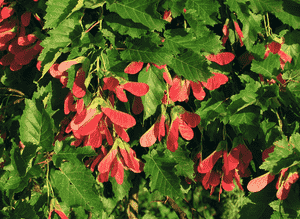
Tartarian maple (Acer tataricum)
Also known as: Tatarian maple, Amur maple
The Tartarian maple (Acer tataricum) derives its name from the Tatar people of southern Russia. It thrives in temperate regions across Europe and Asia. This versatile plant can grow as a shrub or a tree, reaching up to 12 meters in height and producing distinctive winged seeds. It is often used by farmers as a windbreak and is also popular as an ornamental tree.
In This Article
Attributes of Tartarian maple
Lifespan
Perennial
Plant Type
Tree, Shrub
Plant Height
5 m
Spread
3 m
Leaf Color
Green
Flower Size
2.5 cm to 8 cm
Flower Color
White Green Cream
Images of Tartarian maple
Quickly Identify Tartarian maple
1
Opposite, simple leaves with irregular double serration, 2-4 inches (5-10 cm) long
2
Distinctive reddish-brown stem with small lens-shaped lenticels, 1/8 to 1/4 inches (3-6 mm) long
3
Upright panicles of greenish-white flowers in April-May, 2-3 inches (5-7.5 cm) long
4
Winged samara fruit, 3/4 - 1 inch (1.9 - 2.5 cm) with red to brown color transition
5
Young pale brown bark with shallow fissures, transitioning to a rougher texture
Scientific Classification of Tartarian maple
Phylum
Vascular plants
Class
Dicotyledons
Order
Sapindales
Family
Soapberry
Genus
Maples
Species
Tartarian maple
Planting and Growing of Tartarian maple
Care Difficulty
Easy
Watering Schedule
Every 4 days
Sunlight Requirements
Full sun
Sunshine Duration
6-10 hours
Ideal Temperature
50-70℉
Soil Type
Potting Mix, Peat Mix
Soil pH
6.5-7.5
Fertilizer Type
Balanced
Pruning Season
Spring, Summer
Pruning Area
Branches, Leaves
Pruning Frequency
2 times a year
Repotting Season
Spring
Pot Type
Ceramic, Plastic
 How to Water Tartarian maple?
For Acer tataricum, it is crucial to maintain a balance in watering by providing about 1000 milliliters each time. Ensure that the soil is moist but not waterlogged. Use the finger test: insert your finger into the soil up to the second knuckle—if the soil feels dry at this depth, it’s time to water.
What are the symptoms of an underwatered Tartarian maple?
›
What should I do if my Tartarian maple is not getting enough water?
›
What are the symptoms of an overwatered Tartarian maple?
›
How to save an overwatered Tartarian maple?
›
 What Are the Sunlight Requirements for Tartarian maple?
Acer tataricum thrives under partial to full sun conditions, ideally with 6 to 8 hours of daily sunlight exposure. This ensures robust growth and vivid foliage display.
More About Sunlight Requirements Techniques→
What is the best location for Acer tataricum?
›
How to ensure Acer tataricum gets optimal light?
›
What are the benefits of ideal lighting for Acer tataricum?
›
 What Is the Ideal Temperature Range for Tartarian maple?
The ideal temperature range for Acer tataricum is between 50°F and 70°F. Within this range, the plant can photosynthesize efficiently, maintain healthy growth, and support optimal metabolic processes. Ensuring that the temperature stays within this range helps in minimizing stress and promoting lush foliage.
 What Soil is Best for Tartarian maple?
Acer tataricum thrives in well-drained soil which prevents root rot and promotes healthy root development. Ensuring good drainage can lead to vigorous growth and a robust tree structure. This plant prefers soil that retains moderate moisture, avoiding drought stress. Maintaining consistent moisture levels can help produce lush foliage and a strong plant resilience. Acer tataricum benefits from nutrient-rich soil, enhancing its growth and vitality. Adequate nutrition supports healthy leaves and vibrant colors, especially in the growing season.
 How to Fertilize Tartarian maple?
For Acer tataricum, the recommended fertilizer amount involves using a balanced 10-10-10 NPK fertilizer. When applying liquid fertilizer, dilute it to half strength to avoid root burn. A typical application for a mature plant is about 1 cup (approximately 240 milliliters) per application with ample water, ensuring the soil is evenly moist but not oversaturated.
 How to Prune Tartarian maple?
Start by identifying and removing any dead or diseased branches. These branches can harbor pests and pathogens that may spread to healthy parts of the tree. Prune them back to a living side branch or to the trunk, leaving no stubs. Acer tataricum can sometimes develop dense growth. Use pruning to thin out crowded areas, which will improve air circulation and light penetration. Focus on removing inward-facing branches and those that cross over or rub against each other. While shaping the tree, keep in mind its natural form. Avoid drastic cuts that may stress the tree. Instead, aim for subtle shaping that encourages a balanced silhouette. Make cuts just above a bud facing outward to guide future growth in the desired direction.
More About Pruning Techniques→
 How to Propagate Tartarian maple plant?
1
Collect seeds from a healthy Acer tataricum tree in the autumn when they are mature. Stratify them by placing in a moist, cold environment for 3-4 months to simulate winter conditions.
2
Select healthy branches in early spring for cuttings. Cut sections about 10-15 cm in length, ensuring each has a few leaves. Dip in rooting hormone to enhance root development.
3
For grafting, choose a compatible rootstock and a scion from the parent plant in early spring. Ensure clean cuts on both and secure them together using grafting tape to promote healing and fusion.
 How to Repot Tartarian maple plant?
1
Look for signs such as roots poking through the drainage holes and stunted growth. These are clear indicators that your Acer tataricum needs more room to expand and thrive. Repotting in spring or autumn offers the best conditions for recovery and growth.
2
Choose a container that is 2-3 inches larger in diameter than the current pot, ensuring it has adequate drainage holes. This prevents waterlogging and encourages healthy root growth, giving your plant space to flourish without risking root rot.
3
Opt for a well-draining potting mix, ideally with a balance of peat, bark, and perlite. This combination ensures aeration and prevents soil compaction, allowing the roots of your Acer tataricum to access ample oxygen and water efficiently.



