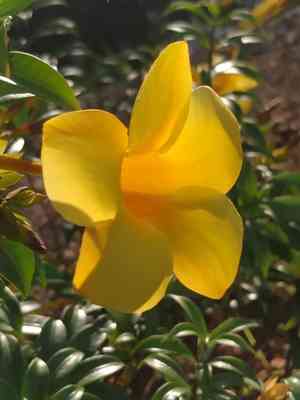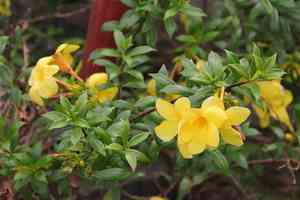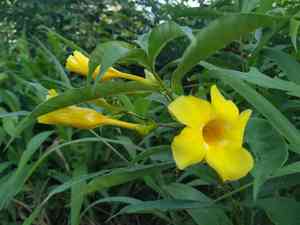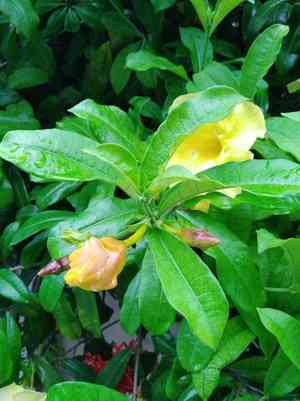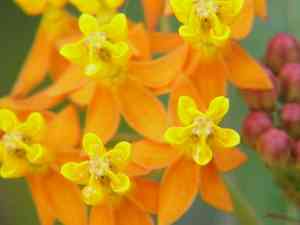
Golden trumpet(Allamanda cathartica)

Golden trumpet (Allamanda cathartica)

Also known as: Buttercup Flower, Allamanda, Golden Cup, Yellow allamanda, Angel's trumpet

The official flower of Canóvanas, Puerto Rico, is the Golden Trumpet (Allamanda cathartica), a species originally from Brazil. This plant, noted in Flora Brasiliensis, can reach up to 6 meters if left untrimmed.

Attributes of Golden trumpet

Lifespan
Perennial
Plant Type
Shrub, Vine
Plant Height
4 m
Spread
90 cm to 1.8 m
Leaf Color
Green
Flower Size
10 cm
Flower Color
Yellow Pink Gold

PlantJoy - Identify plants with a snap

Identify and diagnose plants, get toxicity alerts, and explore safety guides for all types of fungi.

Try for Free

Images of Golden trumpet

Golden trumpet(Allamanda cathartica)

Quickly Identify Golden trumpet

1
Large, trumpet-shaped flowers in vibrant golden yellow hue up to 5 inches (13 cm) across.
2
Leathery, glossy, evergreen leaves in whorls of four, oblong-lanceolate, 6.3 inches (16 cm) long.
3
Twining stem with milky sap, can grow up to 19 feet (5.8 meters) or more.
4
Distinctive spiny fruit capsules, green to brownish, 2-3 inches (5-7.6 cm) in length.
5
Yellow tubular flowers, 3.5 inches (8.9 cm) long, in clusters of 12 on branches.

Scientific Classification of Golden trumpet

Phylum
Vascular plants
Class
Dicotyledons
Order
Gentianales
Family
Dogbane
Genus
Allamanda
Species
Golden trumpet

Planting and Growing of Golden trumpet

Care Difficulty
Easy
Watering Schedule
Every 4 days
Sunlight Requirements
Full sun
Sunshine Duration
6-8 hours
Ideal Temperature
65-80℉
Soil Type
Potting Mix, Peat Mix
Soil pH
6.5-7.5
Fertilizer Type
Balanced
Pruning Season
Spring, Summer
Pruning Area
Branches, Leaves
Pruning Frequency
2 times a year
Repotting Season
Spring
Pot Type
Plastic, Ceramic

water icon How to Water Golden trumpet?

When watering Allamanda cathartica, ensure that the soil is moist but not waterlogged. The rule of thumb is to apply approximately 500 ml of water each time, allowing the water to evenly penetrate the soil without forming puddles on the surface.
What are the symptoms of an underwatered Golden trumpet?
What should I do if my Golden trumpet is not getting enough water?
What are the symptoms of an overwatered Golden trumpet?
How to save an overwatered Golden trumpet?
More About Watering Techniques

sunlight icon What Are the Sunlight Requirements for Golden trumpet?

Sunlight Requirements: Full sun, Partial sun
Duration of light: 6 to 8 hours daily
Full sun is ideal for Allamanda cathartica, with benefits including enhanced blooming and robust foliage. Exposure to 6-8 hours of sunlight daily ensures healthy and vigorous growth.
What is the best lighting condition for Allamanda cathartica?
How can I ensure ideal lighting for Allamanda cathartica?
What benefits does Allamanda cathartica gain from ideal lighting?
More About Sunlight Requirements Techniques

temperature icon What Is the Ideal Temperature Range for Golden trumpet?

Ideal Temperature: 65 ~ 80℉
Allamanda cathartica thrives best in warm climates with temperatures ranging from 65°F to 80°F. This temperature range promotes optimal growth and flowering. Adequate warmth ensures that the plant's metabolic processes function efficiently, allowing for healthy foliage development and vibrant blooms.

soil icon What Soil is Best for Golden trumpet?

Soil type: Loam, Sandy loam
Soil PH: 6.5 ~ 7.5
Allamanda cathartica thrives in nutrient-rich loam or sandy loam soil that supports its vigorous growth. This type of soil ensures the plant receives essential nutrients, promoting lush green foliage and abundant blooms. The plant needs well-draining soil to prevent root rot, which can be detrimental. Loam or sandy loam offers good drainage, keeping the roots healthy and oxygenated, crucial for its growth. While drainage is vital, retaining adequate moisture is equally important. Sandy loam balances these needs by holding some moisture, ensuring the plant remains hydrated between waterings without getting waterlogged. More About Soil

fertilize icon How to Fertilize Golden trumpet?

Fertilizer type: Balanced
Allamanda cathartica benefits from a balanced fertilizer with an NPK ratio of 10-10-10. For liquid fertilizer, dilute it to half strength; this ensures the plant gets essential nutrients without the risk of burning its roots. A tablespoon per gallon of water is typically sufficient. More About Fertilizing Techniques

prune icon How to Prune Golden trumpet?

Pruning Time: Spring, Summer
Start by using clean, sharp pruning shears. Trim back long, lanky stems to promote a fuller appearance. Focus on cutting just above a node to encourage branching. Carefully examine the plant for any dead or diseased branches. Remove these completely to prevent the spread of any potential diseases. Cut all the way back to healthy wood. After the plant flowers, remove spent blooms to make way for new growth. Cut back any stem that looks too weak to bear flowers, which helps the plant redirect energy to healthier parts. More About Pruning Techniques

propagate icon How to Propagate Golden trumpet plant?

Propagate Time: Early spring, Spring, Late spring, Summer, Early summer
1
Choose a healthy stem from the mother plant. Cut a section that is at least 6 inches long with a few leaves on it. Ensure the cut is clean and straight for optimal rooting potential.
2
Prepare a pot with a well-draining soil mix. A mix of peat and perlite works well for rooting cuttings as it balances moisture retention and drainage.
3
Insert the cutting's basal end into the soil just a few inches deep. Firmly press the soil around the base to eliminate air pockets, which helps the cutting stay upright and stable.
More About Propagating Techniques

repot icon How to Repot Golden trumpet plant?

Repotting frequency: Once every 2-3 years
1
Allamanda cathartica should be repotted when the roots become pot-bound and start growing through the drainage holes. A good time is during its growing season for optimal adaptation. Also, if you notice slowed growth or leaf discoloration, it's time to provide fresh nutrients and space.
2
Select a pot that is one size larger than the current one, with adequate drainage holes to prevent waterlogging. The pot material can be clay or ceramic to ensure stability and breathability, aiding in root health and reducing rot risks while anchoring the vigorous vine growth.
3
Choose a well-draining soil mix rich in organic matter; a blend with peat, perlite, and a pH-neutral component works well. This mix ensures proper aeration and nutrient availability, allowing the Allamanda to thrive and reduce compaction issues.
More About Repotting Techniques

PlantJoy - Identify plants with a snap

Find the best spots for them to optimize their health, simply using your phone.

Try for Free

Toxicity of Golden trumpet

Is Golden trumpet toxic to humans?

Every part of the golden trumpet plant is toxic when ingested by humans, and it may also lead to mild skin irritation due to contact with its sap. Poisoning is more likely to happen if large amounts are consumed or through accidental exposure to the plant. Symptoms of golden trumpet ingestion include fever, swollen lips, increased thirst, nausea, and diarrhea. When people come into contact with the sap, they may experience a red, itchy, and inflamed rash at the site of contact, or eye irritation if the sap gets into the eyes. It is occasionally found as a greenhouse or houseplant in temperate regions.

Is Golden trumpet toxic to cat?

Golden trumpet exhibits a moderate level of toxicity to cats, posing a risk if consumed in significant amounts. Every component of the plant is poisonous, and when a cat ingests any part of it, they may suffer from physical distress, sickness, or discomfort. Although the exact toxic agents are not specified, cat owners should be vigilant for general indicators of poisoning. In any instance of suspected ingestion, it is crucial to obtain prompt veterinary care to safeguard the cat's health.

Is Golden trumpet toxic to dog?

The golden trumpet plant is regarded as having mild toxicity for dogs. Poisoning is likely to occur when a dog ingests significant amounts of the plant. Every part of the golden trumpet is toxic, which indicates that consuming any part, be it leaves, flowers, or stems, can result in harmful health outcomes. Signs of poisoning may involve vomiting, diarrhea, and potentially more severe complications based on the quantity consumed. Given the dangers associated with golden trumpet, it is vital for dog owners to keep a close watch on their pets and restrict access to this plant. Should a dog consume golden trumpet, it is imperative to seek immediate veterinary assistance to ensure proper treatment and care.

Identify toxic plants for your safety

Learn which plants are harmful to you and your pets, and make informed choices for a safer home!

Try for Free
WARNING
The judgment on toxicity and danger is for reference only. We DO NOT GUARANTEE any accuracy of such judgment. Therefore, you SHALL NOT rely on such judgment. It is IMPORTANT TO SEEK PROFESSIONAL ADVICE in advance when necessary.
More About Toxic Techniques