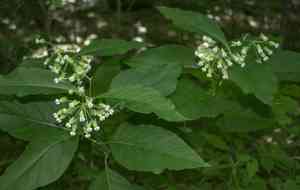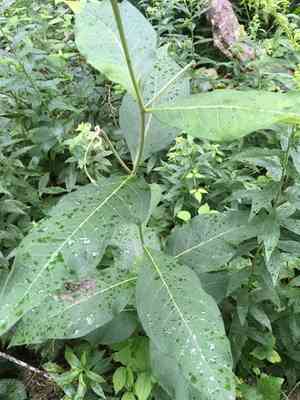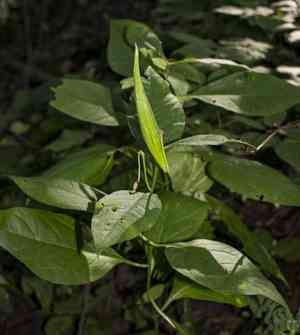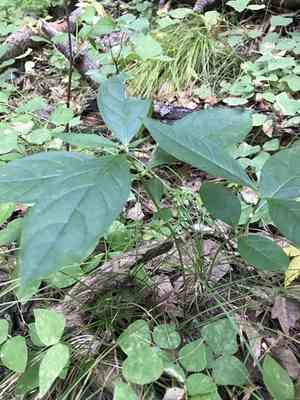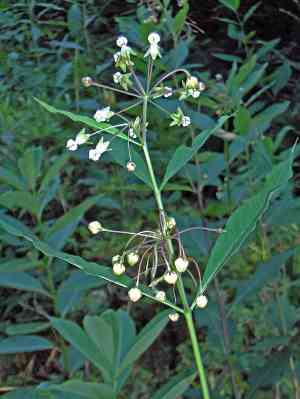
Poke milkweed(Asclepias exaltata)

Poke milkweed (Asclepias exaltata)

Also known as: Poke Milkweed

Poke milkweed grows best in woodland areas with partial to full shade. It prefers moist, well-drained soils and is a favorite of both monarch butterflies and rabbits. The plant is long-lived and non-invasive.

Attributes of Poke milkweed

Lifespan
Perennial
Plant Type
Herb
Plant Height
60 cm to 1.5 m
Spread
30 cm to 60 cm
Leaf Color
Green
Flower Size
2.5 cm
Flower Color
White Green

PlantJoy - Identify plants with a snap

Identify and diagnose plants, get toxicity alerts, and explore safety guides for all types of fungi.

Try for Free

Images of Poke milkweed

Poke milkweed(Asclepias exaltata)

Quickly Identify Poke milkweed

1
Tall herbaceous perennial, reaching 3-6 feet (90-180 cm) in height.
2
Distinctive creamy-white to pale lavender flowers, with reflexed petals and curving hoods.
3
Slender, elongated fruit pods, 3-6 inches (7.5-15 cm) in length, with tufted seeds for wind dispersal.
4
Green leaves with purplish veins, 2-11 inches (5-28 cm) long, hairy underneath.
5
Green stem, slightly hairy, 0.2-0.4 inches (0.5-1 cm) thick, with purplish umbel stems.

Scientific Classification of Poke milkweed

Phylum
Vascular plants
Class
Dicotyledons
Order
Gentianales
Family
Dogbane
Genus
Milkweeds
Species
Poke milkweed

Planting and Growing of Poke milkweed

Care Difficulty
Easy
Watering Schedule
Every 3 days
Sunlight Requirements
Partial sun
Sunshine Duration
4-8 hours
Ideal Temperature
65-75℉
Soil Type
Potting Mix, Peat Mix
Soil pH
6.5-7.5
Fertilizer Type
Balanced
Pruning Season
Spring, Summer
Pruning Area
Branches, Leaves
Pruning Frequency
Once a year
Repotting Season
Spring
Pot Type
Plastic, Ceramic

water icon How to Water Poke milkweed?

For Asclepias exaltata, the watering should be thorough but not excessive. This plant prefers the soil to remain moist, particularly during its active growth period in spring and summer. You should aim to water until the soil is evenly moist, approximately 250 milliliters per watering session, ensuring it is absorbed and not pooling on the surface.
What are the symptoms of an underwatered Poke milkweed?
What should I do if my Poke milkweed is not getting enough water?
What are the symptoms of an overwatered Poke milkweed?
How to save an overwatered Poke milkweed?

sunlight icon What Are the Sunlight Requirements for Poke milkweed?

Sunlight Requirements: Partial sun, Full shade
Duration of light: 2-6 hours daily
Asclepias exaltata does well in partial sun to full shade environments. Ideal light fosters balanced growth, maximizes flower yields, and enhances the plant's natural attractiveness, particularly in woodland settings.
How much sunlight does Asclepias exaltata need?
What is the best way to achieve this light condition?
What are the benefits of providing ideal light conditions?

temperature icon What Is the Ideal Temperature Range for Poke milkweed?

Ideal Temperature: 65 ~ 75℉
Asclepias exaltata, commonly known as poke milkweed, thrives best in a temperature range of 65 to 75°F. Keeping the plant within this window ensures optimal growth and health by closely mimicking its natural habitat conditions.

soil icon What Soil is Best for Poke milkweed?

Soil type: Loam, Sandy loam
Soil PH: 6.5 ~ 7.5
Asclepias exaltata thrives in well-drained soil which prevents waterlogging, a condition that can suffocate roots and cause root rot. Such soil ensures that the plant roots are adequately aerated, promoting healthy root development and overall plant vigor. This plant prefers soil with moderate fertility. Soils that are too rich in nutrients can lead to excessive foliage growth with fewer blooms. Maintaining an intermediate level of fertility can help the plant focus on balanced growth and abundant flowering. The soil should have good moisture retention abilities to keep the roots hydrated without excess water. This is crucial in preventing drought stress which can stunt plant growth and reduce flowering, ensuring a stable supply of water while avoiding swampy conditions.

fertilize icon How to Fertilize Poke milkweed?

Fertilizer type: Balanced
For Asclepias exaltata, it is important not to over-fertilize. A general recommendation is to use a balanced liquid fertilizer diluted to half-strength. Use approximately 1/4 to 1/2 cup per plant, depending on the size and soil condition.

prune icon How to Prune Poke milkweed?

Pruning Time: Spring, Summer, Autumn
Begin your pruning by removing any dead, damaged, or diseased stems. This will help your Asclepias exaltata redirect its energy to new, healthy growth. Use sharp, sterilized shears to make clean cuts just above a node or leaf joint. Prune back crowded branches to open up the plant. This thinning promotes air circulation, reducing the risk of mold and fungal diseases. Cut back to a main branch, removing any cross branches or branches that rub against each other. To stimulate flowering, consider cutting back the plant by one-third after the first bloom. This can encourage an additional round of blooms and keep your Asclepias exaltata looking vibrant throughout the growing season.

propagate icon How to Propagate Poke milkweed plant?

Propagate Time: Spring, Early spring
1
Collect seeds from mature Asclepias exaltata plants in late summer after the seed pods have turned brown. Ensure that seeds are fully mature for better germination rates.
2
Fill a seed tray with potting mix. Ensure the mix is damp but not waterlogged to provide an optimal environment for seed germination.
3
Sow the seeds on the surface of the potting mix and lightly press them down. Cover with a thin layer of soil, and water gently.

repot icon How to Repot Poke milkweed plant?

Repotting frequency: Every 2-3 years
1
Look for signs like roots emerging from drainage holes, soil drying out quickly, or stunted growth. These are your plant’s way of telling you it's time to refresh its living quarters.
2
Opt for a pot that’s one size larger than the current one, with good drainage holes to prevent waterlogging. A slightly bigger pot allows for root expansion without overwhelming the plant, promoting healthier growth.
3
Use a well-draining soilless mix that enhances aeration, retains necessary moisture, but prevents sogginess. This type of soil encourages robust root growth while avoiding rot due to excessive water retention.

PlantJoy - Identify plants with a snap

Find the best spots for them to optimize their health, simply using your phone.

Try for Free

Toxicity of Poke milkweed

Is Poke milkweed toxic to humans?

The consumption of significant amounts of poke milkweed can lead to a critical situation that necessitates urgent medical intervention. Poisoning can also arise from exposure to the plant's sap. All parts of this plant are poisonous; its leaves are particularly rich in toxic cardiac glycosides. Ingesting these plants may result in symptoms such as vomiting, lethargy, weakness, and muscle spasms. One might also observe skin, mouth, tongue, and throat irritation, which can cause throat swelling, breathing challenges, a sensation of burning pain, and gastrointestinal distress. Direct contact with the sap of poke milkweed may trigger skin irritation or rashes. This plant is commonly cultivated in gardens and can be found in many households, rendering children especially vulnerable.

Identify toxic plants for your safety

Learn which plants are harmful to you and your pets, and make informed choices for a safer home!

Try for Free
WARNING
The judgment on toxicity and danger is for reference only. We DO NOT GUARANTEE any accuracy of such judgment. Therefore, you SHALL NOT rely on such judgment. It is IMPORTANT TO SEEK PROFESSIONAL ADVICE in advance when necessary.
More About Toxic Techniques