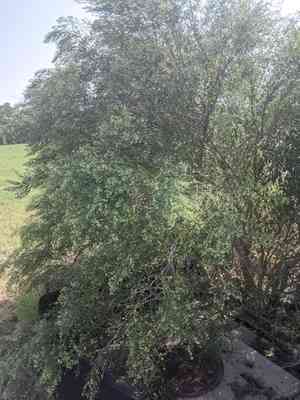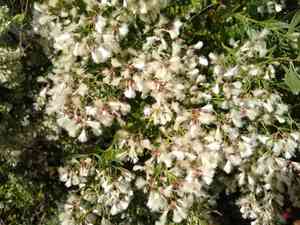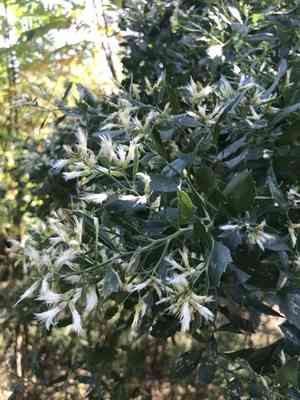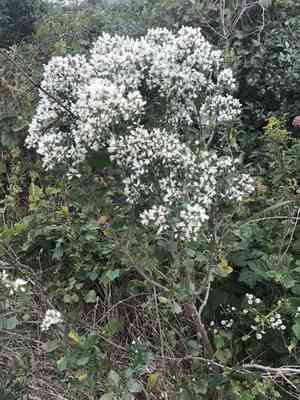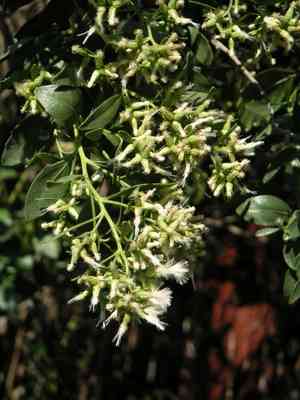
Groundsel bush(Baccharis halimifolia)

Groundsel bush (Baccharis halimifolia)

Also known as: Eastern baccharis, Consumption weed

Baccharis halimifolia is native to the eastern United States, ranging from Massachusetts to Texas, as well as parts of the Bahamas and Cuba. Notably, it is the northernmost species of the Baccharis genus. When introduced to other regions like Australia and Spain, it has become invasive. Additionally, its seeds are toxic if ingested by humans.

Attributes of Groundsel bush

Lifespan
Perennial
Plant Type
Shrub
Plant Height
4 m
Spread
3.5 m to 4 m
Leaf Color
Green White Gray Silver
Flower Size
9 cm
Flower Color
White Yellow

PlantJoy - Identify plants with a snap

Identify and diagnose plants, get toxicity alerts, and explore safety guides for all types of fungi.

Try for Free

Images of Groundsel bush

Groundsel bush(Baccharis halimifolia)

Quickly Identify Groundsel bush

1
Leaves are cuneate, bright green to gray-green, with white waxy layer, giving a grey appearance.
2
Flowers are white-green, tubular, in terminal clusters, with green-tipped bracts, blooming from August to October.
3
Fruit is a pyramid-shaped achene with cottony pappus, resembling silver paintbrushes, dispersing seeds by wind.
4
Multi-stemmed shrub grows upright, spreading, reaching 6-10 feet (1.8-3 meters) in height.
5
Trunk is woody, moderately thin, grayish-brown bark with flaking texture, often less than 6 inches (15 cm) in diameter.

Scientific Classification of Groundsel bush

Phylum
Vascular plants
Class
Dicotyledons
Order
Asterales
Family
Daisy
Genus
Baccharises
Species
Groundsel bush

Planting and Growing of Groundsel bush

Care Difficulty
Easy
Watering Schedule
Every 2 days
Sunlight Requirements
Full sun
Sunshine Duration
4-8 hours
Ideal Temperature
60-75℉
Soil Type
Potting Mix, Peat Mix
Soil pH
6.5-7.5
Fertilizer Type
Balanced
Pruning Season
Spring, Summer
Pruning Area
Branches, Leaves
Pruning Frequency
2 times a year
Repotting Season
Spring
Pot Type
Plastic, Ceramic

water icon How to Water Groundsel bush?

Baccharis halimifolia should be watered deeply, allowing the water to reach the roots without leaving the soil soggy. A deep soaking ensures moisture penetration and encourages root growth, and each watering session should use approximately 500 milliliters, keeping in mind to avoid waterlogging.
What are the symptoms of an underwatered Groundsel bush?
What should I do if my Groundsel bush is not getting enough water?
What are the symptoms of an overwatered Groundsel bush?
How to save an overwatered Groundsel bush?
More About Watering Techniques

sunlight icon What Are the Sunlight Requirements for Groundsel bush?

Sunlight Requirements: Full sun, Partial sun
Duration of light: 6 to 8 hours
Baccharis halimifolia flourishes under conditions of full sun to partial sun, benefiting from this light range through enhanced growth, vibrant leaf coloration, and prolific flowering. Adequate light exposure promotes photosynthesis and overall vigor.
How much sun does Baccharis halimifolia prefer?
What are some solutions for achieving ideal lighting?
What benefits come from providing ideal light?
More About Sunlight Requirements Techniques

temperature icon What Is the Ideal Temperature Range for Groundsel bush?

Ideal Temperature: 60 ~ 75℉
The ideal temperature range for Baccharis halimifolia is between 60°F to 75°F. This range supports optimal growth by providing a stable environment that mimics the plant's native conditions. Maintaining this temperature ensures the plant's photosynthetic processes work efficiently, thereby promoting healthy foliage and robust growth.

soil icon What Soil is Best for Groundsel bush?

Soil type: Sandy soil, Loam, Clay soil
Soil PH: 6.5 ~ 7.5
Baccharis halimifolia thrives in well-draining soils that prevent waterlogging. This requirement is vital to avoid root rot, promoting healthy root systems and robust plant growth. This plant benefits from being planted in soils rich in nutrients. Adequately nutrient-filled earth fosters vigorous foliage and blossoms, proving beneficial for ornamental purposes. While Baccharis halimifolia can tolerate dry spells, moderately moist soils support optimal growth. Consistent moisture levels ensure sustained plant health and resistance to drought stress. More About Soil

fertilize icon How to Fertilize Groundsel bush?

Fertilizer type: Balanced
For Baccharis halimifolia, use a balanced fertilizer at a moderate rate. A liquid fertilizer can be applied with a concentration of 1 tablespoon per gallon of water, while a slow-release granular fertilizer should be applied according to package instructions. More About Fertilizing Techniques

prune icon How to Prune Groundsel bush?

Pruning Time: Spring, Summer, Autumn
Begin by inspecting the plant for any dead or damaged branches and remove these first. Use sharp pruning shears to make clean cuts. Aim to cut the branches back to a healthy outward-facing bud to encourage growth away from the center. This promotes a more open structure, allowing light to penetrate and air to circulate. Finally, step back and shape the plant as desired: Baccharis halimifolia can withstand a good pruning session, so don't be shy about shaping it to your liking. More About Pruning Techniques

propagate icon How to Propagate Groundsel bush plant?

Propagate Time: Spring, Summer
1
Collect seeds from mature Baccharis halimifolia plants in the autumn. Ensure the seeds are fully ripened before harvesting. Dry and store them properly until ready for sowing in the spring.
2
Select healthy, disease-free stems for cuttings. Cut below a node and remove the lower leaves. This encourages root development when planted.
3
Place seeds or cuttings in a prepared tray with a well-draining mix. Water lightly to moisten the soil. Avoid over-watering as this can lead to fungal issues.
More About Propagating Techniques

repot icon How to Repot Groundsel bush plant?

Repotting frequency: Every 2-3 years
1
Look for signs like roots growing out of the drainage holes, water sitting on the soil surface, or slowed growth. These indicate the plant may need more space for its roots.
2
Opt for a pot that’s only slightly larger than the current one, with adequate drainage holes. This prevents over-watering and ensures roots have room to expand, enhancing the plant's health.
3
A well-draining soil is vital to prevent water-logged roots. Mix in some sand or perlite for added aeration, allowing roots to breathe and nutrients to flow freely, promoting robust growth.

PlantJoy - Identify plants with a snap

Find the best spots for them to optimize their health, simply using your phone.

Try for Free

Toxicity of Groundsel bush

Is Groundsel bush toxic to humans?

The groundsel bush is considered highly toxic to humans. While the precise mechanisms underlying its toxicity remain largely elusive, it is believed that the seeds and possibly the leaves of this plant can induce serious illness if consumed. These parts of the plant are likely to harbor cardiotoxic glycosides, which have the potential to lead to cardiac arrest and even fatality if ingested, even in minimal amounts. Although sometimes cultivated for ornamental purposes, groundsel bush is predominantly found in its native environments, which encompass damp areas, roadside ditches, and brackish swamps or wetlands. Due to the absence of edible look-alikes, incidents of human poisoning from this plant are exceedingly rare.

Identify toxic plants for your safety

Learn which plants are harmful to you and your pets, and make informed choices for a safer home!

Try for Free
WARNING
The judgment on toxicity and danger is for reference only. We DO NOT GUARANTEE any accuracy of such judgment. Therefore, you SHALL NOT rely on such judgment. It is IMPORTANT TO SEEK PROFESSIONAL ADVICE in advance when necessary.
More About Toxic Techniques