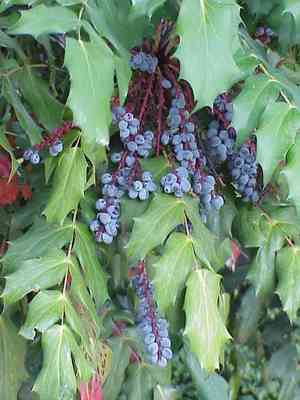
Leatherleaf mahonia(Berberis bealei)

Leatherleaf mahonia (Berberis bealei)

Also known as: Beale's Barberry, Coralberry

The Holly (Ilex) is commonly used for hedging due to its spiny, evergreen leaves that act as a natural barrier against intruders. Besides its distinctive foliage, Holly is also noted for its clusters of dark purple berries that appear in the summer. These berries attract birds, which consume them and help in spreading the seeds, contributing to the plant's wide distribution.

Attributes of Leatherleaf mahonia

Lifespan
Perennial
Plant Type
Shrub
Plant Height
50 cm to 4 m
Spread
90 cm to 2.5 m
Leaf Color
Green Blue Bronze
Flower Size
8 cm to 15 cm
Flower Color
Yellow Green

PlantJoy - Identify plants with a snap

Identify and diagnose plants, get toxicity alerts, and explore safety guides for all types of fungi.

Try for Free

Images of Leatherleaf mahonia

Leatherleaf mahonia(Berberis bealei)

Quickly Identify Leatherleaf mahonia

1
Odd-pinnately compound leaves with stiff, spiny-toothed leaflets, terminal leaflet larger.
2
Distinctive tiered growth with cane-like stems, sparse branching, reaching up to 10 feet (3 meters).
3
Aromatic yellow flowers in late winter, followed by grape-like clusters of blue-black berries.
4
Roundish, stout stems with a gray-brown hue, branching pattern from base, sturdy appearance.
5
Lemon yellow flowers in dense terminal racemes, each flower 0.4 inches (1 cm) wide.

Scientific Classification of Leatherleaf mahonia

Phylum
Vascular plants
Class
Dicotyledons
Order
Ranunculales
Family
Barberry
Genus
salmon barberry
Species
Leatherleaf mahonia

Planting and Growing of Leatherleaf mahonia

Care Difficulty
Easy
Watering Schedule
Every 2 days
Sunlight Requirements
Partial sun
Sunshine Duration
6-12 hours
Ideal Temperature
60-75℉
Soil Type
Potting Mix, Peat Mix
Soil pH
6.5-7.5
Fertilizer Type
Balanced
Pruning Season
Spring, Summer
Pruning Area
Branches, Leaves
Pruning Frequency
2 times a year
Repotting Season
Spring
Pot Type
Plastic, Ceramic

water icon How to Water Leatherleaf mahonia?

Berberis bealei prefers moderate watering. Ensure that the soil is evenly moist but not waterlogged. Pour about 500 ml of water each time, aiming for the soil to be damp to the touch but without standing water.
What are the symptoms of an underwatered Leatherleaf mahonia?
What should I do if my Leatherleaf mahonia is not getting enough water?
What are the symptoms of an overwatered Leatherleaf mahonia?
How to save an overwatered Leatherleaf mahonia?

sunlight icon What Are the Sunlight Requirements for Leatherleaf mahonia?

Sunlight Requirements: Partial sun, Full shade
Duration of light: 2 to 6 hours daily
Partial sun is best for Berberis bealei, with ideal light conditions further enhancing its foliage color and bloom production. This balance helps the plant maintain vigor without the stress of direct sun exposure.
What is the best sunlight exposure for Berberis bealei?
How can Berberis bealei achieve its ideal lighting?
What benefits does ideal lighting bring to Berberis bealei?

temperature icon What Is the Ideal Temperature Range for Leatherleaf mahonia?

Ideal Temperature: 60 ~ 75℉
For optimal growth, Berberis bealei prefers temperatures ranging from 60°F to 75°F. These conditions simulate the plant's native environment, allowing for healthy growth and vibrant foliage. This range offers the best conditions for photosynthesis and nutrient absorption, resulting in a robust plant.

soil icon What Soil is Best for Leatherleaf mahonia?

Soil type: Loam, Sandy loam, Clay soil
Soil PH: 6.5 ~ 7.5
Berberis bealei thrives in well-drained soil to prevent root rot and other waterlogging issues. Well-drained soil ensures the plant's roots have enough oxygen, promoting healthy growth and reducing disease susceptibility. The plant requires moderately fertile soil for optimal growth. Adequate nutrients support lush foliage and vibrant blooms. Fertile soil provides essential minerals, boosting the plant's overall health and resistance to pests. While Berberis bealei needs well-drained soil, it also benefits from some moisture retention. This balance ensures the plant remains adequately hydrated during dry spells, thus preventing drought stress and promoting continuous growth.

fertilize icon How to Fertilize Leatherleaf mahonia?

Fertilizer type: Balanced
For Berberis bealei, a balanced fertilizer with equal parts nitrogen, phosphorus, and potassium (e.g., 10-10-10) is suitable. Apply liquid fertilizer at half strength to avoid over-fertilizing, approximately 1 tablespoon per gallon of water is ideal.

prune icon How to Prune Leatherleaf mahonia?

Pruning Time: Spring, Summer
Focus on removing any dead or diseased branches. Cut these back to their base or to healthy, outward-facing buds to encourage new growth. Prune any branches that grow unevenly to maintain a balanced shape. Aim to open up the center of the plant to allow light to penetrate and improve air circulation. After pruning, dispose of the cuttings properly to prevent the spread of disease. Fertilize the plant lightly to give it the nutrients needed for recovery.

propagate icon How to Propagate Leatherleaf mahonia plant?

Propagate Time: Spring, Early spring
1
Harvest seeds from Berberis bealei berries in autumn. Clean the seeds thoroughly to remove any pulp, then let them dry before storing them in a cool, dry place until ready to plant in spring.
2
Select a healthy, semi-hardwood stem from Berberis bealei, approximately 10 centimeters in length. Remove any lower leaves, dip the cut end in rooting hormone to promote root development, then plant in moist soil.
3
In spring, dig up an established Berberis bealei bush. Gently divide the root ball into smaller sections with shoots attached, ensuring each section has a good amount of root. Replant these divisions at the same depth they were growing before.

repot icon How to Repot Leatherleaf mahonia plant?

Repotting frequency: Every 2-3 years
1
Watch for signs like roots poking out of drainage holes or a stunted growth pattern. These are surefire indicators that your Berberis bealei craves more room to expand and flourish.
2
Select a pot that's one size larger than the current pot with good drainage. This provides enough room for growth, prevents over-watering issues, and ensures a healthy root system.
3
Use a well-draining potting mix that can retain adequate moisture without becoming soggy. This type of soil helps prevent root rot and supports nutrient absorption for robust growth.

PlantJoy - Identify plants with a snap

Find the best spots for them to optimize their health, simply using your phone.

Try for Free

Toxicity of Leatherleaf mahonia

Is Leatherleaf mahonia toxic to cat?

Leatherleaf mahonia is classified as toxic to cats. If a cat inadvertently consumes any part of the leatherleaf mahonia, including its leaves or berries, it can result in poisoning and subsequent health issues. The entirety of the plant, along with all its components, presents a danger. While the precise toxic agents have yet to be identified, evident symptoms of discomfort or pain serve as strong warning signs of possible poisoning and warrant urgent attention. Cat owners must remain watchful and restrict their pets from reaching leatherleaf mahonia. In case of suspected ingestion, it is crucial to seek immediate care and treatment at a veterinary clinic to safeguard the cat's health.

Is Leatherleaf mahonia toxic to dog?

Leatherleaf mahonia is a highly toxic plant for dogs, posing significant health hazards if consumed. Dogs may inadvertently ingest various parts of leatherleaf mahonia, resulting in poisoning. The complete plant—comprising leaves, stems, and berries—is toxic and must be kept away from pets. Following ingestion, dogs might show symptoms like vomiting, diarrhea, lethargy, or more severe manifestations depending on the quantity ingested. It is essential for dog owners to vigilantly supervise their pets and ensure they cannot access leatherleaf mahonia. If there is any suspicion that a dog has consumed any part of leatherleaf mahonia, seeking immediate veterinary care is vital to effectively address the poisoning.

Identify toxic plants for your safety

Learn which plants are harmful to you and your pets, and make informed choices for a safer home!

Try for Free
WARNING
The judgment on toxicity and danger is for reference only. We DO NOT GUARANTEE any accuracy of such judgment. Therefore, you SHALL NOT rely on such judgment. It is IMPORTANT TO SEEK PROFESSIONAL ADVICE in advance when necessary.

