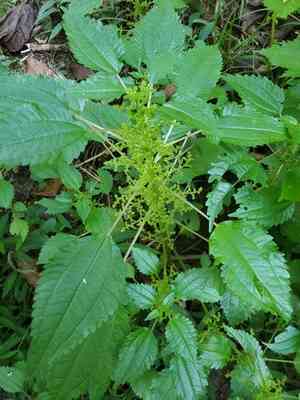
False nettle (Boehmeria cylindrica)
Also known as: Smallspike false nettle
The false nettle typically reaches a height of 50 to 100 cm (about 1.5 to 3 feet). Its flowers are green to greenish-white and form in dense, cylindrical spikes. The seeds are small, oval-shaped, and covered with tiny, hook-like hairs. This plant thrives in floodplains and low-lying areas and is widespread throughout North, Central, and South America.
In This Article
Attributes of False nettle
Lifespan
Perennial
Plant Type
Herb
Plant Height
50 cm to 1.6 m
Spread
30 cm to 90 cm
Leaf Color
Green Red
Flower Size
1 cm to 3 cm
Flower Color
White Green Yellow
Images of False nettle
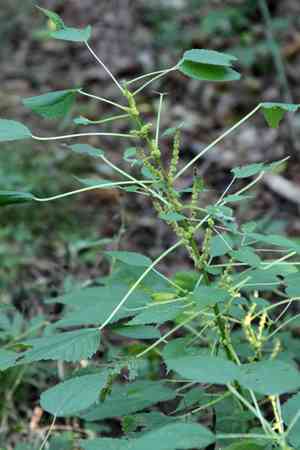
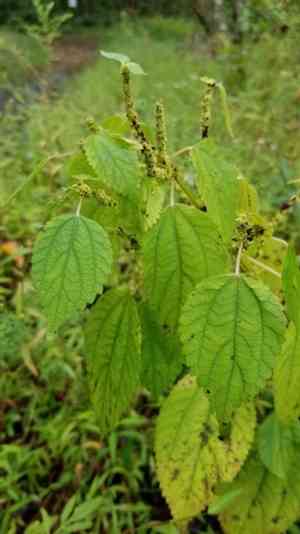
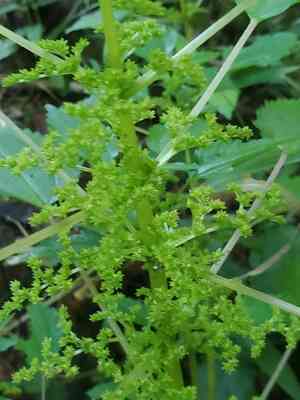
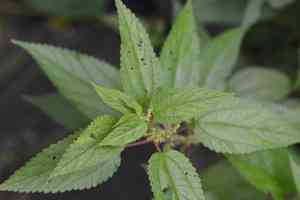
Quickly Identify False nettle
1
Opposite leaves devoid of stinging hairs distinguish false nettle from related species.
2
Cylindrical spikes of tiny, greenish-white wind-pollinated blooms form distinctive inflorescences.
3
Oval seeds with hook-like hairs for attachment have a coarse, dark brown texture.
4
Light green stem, round or 4-angled, with moderate thickness and slight pubescence.
5
Serrated leaves with smooth texture, up to 4 inches long, central vein with parallel secondary veins.
Scientific Classification of False nettle
Phylum
Vascular plants
Class
Dicotyledons
Order
Rosales
Family
Nettle
Genus
False nettles
Species
False nettle
Planting and Growing of False nettle
Care Difficulty
Easy
Watering Schedule
Every 3 days
Sunlight Requirements
Partial sun
Sunshine Duration
4-6 hours
Ideal Temperature
65-75℉
Soil Type
Potting Mix, Peat Mix
Soil pH
5.5-7.5
Fertilizer Type
Balanced
Pruning Season
Spring, Summer
Pruning Area
Branches, Leaves
Pruning Frequency
2 times a year
Repotting Season
Spring
Pot Type
Ceramic, Plastic
 How to Water False nettle?
Boehmeria cylindrica prefers its soil to be consistently moist, but not soggy. Watering it with around 250 ml ensures that the moisture reaches the root zone without waterlogging. It is crucial to let the top inch of soil dry out slightly between waterings, so the roots remain healthy.
What are the symptoms of an underwatered False nettle?
›
What should I do if my False nettle is not getting enough water?
›
What are the symptoms of an overwatered False nettle?
›
How to save an overwatered False nettle?
›
 What Are the Sunlight Requirements for False nettle?
Partial sun exposure is ideal, balancing two to six hours daily. This moderate light supports robust growth, maintains lush foliage, and prevents stress caused by excessive or inadequate light exposure.
What kind of sunlight does Boehmeria cylindrica require?
›
How can I ensure my Boehmeria cylindrica receives the ideal lighting?
›
What benefits will my Boehmeria cylindrica experience with ideal lighting?
›
 What Is the Ideal Temperature Range for False nettle?
The ideal temperature range for growing Boehmeria cylindrica is between 65°F and 75°F. This range provides the appropriate warmth needed for optimal growth and metabolic processes, ensuring that your plant remains healthy and vibrant. Maintaining this temperature range is crucial for active photosynthesis and efficient nutrient absorption.
 What Soil is Best for False nettle?
Boehmeria cylindrica thrives in soils with excellent drainage. Good drainage helps to prevent waterlogging, which can lead to root rot and other health issues for the plant. Ensuring this requirement will help the plant to grow robustly and maintain its health. While good drainage is essential, the soil should also be able to retain some moisture. Boehmeria cylindrica benefits from soils that can hold moisture but do not become overly soggy. This balance ensures that the plant's roots have constant access to water, supporting healthy growth. Incorporating organic matter into the soil is vital for Boehmeria cylindrica. Organic matter improves soil fertility by providing essential nutrients and enhancing soil structure, leading to optimized growth conditions for the plant.
 How to Fertilize False nettle?
For Boehmeria cylindrica, the fertilizer amount must be gauged carefully to avoid over-fertilizing. Typically, using a water-soluble balanced fertilizer at half strength is ideal. For liquid fertilizers, applying around 1/4 teaspoon per gallon of water is sufficient.
 How to Prune False nettle?
Start by inspecting your Boehmeria cylindrica for any dead, discolored, or damaged leaves. Removing these not only improves the plant's appearance but also redirects energy towards healthier parts of the plant. Once the dead parts have been removed, start pruning back any overgrown branches to maintain a desired shape. Make cuts just above a node to promote new growth. This encourages the plant to grow more fully and symmetrically. While it's important to keep your plant tidy, avoid cutting more than one-third of the plant at a time. Over-pruning can stress the plant, making it harder to recover and flourish. Morning is the best time to prune as the cooler temperatures and increased moisture help the plant to recuperate faster from the cuts made during pruning.
 How to Propagate False nettle plant?
1
Gather seeds from mature Boehmeria cylindrica plants in early autumn. Ensure seeds are fully dry before collection to maximize germination success. Clean off any surrounding plant debris to maintain seed purity.
2
Select non-flowering stems for cuttings in late spring or early summer. Cut sections approximately 4-6 inches long, remove the lower leaves, and optionally dip the cut end in rooting hormone to encourage root development.
3
Perform division in early spring by delicately removing a mature plant from its pot or soil, and gently pulling apart the root system into smaller sections, each with sufficient roots and stems for regrowth.
 How to Repot False nettle plant?
1
Boehmeria cylindrica needs repotting when its roots start to fill the pot, showing through the drainage holes, or when growth is stunted. Optimal repotting should be done in early spring or summer when active growth begins, ensuring the plant has plenty of time to establish itself.
2
Opt for a pot that is 1-2 inches larger in diameter than the current one. It should have adequate drainage holes to prevent waterlogging. This helps avert root rot and allows the plant room to grow without overextending its root system.
3
A well-draining potting mix that retains some moisture is ideal for Boehmeria cylindrica. This type of soil helps the roots breathe while retaining enough moisture to keep the plant healthy, preventing both root rot and dehydration.



