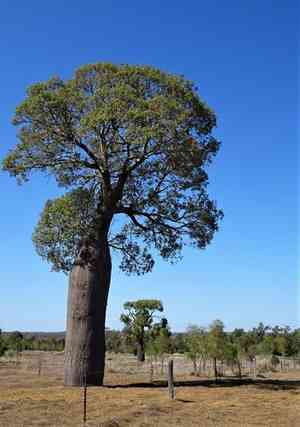
Queensland bottle tree (Brachychiton rupestris)
Also known as: Queensland-flaschenbaum
A native species to Queensland, Australia, the queensland bottle tree is so named due to its bulging trunk that increases in girth as it leaves the ground and then decreases before the first branches. This creates the shape of a bottle and was noted by explorer Sir Thomas Mitchell in 1848. The native aboriginal people have historically used queensland bottle tree as a food source by consuming the roots of young trees.
In This Article
Attributes of Queensland bottle tree
Lifespan
Perennial
Plant Type
Tree
Plant Height
10 m to 25 m
Spread
6 m
Leaf Color
Green
Flower Size
2.5 cm
Flower Color
Pink Cream
Images of Queensland bottle tree
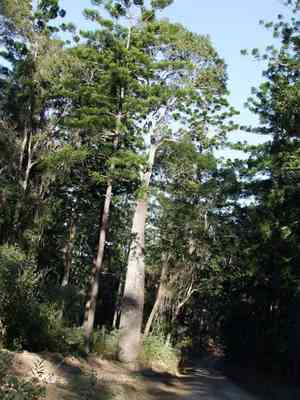
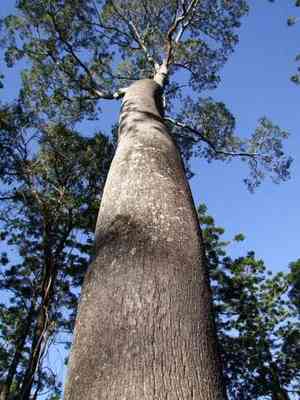
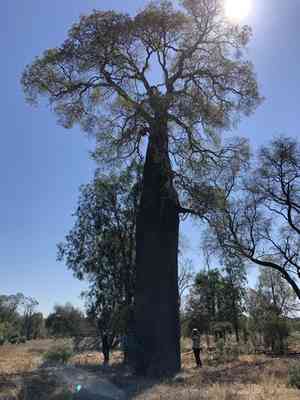
Quickly Identify Queensland bottle tree
1
Unique bottle-shaped trunk, reaching 20-25 feet (6-7.6 meters) tall.
2
Cream and red bell-shaped flowers lacking petals, in leaf axils.
3
Woody boat-shaped fruit, 1.2 inches (3 cm) long, with 4-8 seeds.
4
Star-like compound young leaves evolving to broader, simpler form.
5
Impressively wide trunk, 6.5-11.5 feet (2-3.5 meters) in diameter, with rugged, furrowed bark.
Scientific Classification of Queensland bottle tree
Phylum
Vascular plants
Class
Dicotyledons
Order
Malvales
Family
Mallow
Genus
Kurrajong
Species
Queensland bottle tree
Planting and Growing of Queensland bottle tree
Care Difficulty
Easy
Watering Schedule
Every 3 days
Sunlight Requirements
Full sun
Sunshine Duration
4-6 hours
Ideal Temperature
45-85℉
Soil Type
Potting Mix, Peat Mix
Soil pH
6-7.8
Fertilizer Type
Balanced
Pruning Season
Spring, Summer
Pruning Area
Branches, Leaves
Pruning Frequency
2 times a year
Repotting Season
Spring
Pot Type
Plastic, Ceramic
 How to Water Queensland bottle tree?
The Brachychiton rupestris, or the Queensland Bottle Tree, doesn't need a significant amount of water. A good rule of thumb when watering is to soak the soil, around 1000ml per watering, until it starts draining from the bottom. Make sure you allow the soil to dry out before the next watering.
More About Watering Techniques→
What are the symptoms of an underwatered Queensland bottle tree?
›
What should I do if my Queensland bottle tree is not getting enough water?
›
What are the symptoms of an overwatered Queensland bottle tree?
›
How to save an overwatered Queensland bottle tree?
›
 What Are the Sunlight Requirements for Queensland bottle tree?
The ideal light range for Brachychiton rupestris is full to partial sun, 6-8 hours a day. This amount of light promotes on optimal growth, lush leaf production, and overall plant health.
More About Sunlight Requirements Techniques→
What is the ideal light condition for Brachychiton rupestris?
›
How to achieve this?
›
What are the observable benefits?
›
 What Is the Ideal Temperature Range for Queensland bottle tree?
The ideal temperature range for Brachychiton Rupestris is between 45°F to 85°F. At these temperatures, the plant can perform photosynthesis optimally and grow healthily. Exposing the plant to temperatures outside this range may stunt its growth and cause damage to its foliage.
 What Soil is Best for Queensland bottle tree?
The Brachychiton rupestris, also known as the Queensland bottle tree, prefers loamy soil. This type of soil has a great balance of silt, sand, and clay, which makes it nutrient-rich and well-draining, ideal for the tree's growth. This tree also fares well in clay soil, largely due to its ability to retain water, which is beneficial for the tree during dry seasons. However, ensure proper drainage to prevent water-logging. Lastly, the Queensland bottle tree can also thrive in calcareous soil, which is alkaline in nature. This soil type has high levels of calcium carbonate, which directly contributes to nutritional sustenance for the tree.
More About Soil→
 How to Fertilize Queensland bottle tree?
For young Brachychiton rupestris, apply a balanced slow-release fertilizer (NPK 14-14-14) at a rate of 50-100g per plant twice a year. Older specimens are hardier and require less feeding, a single, annual application of 50-100g slow-release fertilizer per meter of trunk height is sufficient.
More About Fertilizing Techniques→
 How to Prune Queensland bottle tree?
Start pruning at the top of the Brachychiton rupestris and work your way down. Remove dead branches and those that cross each other. Be sure to make your cuts just outside the branch collar. Leave branch stubs as it can lead to decay. For larger branches, use the 3-cut approach: a small notch on the side of the branch that faces away from the branch to be retained, a second cut through the branch right at the notch, and the final cut removing the stub.
More About Pruning Techniques→
 How to Propagate Queensland bottle tree plant?
1
Collect the seeds from mature Brachychiton rupestris, which usually ripen in Autumn, and store them in a dry and cool place.
2
Before planting, soak the seeds in hot water for about an hour. This will help to increase the germination rate.
3
Then plant the seeds in a potting mix and lightly cover them with soil. They should be placed in a warm and bright location.
 How to Repot Queensland bottle tree plant?
1
Repotting of Brachychiton rupestris, commonly known as Queensland bottle tree, is best done in spring or autumn when the plant is starting new growth cycles. Signs that repotting is needed can include the plant appearing root-bound, with roots growing out of the drainage holes, or leaves looking droopy and dull despite adequate watering.
2
Select a pot that is a couple of inches larger in diameter than the current one. The new pot should have sufficient drainage holes to allow for proper water management. The slightly larger pot will encourage growth, and the drainage will prevent potential root rot.
3
Fill the pot with a mixture of loam, sand, and perlite, providing a balance between retention of moisture and drainage. This will provide the roots with the optimal environment for growth, preventing water-logging, and providing the plant with the nutrients it needs to flourish.
Learn More About Queensland bottle tree Diseases
Anthracnose
Bacterial Leaf Spot
Bacterial Soft Rot
Bacterial Wilt
Black Spot
Chemical Injury
Crown Gall
Cyst Nematode
Damping-off
Drought Stress
Fusarium Wilt
Gray Mold
Leaf Curl
Leaf Spot
Mosaic
Nutrient Deficiency
Nutrient Toxicity
Powdery Mildew
Root Rot
Root-knot Nematode
Rusts
Sooty Mold
Spider Mites
Temperature Stress
Thrips Damage
White Mold



