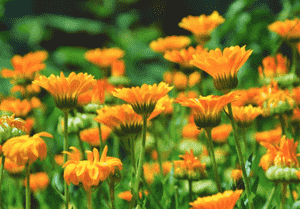
Pot marigold(Calendula officinalis)

Pot marigold (Calendula officinalis)

Also known as: Marigold, English Marigold, Hen-and-chickens, Ruddles

Pot marigold, also known as calendula, is a herbaceous perennial celebrated for its vibrant orange-yellow blossoms. The flowers have various applications:

1. **Culinary**: The petals are frequently added to salads or used as garnishes, providing both color and a mild flavor.
2. **Natural Dye**: The petals can be processed to produce a yellow dye suitable for coloring foods, fabrics, and cosmetics.
3. **Medicinal**: Often found in creams and ointments due to their anti-inflammatory and healing qualities.
4. **Cosmetic**: Widely used in natural skincare products for their soothing and moisturizing properties.
5. **Gardening**: Acts as a companion plant to deter pests and attract beneficial insects.

Attributes of Pot marigold

Lifespan
Annual, Biennial, Perennial
Plant Type
Herb
Plant Height
20 cm to 80 cm
Spread
25 cm to 50 cm
Leaf Color
Green
Flower Size
4 cm to 5 cm
Flower Color
Orange Yellow Gold Red

PlantJoy - Identify plants with a snap

Identify and diagnose plants, get toxicity alerts, and explore safety guides for all types of fungi.

Try for Free

Images of Pot marigold

Pot marigold(Calendula officinalis)

Quickly Identify Pot marigold

1
Daisy-like flowers, 3 inches (7.6 cm) wide, in yellows, oranges, reds, with darker centers.
2
Robust, slightly hairy green leaves, lance-shaped to oblong-obovate, up to 6 inches (15 cm) long.
3
Erect, sparsely branching stems up to 2 feet (60 cm) tall, slightly hairy and ribbed.
4
Fruits are dry, golden-brown achenes with a crescent shape, desiccated with a thorny exterior.
5
Aromatic leaves with fuzzy texture, prominent central vein, finely toothed or smooth edges.

Scientific Classification of Pot marigold

Phylum
Vascular plants
Class
Dicotyledons
Order
Asters bellflowers fanflowers and allies
Family
Daisy
Genus
Marigolds
Species
Pot marigold

Planting and Growing of Pot marigold

Care Difficulty
Easy
Watering Schedule
Every 8 days
Sunlight Requirements
Full sun
Sunshine Duration
6-10 hours
Ideal Temperature
60-70℉
Soil Type
Potting Mix, Peat Mix
Soil pH
6.5-7.5
Fertilizer Type
Balanced
Pruning Season
Spring, Summer
Pruning Area
Branches, Leaves
Pruning Frequency
2 times a year
Repotting Season
Spring
Pot Type
Plastic, Ceramic

water icon How to Water Pot marigold?

Calendula officinalis prefers a moderate watering schedule where the soil remains consistently moist but not waterlogged. Each time you water, aim to give about 200 ml ensuring that the water reaches the roots but doesn't pool on the surface. This allows the plant to absorb water effectively, supporting its vibrant bloom.
What are the symptoms of an underwatered Pot marigold?
What should I do if my Pot marigold is not getting enough water?
What are the symptoms of an overwatered Pot marigold?
How to save an overwatered Pot marigold?

sunlight icon What Are the Sunlight Requirements for Pot marigold?

Sunlight Requirements: Full sun, Partial sun
Duration of light: 6 to 8 hours
Calendula officinalis flourishes under full sun conditions, achieving its best health and flowering capabilities. Proper lighting encourages robust growth and vibrant blooms, enhancing its overall resistance to environmental stresses.
What is the ideal lighting for Calendula officinalis?
How can I ensure the ideal lighting for Calendula officinalis?
What benefits does Calendula officinalis gain from ideal lighting?

temperature icon What Is the Ideal Temperature Range for Pot marigold?

Ideal Temperature: 60 ~ 70℉
Calendula officinalis thrives best in temperatures ranging from 60°F to 70°F. This range ensures adequate warmth for proper growth without causing heat stress. Within this range, Calendula can efficiently perform photosynthesis and metabolic functions, leading to strong flower development and vibrant color expression.

soil icon What Soil is Best for Pot marigold?

Soil type: Loam, Sandy soil
Soil PH: 6.5 ~ 7.5
Calendula officinalis thrives in well-drained soil, which prevents waterlogging and root rot. Ensuring proper drainage allows the plant to absorb nutrients efficiently and helps promote healthy growth. This plant prefers nutrient-rich soils that support robust growth. Amending the soil with organic matter like compost enhances the availability of essential nutrients, leading to vibrant blooms. It is essential for the soil pH to be slightly alkaline to neutral for optimal nutrient uptake. This pH range supports enzyme activity and increases the availability of critical nutrients for the plant.

fertilize icon How to Fertilize Pot marigold?

Fertilizer type: Balanced
For Calendula officinalis, it is best to apply liquid fertilizer at half the strength recommended on the package. When using slow-release fertilizer, apply it sparingly around the base of the plant, ensuring it does not contact the stem. A teaspoon per plant every three to four months is generally sufficient.

prune icon How to Prune Pot marigold?

Pruning Time: Spring, Summer
Although Calendula officinalis benefits from regular pruning, avoid cutting the plant too aggressively. Over-pruning can stress the plant and hinder blooming. Instead, focus on removing dead or faded flowers and lightly trimming back lengthy stems. This approach prevents unnecessary stress while allowing the plant to channel its energy efficiently into producing more blooms. Be cautious when pruning during excessively hot weather. Intense heat can stress the plant, and pruning might increase the stress. Consider early morning or late afternoon pruning to minimize the plant's exposure to direct sunlight during peak heat. Additionally, ensure the plant is well-watered after pruning to aid in its recovery and resilience.

propagate icon How to Propagate Pot marigold plant?

Propagate Time: Spring, Late spring, Early spring
1
Before planting, soak calendula seeds in warm water for 12 hours to improve germination. This step enhances seed coat permeability, allowing quicker water absorption and faster sprouting.
2
Fill a seed tray with a soilless seed-starting mix. Sow the seeds approximately 1/4 inch deep, ensuring even spacing to prevent overcrowding and encourage healthy seedling development.
3
Gently mist the sown seeds and cover with a plastic dome to maintain humidity. Consistent moistness without waterlogging is critical for seedling emergence and growth.

repot icon How to Repot Pot marigold plant?

Repotting frequency: Annually or biannually
1
Calendula officinalis should be repotted when the roots begin to grow through the drainage holes or if the plant looks root-bound. Spring and summer are optimal times as the plant is in its active growth phase, making it more resilient to transplant shock. Also, if there is noticeable decline in flowering or the soil quality seems poor, it's time to consider repotting.
2
Select a pot that is one size larger than the current one, ideally with good drainage holes. A slightly larger pot encourages healthy root growth without overwhelming the plant with excess soil moisture, which can lead to root rot. Terracotta pots are excellent as they allow for better airflow and moisture evaporation, maintaining a balanced moisture level.
3
Opt for a well-draining potting mix that retains some moisture but doesn't stay too wet. Calendulas thrive in a mix that includes some organic matter while ensuring excess water can escape easily. A blend with perlite or vermiculite is ideal as it improves aeration and helps maintain the right balance of moisture.

PlantJoy - Identify plants with a snap

Find the best spots for them to optimize their health, simply using your phone.

Try for Free

