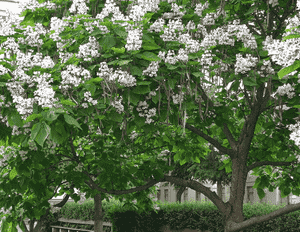
Cigartree (Catalpa bignonioides)
Also known as: Catawba, Caterpillar tree
The primary food source for the sphinx moth caterpillar is the leaves of the Catalpa tree, also known as the cigar tree. Native to the southeastern United States, this tree is often used as a shade or ornamental tree due to its large, heart-shaped leaves and clusters of showy flowers. The tree produces long, cigar-like seed pods, and its leaves release an unpleasant odor when crushed. The caterpillars that feed on these trees are also popular as fish bait.
In This Article
Attributes of Cigartree
Lifespan
Perennial
Plant Type
Tree
Plant Height
15 m to 18 m
Spread
6 m to 12 m
Leaf Color
Green Yellow
Flower Size
2.5 cm to 4 cm
Flower Color
White Purple Yellow
Images of Cigartree
Quickly Identify Cigartree
1
Large heart-shaped leaves with prominent vein patterns, emitting an unpleasant odor when crushed.
2
White bell-shaped flowers with yellow and purple spots, forming 6 to 12-inch panicles.
3
Distinctive dark brown, woody seed pods resembling elongated cigars, splitting open lengthwise.
4
Rough, deeply furrowed bark on mature trunk with crooked branching pattern, stout coarse branches.
5
Green smooth young stems transitioning to textured grayish-brown bark, twisted and turning as they grow.
Scientific Classification of Cigartree
Phylum
Vascular plants
Class
Dicotyledons
Order
Lamiales
Family
Bignonia
Genus
Catalpas
Species
Cigartree
Planting and Growing of Cigartree
Care Difficulty
Easy
Watering Schedule
Every 3 days
Sunlight Requirements
Full sun
Sunshine Duration
4-6 hours
Ideal Temperature
60-85℉
Soil Type
Potting Mix, Peat Mix
Soil pH
6.5-7.5
Fertilizer Type
Balanced
Pruning Season
Spring, Summer
Pruning Area
Branches, Leaves
Pruning Frequency
2 times a year
Repotting Season
Spring
Pot Type
Plastic, Terracotta
 How to Water Cigartree?
For Catalpa bignonioides, it's essential to provide deep watering sessions. Make sure that the soil is thoroughly soaked—ideally until water starts to drain from the bottom of the container. This process typically involves around 3000 ml of water per session, ensuring that moisture reaches the root zone deeply. The amount might vary slightly based on the plant's size and environmental conditions.
More About Watering Techniques→
What are the symptoms of an underwatered Cigartree?
›
What should I do if my Cigartree is not getting enough water?
›
What are the symptoms of an overwatered Cigartree?
›
How to save an overwatered Cigartree?
›
 What Are the Sunlight Requirements for Cigartree?
Catalpa bignonioides grows best with full sun to partial sun, ideally achieving 6-8 hours of light each day. Adequate light exposure enhances growth rate, branch strength, and flowering productivity.
More About Sunlight Requirements Techniques→
What is the ideal lighting condition for Catalpa bignonioides?
›
What are some solutions to achieve ideal lighting?
›
How does it benefit from ideal lighting?
›
 What Is the Ideal Temperature Range for Cigartree?
Maintaining the ideal temperature range between 60°F and 85°F ensures optimal growth and health. Catalpa bignonioides thrives in warmer climates and requires these conditions to support its metabolic processes, photosynthesis, and stress management efficiently.
 What Soil is Best for Cigartree?
Catalpa bignonioides thrives in nutrient-rich soil, which aids in robust growth and vibrant leaf coloration. The nutrients support the tree's overall health and flowering capacity. Well-drained soil is crucial to prevent root rot in Catalpa bignonioides. It ensures that excess water doesn't suffocate the roots, promoting healthy root development and overall plant vigor. While well-draining, the soil should retain some moisture to keep the roots hydrated during dry spells. This balance is vital for sustained growth and stress resilience.
More About Soil→
 How to Fertilize Cigartree?
Catalpa bignonioides typically requires a balanced approach to fertilization. For liquid fertilizers, aim for a dilution of half of what is recommended on the package. For slow-release fertilizers, apply about 100 grams per square meter of soil surface around the plant. Ensure the fertilizer is equally spread out to avoid nutrient burns.
More About Fertilizing Techniques→
 How to Prune Cigartree?
Ensure all cutting tools are sharp and clean to avoid tearing the bark or spreading disease. Sterilize tools before and after use, especially if working with multiple trees, to maintain healthy plant material. Although Catalpa bignonioides can be pruned year-round, avoid heavy pruning in late fall to prevent new growth susceptible to frost damage. Also, be cautious of heavy pruning during flowering to enjoy its beautiful blooms. Keep an eye out for signs of pests and diseases during pruning. Any branches showing signs of infestation, such as unusual swelling or discoloration, should be removed promptly to stop further spread and keep the tree healthy.
More About Pruning Techniques→
 How to Propagate Cigartree plant?
1
Harvest mature seeds from the pods of Catalpa bignonioides in late summer. Ensure the pods are dry, and the seeds are brown for optimal viability.
2
Select healthy, semi-hardwood cuttings from the plant during early summer. Trim the cuttings to about 6 inches, removing the lower leaves to reduce moisture loss.
3
Fill a seed tray with a well-draining potting mix. Sow the seeds on the surface and lightly cover them with soil. Maintain consistent moisture and warmth to promote germination.
 How to Repot Cigartree plant?
1
Catalpa bignonioides needs repotting when its roots start to circle the pot or grow out of the drainage holes. The best time to look for repotting signals is during the starting of spring when new growth kicks off. Be mindful of the plant's signal as it may show stunted growth or drying leaves, indicating it needs more space for root development.
2
When selecting a pot for Catalpa bignonioides, ensure it is only one size larger than the current pot. A pot that is too large can hold excess water that might lead to root rot. The selected pot should also have good drainage holes to ensure water flows through easily, preventing overly wet soil conditions. Choose a pot made of breathable material like terracotta, which helps regulate soil moisture levels.
3
The ideal soil for repotting Catalpa bignonioides is a well-draining potting soil. This type of soil is essential as it prevents waterlogged conditions, reducing the risk of root rot. A mix enriched with organic matter is beneficial as it provides nutrients while maintaining good soil structure. Adding perlite or sand can enhance drainage, ensuring the roots have access to both air and water.



