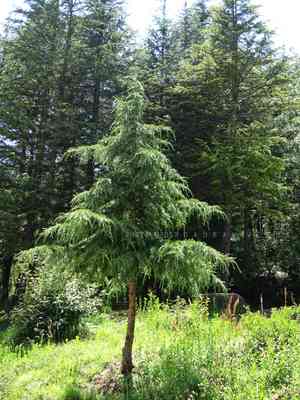
Deodar cedar (Cedrus deodara)
Also known as: Cedar of the himalaya, Deodar
The deodar cedar is a finely textured evergreen tree, admired for its graceful appearance in various landscapes. Known for producing aromatic oil that repels many insects, it also provides a habitat for birds and woodpeckers. In Hinduism, this tree is regarded as sacred. Its specific epithet, "deodara," is rooted in the Sanskrit word "devadāru," translating to "timber of the gods," underscoring its divine association and spiritual significance.
In This Article
Attributes of Deodar cedar
Lifespan
Perennial
Plant Type
Tree
Plant Height
30 m
Spread
3 m
Leaf Color
Green Blue Gray
Flower Size
5 mm
Flower Color
Violet Gold
Images of Deodar cedar
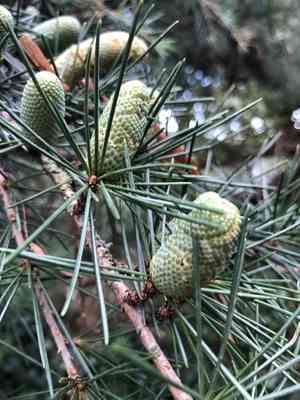
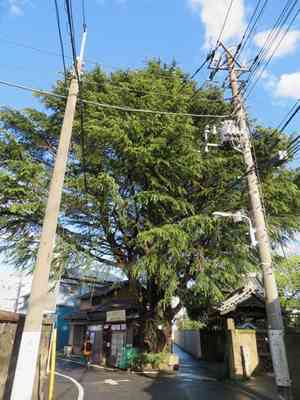
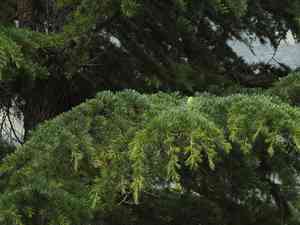
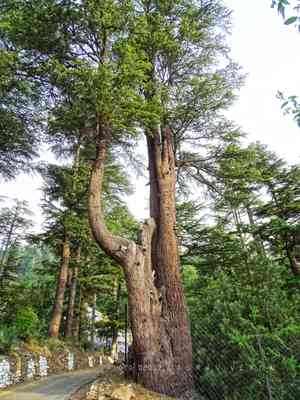
Quickly Identify Deodar cedar
1
Needles measure 1-2 inches (2.5-5 cm) - grayish-green with light blue tips on dwarf shoots.
2
Large, erect male cones and barrel-shaped female cones atop branches distinguish deodar cedar.
3
Needles are triangular to quadrangular in cross-section, singularly born on stems.
4
Leaves are needle-like, blue-green with a silvery sheen, sharply pointed in clusters.
5
Stem shows a spur-like structure, brown-reddish, with rough bark, supporting dense canopy.
Scientific Classification of Deodar cedar
Phylum
Vascular plants
Class
Conifers
Order
Pines and allies
Family
Pine
Genus
Cedars
Species
Deodar cedar
Planting and Growing of Deodar cedar
Care Difficulty
Easy
Watering Schedule
Every 2 days
Sunlight Requirements
Full sun
Sunshine Duration
6-10 hours
Ideal Temperature
60-75℉
Soil Type
Potting Mix, Peat Mix
Soil pH
6.5-7.5
Fertilizer Type
Balanced
Pruning Season
Spring, Summer
Pruning Area
Branches, Leaves
Pruning Frequency
2 times a year
Repotting Season
Spring
Pot Type
Terracotta, Plastic
 How to Water Deodar cedar?
Cedrus deodara, also known as the Deodar cedar, thrives with deep and infrequent watering. When watering, aim for approximately 500 ml, ensuring the soil is moistened thoroughly but not waterlogged. This allows the roots to grow deep and strong, supporting the tree's robust growth. Always ensure excess water is able to drain away, preventing root rot.
More About Watering Techniques→
What are the symptoms of an underwatered Deodar cedar?
›
What should I do if my Deodar cedar is not getting enough water?
›
What are the symptoms of an overwatered Deodar cedar?
›
How to save an overwatered Deodar cedar?
›
 What Are the Sunlight Requirements for Deodar cedar?
The ideal light range involves a balance between full sun for energy and partial shade to prevent stress. This combination supports vigorous growth and lush foliage, making Cedrus deodara both attractive and healthy.
More About Sunlight Requirements Techniques→
How much light does Cedrus deodara need?
›
What happens if Cedrus deodara doesn't get enough light?
›
How can I ensure optimal lighting for Cedrus deodara?
›
 What Is the Ideal Temperature Range for Deodar cedar?
The ideal temperature range for Cedrus deodara, also known as Deodar Cedar, is between 60 and 75 degrees Fahrenheit. This range provides the optimal growth conditions, ensuring the tree develops strong roots, healthy foliage, and a robust structure. In these temperatures, the plant can actively photosynthesize, absorb nutrients efficiently, and maintain its overall vitality.
 What Soil is Best for Deodar cedar?
A nutrient-rich soil provides essential minerals and nutrients for Cedrus deodara, aiding optimal growth and health. The soil should be well-balanced with organic matter to support sustained development of the tree. Cedrus deodara thrives in well-drained soil, which prevents root rot and allows the roots to access oxygen efficiently. Ensuring proper drainage helps the tree grow stronger and more resilient against diseases. While Cedrus deodara prefers well-drained conditions, it also requires adequate moisture for optimal growth. Maintaining moisture levels helps support its metabolic processes and overall vigor.
More About Soil→
 How to Fertilize Deodar cedar?
For Cedrus deodara, apply a balanced liquid fertilizer at a concentration of half strength every two weeks during the growing season. Fertilize lightly, ensuring not to exceed 200 milliliters per young tree to prevent root burn.
 How to Prune Deodar cedar?
Use clean, sharp pruning shears or saws to ensure clean cuts that minimize damage. Using the correct tools will make the task easier and promote quicker healing for the plant. Before pruning, thoroughly assess the tree to identify any dead, diseased, or crossing branches. Plan your cuts to improve air circulation and light penetration within the crown. When cutting, always prune back to where the branch meets another branch or the main trunk. Avoid leaving stubs as they can encourage pest and disease invasion, and aim for a slight angle cut to facilitate rainwater runoff.
More About Pruning Techniques→
 How to Propagate Deodar cedar plant?
1
Soak the seeds in warm water for 24 hours to break dormancy, then stratify them in a refrigerator for about six weeks to mimic winter conditions.
2
Select healthy, non-flowering shoots of about 10-15cm in length, remove the lower leaves, and dip the cut end in rooting hormone to encourage root growth.
3
Select healthy rootstock and scion, make a clean cut, and use grafting tape to securely bind them together, ensuring the cambium layers align properly for successful grafting.
 How to Repot Deodar cedar plant?
1
Cedrus deodara should be repotted when you notice the roots are growing out of the drainage holes or circling inside the pot. Another sign is when the plant's growth has significantly slowed down, indicating it may need a larger space to continue thriving.
2
Select a pot that is slightly larger than the current one. Ensure it has good drainage holes to prevent waterlogging, which can harm the roots. A well-chosen pot provides stability and allows the plant to expand its roots comfortably, promoting healthy growth.
3
Use well-draining, loamy soil to support the Cedrus deodara's root system. Such soil ensures that water does not accumulate, reducing the risk of root rot, and allows roots to access essential nutrients efficiently.



