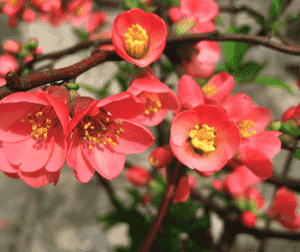
Flowering quince(Chaenomeles speciosa)

Flowering quince (Chaenomeles speciosa)

Also known as: Chinese quince, Japonica

Goumi (Elaeagnus multiflora) is a deciduous shrub originating from China. It yields edible red fruits in the autumn, which can be enjoyed fresh or used in various culinary applications. Known for its thick foliage, Goumi can serve as an effective privacy hedge while also attracting hummingbirds with its appealing flowers.

Attributes of Flowering quince

Lifespan
Perennial
Plant Type
Shrub
Plant Height
2 m
Spread
2 m to 3 m
Leaf Color
Green
Flower Size
4 cm to 5 cm
Flower Color
Red White Pink Yellow Orange

PlantJoy - Identify plants with a snap

Identify and diagnose plants, get toxicity alerts, and explore safety guides for all types of fungi.

Try for Free

Images of Flowering quince

Flowering quince(Chaenomeles speciosa)

Quickly Identify Flowering quince

1
Thorny shrub with cane-like growth
2
Glossy leaves with bronzy red color
3
Solitary flowers in scarlet, red, pink, white
4
Apple-shaped pome fruit with yellow-green hue
5
Slender brownish stem with spiny texture

Scientific Classification of Flowering quince

Phylum
Vascular plants
Class
Dicotyledons
Order
Roses, elms, figs, and allies
Family
Rose
Genus
Flowering quinces
Species
Flowering quince

Planting and Growing of Flowering quince

Care Difficulty
Easy
Watering Schedule
Every 2 days
Sunlight Requirements
Full sun
Sunshine Duration
4-6 hours
Ideal Temperature
60-75℉
Soil Type
Potting Mix, Peat Mix
Soil pH
6-7.5
Fertilizer Type
Balanced
Pruning Season
Spring, Summer
Pruning Area
Branches, Leaves
Pruning Frequency
2 times a year
Repotting Season
Spring
Pot Type
Plastic, Terracotta

water icon How to Water Flowering quince?

For Chaenomeles speciosa, the key to watering is ensuring the soil is moist but not waterlogged. You should provide enough water, generally around 500 ml, to allow moisture to penetrate deeply into the root zone. The soil should feel damp to the touch but not overly wet. Let the top inch of soil dry out between waterings to strike the right balance.
What are the symptoms of an underwatered Flowering quince?
What should I do if my Flowering quince is not getting enough water?
What are the symptoms of an overwatered Flowering quince?
How to save an overwatered Flowering quince?

sunlight icon What Are the Sunlight Requirements for Flowering quince?

Sunlight Requirements: Full sun, Partial sun
Duration of light: 4 to 6 hours
A combination of full sun and partial sun provides Chaenomeles speciosa with the ideal light conditions. Adequate sunlight promotes strong flowering and healthier plant development, ensuring its ornamental characteristics are fully realized.
How much sunlight does Chaenomeles speciosa need?
What solutions exist to optimize its sunlight exposure?
What benefits does ideal sunlight provide to Chaenomeles speciosa?

temperature icon What Is the Ideal Temperature Range for Flowering quince?

Ideal Temperature: 60 ~ 75℉
The ideal temperature range for Chaenomeles speciosa cultivation is between 60°F and 75°F. Within this range, the plant can thrive, showing robust growth and vibrant flowering. Temperatures within this range emulate their natural habitat conditions, supporting both metabolic processes and optimal photosynthesis rates, which are crucial for healthy plant development.

soil icon What Soil is Best for Flowering quince?

Soil type: Loam, Sandy loam
Soil PH: 6 ~ 7.5
Chaenomeles speciosa thrives in nutrient-rich soil. This results in vibrant blooms and healthy foliage. By providing nutrient-rich soil, you ensure that the plant has ample resources for photosynthesis and growth, enhancing its overall appearance and health. Well-drained soil prevents waterlogging, which can be detrimental to the roots. Ensuring proper drainage avoids root rot and supports robust root development. This helps the plant absorb nutrients efficiently and maintain its vigor over time. While drainage is essential, the soil should still retain some moisture to support the plant during dry spells. Soil that balances retention and drainage helps the Chaenomeles speciosa remain hydrated, promoting sustained growth and resisting drought stress.

fertilize icon How to Fertilize Flowering quince?

Fertilizer type: Balanced
When fertilizing Chaenomeles speciosa, use a balanced fertilizer at a rate of approximately 1-2 tablespoons per plant. The amount depends on the size and age of the plant. For young plants, 1 tablespoon is adequate, while mature plants may require closer to 2 tablespoons.

prune icon How to Prune Flowering quince?

Pruning Time: Spring, Summer, Autumn
Begin by removing any dead, diseased, or damaged wood. This helps prevent the spread of pests and diseases and keeps the plant healthy. Use sharp, sterilized pruners to make clean cuts just above a healthy bud or branch junction. Selectively thin out any crowded stems, especially those growing inward or crossing each other. This process will help improve the plant's structure and allow for better flower production the following season. Finally, gently shape the quince into a pleasing form. Focus on an open-centered shape to allow light to reach all parts of the plant. Remember not to remove more than a third of the plant in one go to prevent stressing it too much.

propagate icon How to Propagate Flowering quince plant?

Propagate Time: Spring, Late spring, Early spring
1
Choose young, healthy stems from the plant for cuttings. These should be around 6-8 inches long with several leaves, which should be trimmed to reduce moisture loss.
2
When propagating from seeds, sow them in a well-draining medium. Keep the soil consistently moist but not waterlogged, and maintain a warm and stable environment for seed germination.
3
For grafting, ensure both the scion and rootstock are healthy. Align the scion with the rootstock well, ensuring good contact for successful cambium layers' connection.

repot icon How to Repot Flowering quince plant?

Repotting frequency: Every 2-3 years
1
Spotting the right time for repotting Chaenomeles speciosa involves observing its growth patterns and root system. Typically, if you notice roots circling around the pot's bottom or emerging from the drainage holes, it's a clear signal the plant requires more space, indicating it's time to repot.
2
Selecting an appropriate pot for Chaenomeles speciosa is crucial. Opt for one that's slightly larger than the current one, with ample drainage holes to prevent waterlogging. A pot with good weight on the bottom also helps, stabilizing the plant once it grows taller.
3
Choosing the right soil involves ensuring it supports water drainage while holding essential nutrients. A well-draining loamy mix is ideal; it retains just the right amount of moisture while allowing excess water to escape, preventing root rot and providing the plant ample room for growth.

PlantJoy - Identify plants with a snap

Find the best spots for them to optimize their health, simply using your phone.

Try for Free

Toxicity of Flowering quince

Is Flowering quince toxic to humans?

The flowering quince is known to have a relatively low toxicity level for humans, largely attributed to the ingestion of its seeds. These seeds contain hydrogen cyanide, a chemical that can be harmful and potentially lead to poisoning. Consuming the seeds may trigger symptoms such as difficulty in breathing, dizziness, headaches, and nausea. In more severe instances, individuals may experience convulsions and a significant drop in blood pressure. Therefore, it is essential for people to refrain from eating the seeds of flowering quince to avoid such negative health impacts. Although the other parts of the plant are non-toxic, caution should be exercised with the seeds to minimize the risk of accidental ingestion, particularly among children who might be attracted to their appearance.

Is Flowering quince toxic to cat?

Flowering quince possesses a low degree of toxicity to cats, potentially resulting in discomfort if they consume any parts of the plant, especially its seeds. Poisoning typically happens when a cat inadvertently eats the seeds, which harbor hydrogen cyanide, a toxic substance. Following ingestion, affected cats may show a range of symptoms such as stomach upset, respiratory distress, or excess drooling. It is crucial to closely observe your pet and obtain prompt veterinary assistance if poisoning occurs. Timely intervention can be essential for effectively managing the recovery of the cat.

Is Flowering quince toxic to dog?

The flowering quince has a low toxicity risk for dogs. Canines may unknowingly ingest parts of this plant, especially the seeds, which have been identified to contain harmful compounds. If eaten, a dog could show signs like gastrointestinal disturbance or more serious reactions depending on the quantity consumed. It is vital for pet owners to supervise their dogs and restrict their access to the seeds of flowering quince. Should poisoning be suspected, prompt veterinary attention is vital to guarantee swift and suitable treatment.

Identify toxic plants for your safety

Learn which plants are harmful to you and your pets, and make informed choices for a safer home!

Try for Free
WARNING
The judgment on toxicity and danger is for reference only. We DO NOT GUARANTEE any accuracy of such judgment. Therefore, you SHALL NOT rely on such judgment. It is IMPORTANT TO SEEK PROFESSIONAL ADVICE in advance when necessary.

