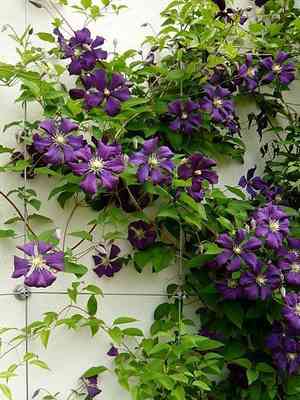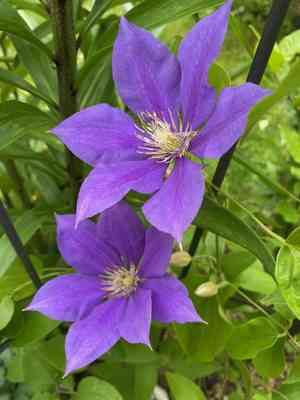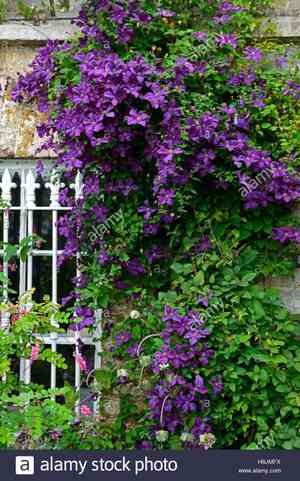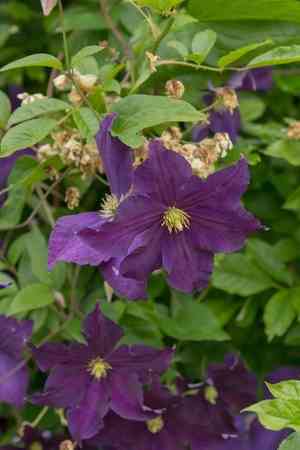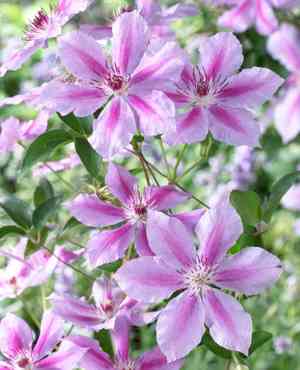
Italian leather flower(Clematis viticella)

Italian leather flower (Clematis viticella)

Also known as: Purple clematis, Italian Clematis

The Italian leather flower (Clematis viticella) is a climbing perennial that hails from Europe. Its striking, bell-shaped flowers and extended blooming period, spanning from midsummer to early autumn, make it a favored choice for flower gardens. A wide range of varieties offers diverse flower shapes and colors, enhancing its appeal. Additionally, its robust nature and resistance to clematis wilt contribute to its popularity, while its climbing ability adds vertical charm to garden spaces.

Attributes of Italian leather flower

Lifespan
Perennial
Plant Type
Vine, Herb
Plant Height
2 m to 4 m
Spread
90 cm to 1.5 m
Leaf Color
Green
Flower Size
2.5 cm to 8 cm
Flower Color
Purple Blue Pink Red White Violet

PlantJoy - Identify plants with a snap

Identify and diagnose plants, get toxicity alerts, and explore safety guides for all types of fungi.

Try for Free

Images of Italian leather flower

Italian leather flower(Clematis viticella)

Quickly Identify Italian leather flower

1
Compound leaves with 3 oval leaflets (2-5 inches/5-13 cm long)
2
Bell-shaped flowers in shades of deep purple to light violet (1-3 inches/2.5-7.6 cm wide)
3
Slender stems climbing up to 10-15 feet (3-4.5 meters) with twisting leaf stalks
4
Fruit with elongated, silky-plumose tails for wind dispersal in silver or light tan color
5
Feather-like, pinnately divided leaves (2-4 inches/5-10 cm long) with prominent reticulate veining

Scientific Classification of Italian leather flower

Phylum
Vascular plants
Class
Dicotyledons
Order
Ranunculales
Family
Buttercup
Genus
Clematis
Species
Italian leather flower

Planting and Growing of Italian leather flower

Care Difficulty
Easy
Watering Schedule
Every 4 days
Sunlight Requirements
Partial sun
Sunshine Duration
6-10 hours
Ideal Temperature
60-75℉
Soil Type
Potting Mix, Peat Mix
Soil pH
6.5-7.5
Fertilizer Type
Balanced
Pruning Season
Spring, Summer
Pruning Area
Branches, Leaves
Pruning Frequency
2 times a year
Repotting Season
Spring
Pot Type
Plastic, Ceramic

water icon How to Water Italian leather flower?

For Clematis viticella, water until the soil is consistently moist but not waterlogged. A good rule is to check the top inch of soil; if it's dry, it's time to water. Aim for about 1000 ml of water to reach the deeper roots, ensuring full soil saturation without pooling.
What are the symptoms of an underwatered Italian leather flower?
What should I do if my Italian leather flower is not getting enough water?
What are the symptoms of an overwatered Italian leather flower?
How to save an overwatered Italian leather flower?

sunlight icon What Are the Sunlight Requirements for Italian leather flower?

Sunlight Requirements: Partial sun, Full sun
Duration of light: 4 to 6 hours
Partial sun, full sun provides Clematis viticella with sufficient energy for flowering and lush foliage. Proper exposure ensures it maximizes growth potential and overall health.
What is the ideal sunlight exposure for Clematis viticella?
How can I ensure Clematis viticella receives the right amount of sunlight?
What are the benefits of providing ideal lighting conditions?

temperature icon What Is the Ideal Temperature Range for Italian leather flower?

Ideal Temperature: 60 ~ 75℉
The ideal temperature range for Clematis viticella is between 60°F and 75°F. This range allows for optimal growth and flowering. Keeping the plant within this temperature range helps ensure vigorous growth and ample flowering, while preventing stress that could lead to poor health or reduced blooms.

soil icon What Soil is Best for Italian leather flower?

Soil type: Loam, Sandy loam
Soil PH: 6.5 ~ 7.5
Clematis viticella thrives in well-drained soil. Ensuring good drainage prevents waterlogging that could lead to root rot, promoting healthy root development vital for robust growth. The plant benefits from soil rich in organic matter. This nutrient-rich environment supports vigorous flowering and enhances the plant's overall vitality. The soil for Clematis viticella should remain consistently moist. Proper moisture levels ensure the plant absorbs adequate hydration without suffocating the roots, supporting lush foliage and abundant blooms.

fertilize icon How to Fertilize Italian leather flower?

Fertilizer type: Balanced
For Clematis viticella, it's crucial to provide nutrients in a balanced manner. Using a general-purpose fertilizer, apply around 30 grams per square meter, ensuring not to overwhelm the plant. This amount keeps the plant strong and lush without causing harm.

prune icon How to Prune Italian leather flower?

Pruning Time: Autumn
Begin by cutting back all old growth to a pair of healthy buds, typically around 12 inches from the base of the plant. Use clean, sharp pruning shears to make a clean cut. This helps rejuvenate the plant by encouraging fresh, new shoots to develop. Inspect the plant carefully and remove any crossing or damaged stems that may hinder growth. Crossing stems can cause cuts and abrasions, which make the plant susceptible to diseases. Focus on opening up the center of the plant to improve air circulation.

propagate icon How to Propagate Italian leather flower plant?

Propagate Time: Early spring, Late spring, Summer
1
Select a healthy, non-flowering stem and make a clean cut just below a node. Ensure the cutting is about 10-15 centimeters long for optimal growth potential.
2
Use a mix of peat and perlite to ensure good drainage and aeration. Moisten the mix lightly before planting the cuttings to provide an ideal environment for root development.
3
Dip the cut end in rooting hormone, then plant it in the prepared potting mix. Cover with a plastic bag or a propagator lid to maintain humidity, which is critical for rooting.

repot icon How to Repot Italian leather flower plant?

Repotting frequency: Every 2-3 years
1
Clematis viticella should be repotted when you notice the roots starting to emerge from the drainage holes or when the plant's growth becomes sluggish. These signs indicate that the plant has outgrown its current pot and needs a larger space to thrive and continue its vigorous blooming.
2
Select a pot that is one size larger than the current one, with ample drainage holes. The extra space provides roots room to grow, preventing problems associated with root binding. A breathable material like terracotta is ideal, as it helps regulate soil moisture levels and keeps roots aerated.
3
Opt for a well-draining loamy soil that combines good aeration with moisture retention. This balance ensures the Clematis viticella retains necessary moisture while excess water drains away, preventing root rot. Adding some perlite or sand can enhance the drainage properties even further.

PlantJoy - Identify plants with a snap

Find the best spots for them to optimize their health, simply using your phone.

Try for Free

Toxicity of Italian leather flower

Is Italian leather flower toxic to humans?

The Italian leather flower is highly toxic in every part of the plant, including its flowers, fruits, seeds, stem, sap, and leaves, posing significant health risks to humans if ingested, inhaled, or touched. Symptoms of poisoning from the Italian leather flower can include intense pain or sores in the mouth, redness, burning sensations, and inflammation of the skin, along with excessive salivation, vomiting, and diarrhea. This plant is often found as an ornamental vine adorning fences, walls, or in various garden settings. Accidental contact with the plant is the most common cause of poisoning.

Is Italian leather flower toxic to cat?

The Italian leather flower presents a moderate toxic risk for felines. Ingesting any portion of this plant may lead to poisoning. Cats that consume the Italian leather flower could display various symptoms of unease or sickness. It is essential to monitor cats exhibiting signs of distress closely, and seeking prompt veterinary care is vital to address any possible health hazards.

Is Italian leather flower toxic to dog?

The Italian leather flower plant species is regarded as possessing a moderate toxicity level for dogs. If dogs consume any portion of this plant, they can be poisoned, as every part is toxic. After swallowing Italian leather flower, dogs may display symptoms such as vomiting, diarrhea, excessive drooling, or more serious signs depending on the quantity ingested. It is essential for dog owners to keep their pets away from Italian leather flower and to closely observe them if they are in proximity to the plant's growth. Should a dog ingest any part of the Italian leather flower, prompt veterinary care is critical to ensure the best possible outcome for the animal.

Identify toxic plants for your safety

Learn which plants are harmful to you and your pets, and make informed choices for a safer home!

Try for Free
WARNING
The judgment on toxicity and danger is for reference only. We DO NOT GUARANTEE any accuracy of such judgment. Therefore, you SHALL NOT rely on such judgment. It is IMPORTANT TO SEEK PROFESSIONAL ADVICE in advance when necessary.