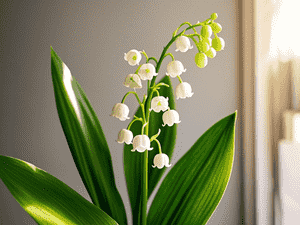
Lily of the valley(Convallaria majalis)

Lily of the valley (Convallaria majalis)

Also known as: Our lady's tears, Mary's tears

The Lily of the Valley, native to Eurasia, is the national flower of Finland. Despite its toxicity, it is widely adored for its lovely blooms and sweet scent, making it a favorite in gardens and the perfume industry. This flower was also the national emblem of the former Yugoslavia.

Attributes of Lily of the valley

Lifespan
Perennial
Plant Type
Herb
Plant Height
15 cm to 30 cm
Spread
23 cm to 30 cm
Leaf Color
Green
Flower Size
4 mm to 9 mm
Flower Color
White Pink

PlantJoy - Identify plants with a snap

Identify and diagnose plants, get toxicity alerts, and explore safety guides for all types of fungi.

Try for Free

Images of Lily of the valley

Lily of the valley(Convallaria majalis)

Quickly Identify Lily of the valley

1
Low height of 10 inches (25 cm) distinguishes lily of the valley as a groundcover species.
2
Fragrant, white, bell-shaped flowers with 6 lobes bloom in 1-sided racemes.
3
Bright red, 1/4 inch (6 mm) berries develop in summer, each containing 1-6 seeds.
4
Basal leaves are elliptic, 5-10 inches (12-25 cm) long, with entire margins and parallel veins.
5
Foliage is vibrant green with broad leaves, providing a subtle charm as groundcover.

Scientific Classification of Lily of the valley

Phylum
Vascular plants
Class
Monocotyledons
Order
Asparagales
Family
Asparagus
Genus
Lily of the valley
Species
Lily of the valley

Planting and Growing of Lily of the valley

Care Difficulty
Easy
Watering Schedule
Every 4 days
Sunlight Requirements
Partial sun
Sunshine Duration
6-10 hours
Ideal Temperature
60-70℉
Soil Type
Potting Mix, Peat Mix
Soil pH
6.5-7.5
Fertilizer Type
Balanced
Pruning Season
Spring, Summer
Pruning Area
Branches, Leaves
Pruning Frequency
2 times a year
Repotting Season
Spring
Pot Type
Plastic, Ceramic

water icon How to Water Lily of the valley?

Convallaria majalis benefits from a consistent watering regimen. Each watering session should be approximately 200 milliliters. Ensure that the soil is moist, but not waterlogged. A good rule of thumb is to wait until the topsoil feels slightly dry before watering again.
What are the symptoms of an underwatered Lily of the valley?
What should I do if my Lily of the valley is not getting enough water?
What are the symptoms of an overwatered Lily of the valley?
How to save an overwatered Lily of the valley?

sunlight icon What Are the Sunlight Requirements for Lily of the valley?

Sunlight Requirements: Partial sun, Full shade
Duration of light: 2–6 hours of sunlight
Convallaria majalis thrives in partial sun to full shade conditions. Ideal lighting promotes robust growth, rich foliage, and abundant blooms, enhancing garden aesthetics and fragrance.
What is the ideal light level for Convallaria majalis?
How can I achieve the ideal lighting for this plant?
What are the benefits of ideal lighting for Convallaria majalis?

temperature icon What Is the Ideal Temperature Range for Lily of the valley?

Ideal Temperature: 60 ~ 70℉
Convallaria majalis, commonly known as lily of the valley, thrives best in temperatures ranging from 60°F to 70°F. This range is perfect for ensuring the plant's energy is efficiently used in photosynthesis, leading to robust growth and healthy blooms. Maintaining such temperatures will help the plant develop a strong root system and achieve the best flowering performance.

soil icon What Soil is Best for Lily of the valley?

Soil type: Loam, Sandy loam, Acidic soil
Soil PH: 6.5 ~ 7.5
Convallaria majalis thrives in nutrient-rich loam soil that is well-draining yet retains enough moisture. A high organic matter content helps in providing essential nutrients, ensuring robust growth and flowering. This plant prefers moist soil conditions, crucial for maintaining the vibrancy of its lush foliage and flowers. Consistent moisture helps avoid stress caused by drought conditions. While Convallaria majalis enjoys moisture, it also requires soil with adequate drainage to prevent root rot. Proper drainage also facilitates nutrient uptake and helps maintain root health.

fertilize icon How to Fertilize Lily of the valley?

Fertilizer type: Balanced
Convallaria majalis, commonly known as Lily of the Valley, requires minimal fertilization. When using liquid fertilizer, a diluted solution at half the recommended strength suffices to prevent nutrient overload and maintain healthy growth. Solid slow-release fertilizers should be applied sparingly, covering only the plant's base soil without clumping.

prune icon How to Prune Lily of the valley?

Pruning Time: Spring, Summer
When pruning, be careful of contact with the sap, as it can be irritating to the skin. Wear gloves to protect yourself. Avoid cutting back healthy green leaves, as they are vital for photosynthesis and storing energy for the next growing season.

propagate icon How to Propagate Lily of the valley plant?

Propagate Time: Early spring, Autumn
1
Before dividing Convallaria majalis, choose a well-shaded, moist location with fertile soil for planting. Prepare the site by removing weeds and adding some organic matter to enrich the soil, ensuring better conditions for new growth.
2
Carefully dig around the plant's base and lift the clumps using a garden fork. Gently shake off excess soil and, with a sharp knife, cut through the rhizomes ensuring each division has roots and a few shoots.
3
Replant the divisions at the same depth they were growing, spacing them about 6-12 inches apart. Ensure the rhizomes are covered with soil and water thoroughly to eliminate air pockets and encourage root establishment.

repot icon How to Repot Lily of the valley plant?

Repotting frequency: Every 2-3 years
1
Convallaria majalis shows signals for repotting when it becomes root-bound, with roots emerging from the drainage holes or spiraling within the pot. Another telling indicator is when water runs through the pot without soaking the soil properly. Perform repotting during early spring when new growth is just commencing, as it minimizes shock and stresses on the plant.
2
Select a pot that is only slightly larger than the current one. Using a pot that's too large can lead to overwatering issues since the soil will retain moisture for too long. The pot should have drainage holes to prevent water from pooling at the bottom, which is crucial for preventing root rot.
3
Opt for a rich, well-draining soil mixture that retains enough moisture but drains excess water efficiently. Mix ordinary garden loam with organic matter like leaf mold or compost. This combination ensures nourishing support while preventing waterlogging, keeping the roots healthy.

PlantJoy - Identify plants with a snap

Find the best spots for them to optimize their health, simply using your phone.

Try for Free

Toxicity of Lily of the valley

Is Lily of the valley toxic to humans?

Lily of the valley possesses a significant level of toxicity, containing various harmful substances such as cardiac glycosides and saponins. Fortunately, in many cases, the toxic elements present in lily of the valley can pass through the digestive system without being absorbed. Even when poisoning does take place, it often triggers vomiting, which aids in expelling the toxins from the body. In more severe instances, however, ingestion can result in a comatose condition and, in extreme cases, even lead to death. Other effects of poisoning may include flushed skin, dizziness, headaches, changes in heart rate, weakness, and hallucinations. Furthermore, direct contact with lily of the valley can cause skin irritation.

Is Lily of the valley toxic to cat?

Every part of the lily of the valley (Convallaria majalis) plant, particularly the berries and roots, exhibits significant toxicity and can be fatal. If a cat consumes merely a few berries, immediate veterinary assistance is crucial. The plant contains compounds that can lead to heart failure, respiratory complications, and even death.

Is Lily of the valley toxic to dog?

Lily of the valley is highly poisonous to dogs, as every component of the plant—including flowers, fruits, stems, leaves, and roots—harbors a variety of toxic compounds, some of which can have detrimental effects on the heart. Initial symptoms typically associated with poisoning include vomiting and diarrhea. However, in severe instances, symptoms may escalate to include low blood pressure, irregular heart rate, weakness, seizures, and potentially coma or death. Therefore, immediate veterinary care is essential in cases of lily of the valley ingestion.

Identify toxic plants for your safety

Learn which plants are harmful to you and your pets, and make informed choices for a safer home!

Try for Free
WARNING
The judgment on toxicity and danger is for reference only. We DO NOT GUARANTEE any accuracy of such judgment. Therefore, you SHALL NOT rely on such judgment. It is IMPORTANT TO SEEK PROFESSIONAL ADVICE in advance when necessary.

