
Garden cosmos (Cosmos bipinnatus)
Also known as: Annual cosmos
Garden cosmos (Cosmos bipinnatus) is an annual herbaceous plant widely grown for its ornamental value in temperate zones. Its capacity to self-seed allows it to reappear in the same location year after year, despite being an annual. This characteristic has led to its classification as an invasive species in various regions, where it can overtake native vegetation.
In This Article
Attributes of Garden cosmos
Lifespan
Annual
Plant Type
Herb
Plant Height
61 cm to 2.5 m
Spread
40 cm
Leaf Color
Green
Flower Size
5 cm to 10 cm
Flower Color
White Pink Yellow Red Purple Orange Cream
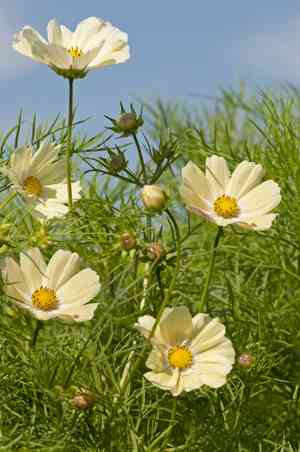
Images of Garden cosmos



Quickly Identify Garden cosmos
1
Daisy-like flowers in maroon, pink, lavender, and white colors.
2
Symmetrical, saucer-shaped blooms with yellow centers.
3
Narrow, cylindrical-fusiform fruit with distinctive beak and erect awns.
4
Lacy, deeply cut leaves with a fern-like appearance and fine texture.
5
Erect, unbranched stem with smooth texture and variable green coloration.
Scientific Classification of Garden cosmos
Phylum
Vascular plants
Class
Dicotyledons
Order
Asters bellflowers fanflowers and allies
Family
Daisy
Genus
Cosmos
Species
Garden cosmos
Planting and Growing of Garden cosmos
Care Difficulty
Easy
Watering Schedule
Every 8 days
Sunlight Requirements
Full sun
Sunshine Duration
6-10 hours
Ideal Temperature
60-75℉
Soil Type
Potting Mix, Peat Mix
Soil pH
6.5-7.5
Fertilizer Type
Balanced
Pruning Season
Spring, Summer
Pruning Area
Branches, Leaves
Pruning Frequency
2 times a year
Repotting Season
Spring
Pot Type
Terracotta, Plastic
 How to Water Garden cosmos?
When watering Cosmos bipinnatus, it is crucial to ensure that the soil remains evenly moist. Aim to provide approximately 500 ml of water per session, allowing the water to soak deeply into the soil. This ensures that the roots can effectively absorb the necessary moisture without becoming waterlogged.
More About Watering Techniques→
What are the symptoms of an underwatered Garden cosmos?
›
What should I do if my Garden cosmos is not getting enough water?
›
What are the symptoms of an overwatered Garden cosmos?
›
How to save an overwatered Garden cosmos?
›
 What Are the Sunlight Requirements for Garden cosmos?
Cosmos bipinnatus thrives best in full sun conditions, which promotes healthy growth and vibrant blooms throughout its flowering season.
More About Sunlight Requirements Techniques→
What is the best location for planting?
›
Is soil preparation needed to enhance light absorption?
›
How can I ensure the plant gets enough sunlight during cloudy days?
›
 What Is the Ideal Temperature Range for Garden cosmos?
Cosmos bipinnatus thrives best in a temperature range of 60°F to 75°F. This range ensures optimal growth, maximizes flowering potential, and minimizes stress. Maintaining this temperature range aids in energy-efficient processes such as photosynthesis and respiration.
 What Soil is Best for Garden cosmos?
Cosmos bipinnatus thrives in well-draining soil to prevent root rot. Well-draining soils like loam and sandy loam ensure that excess water can escape, preserving the plant's health. The plant prefers soil with moderate fertility which supports healthy growth but prevents excessive foliage at the expense of blooms. It allows balanced growth with vibrant flower production. Soil that is loose and aerated supports root expansion and nutrient uptake. This condition prevents compaction and suffocation of the roots, resulting in vigorous plant development.
More About Soil→
 How to Fertilize Garden cosmos?
Cosmos bipinnatus is not a heavy feeder. Apply a balanced liquid fertilizer at half strength to avoid over-fertilizing. When using slow-release fertilizers, ensure the dosage is in accordance with the manufacturer's instructions, usually a few tablespoons spread evenly over the soil.
More About Fertilizing Techniques→
 How to Prune Garden cosmos?
Remove spent blooms to encourage the plant to produce more flowers. Use a pair of clean, sharp scissors or pruning shears to snip off the dead flowers just above the nearest set of leaves. This process, known as deadheading, helps Cosmos bipinnatus concentrate its energy on forming new buds instead of seeds, resulting in an extended bloom period. Trim back any overly long or straggly stems to maintain a neat, compact shape. This can be done by cutting back to a lower leaf node, which will encourage side shoots to develop, leading to a fuller plant. Ensuring the plant maintains a balanced shape also helps maximize sun exposure to all parts, promoting overall healthy growth. Should your Cosmos bipinnatus become too tall and floppy, it’s beneficial to prune the plant by a third. Do this in early summer to encourage a sturdier stem structure. By reducing the height, you prevent the plant from toppling over and foster a more robust growth that can better withstand wind and rain.
More About Pruning Techniques→
 How to Propagate Garden cosmos plant?
1
Fill the seed tray or pot with fine seed compost up to about 1 cm below the rim. Level the top off with a flat surface and water the compost thoroughly to begin with the right moisture level.
2
Scatter Cosmos bipinnatus seeds thinly over the surface of the prepared compost. Cover them with a light layer of compost, and lightly press to ensure good contact between seeds and soil.
3
Place the tray in a warm location with good light, ideally at a temperature between 20-25°C. Keep the compost moist but not waterlogged and expect germination in about 7-14 days.
 How to Repot Garden cosmos plant?
1
For Cosmos bipinnatus, the ideal signals for repotting include roots peeking out of the drainage holes or a matted root ball when you slide the plant gently out. The best time to repot is during the growing seasons of spring or summer when the plant can recover faster.
2
Select a pot that is one size larger than the current pot, with ample drainage holes. This helps prevent waterlogging while giving the roots room to spread. Choosing a breathable pot, like terracotta, can also aid in moisture management.
3
A well-draining potting mix is essential to prevent root rot. Opt for a mix enriched with organic matter that retains some moisture but lets excess water flow through. This balance supports healthy root development and growth.
Learn More About Garden cosmos Diseases
Anthracnose
Bacterial Leaf Spot
Bacterial Soft Rot
Bacterial Wilt
Black Spot
Chemical Injury
Damping-off
Downy Mildew
Drought Stress
Fusarium Wilt
Gray Mold
Leaf Curl
Leaf Spot
Mosaic
Nutrient Deficiency
Nutrient Toxicity
Powdery Mildew
Root Rot
Root-knot Nematode
Rusts
Sooty Mold
Spider Mites
Temperature Stress
Thrips Damage
White Mold



