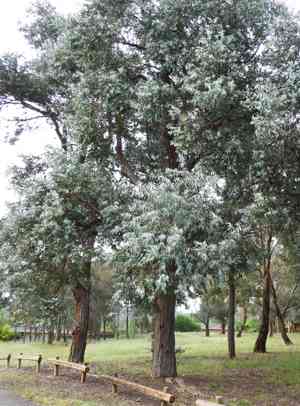
Argyle apple(Eucalyptus cinerea)

Argyle apple (Eucalyptus cinerea)

Also known as: Silver dollar tree, Florist's gum

Argyle apple (Eucalyptus cinerea) is an evergreen tree reaching heights of 6-15 meters and spreading 6-12 meters wide. Its silver-gray, coin-like leaves are aromatic, adding visual and sensory appeal. In spring, it produces abundant clusters of white flowers. This tree prefers full sun and thrives in well-drained soil with dry to medium moisture levels. It is also drought-tolerant once established, making it a striking and low-maintenance addition to any garden.

Attributes of Argyle apple

Lifespan
Perennial
Plant Type
Tree
Plant Height
15 m to 30 m
Spread
6 m to 12 m
Leaf Color
Green Blue White Gray Silver
Flower Size
5 mm to 6 mm
Flower Color
White

PlantJoy - Identify plants with a snap

Identify and diagnose plants, get toxicity alerts, and explore safety guides for all types of fungi.

Try for Free

Images of Argyle apple

Argyle apple(Eucalyptus cinerea)

Quickly Identify Argyle apple

1
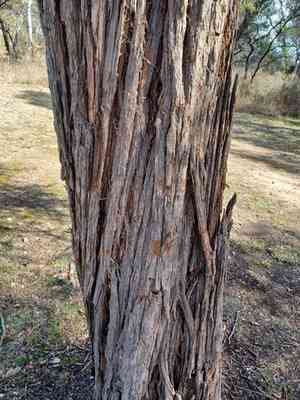
Distinct bark transformation from smooth red-brown to fibrous, thick deep red-brown texture.
2
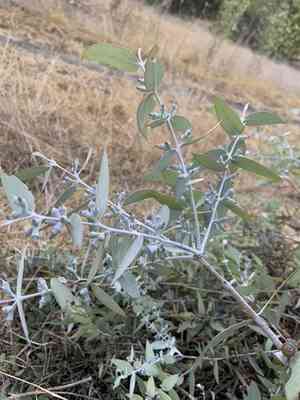
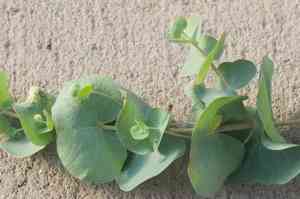
Leaf duality: silvery-powder oval juvenile leaves and lanceolate mature leaves with eucalyptus scent.
3
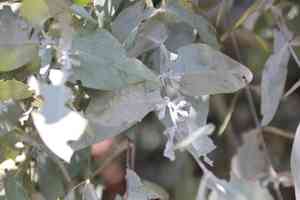
Small creamy-white flowers in axillary clusters with fluffy appearance from prominent stamens.
4
Woody capsule fruit, globular, gray-brown, long-lasting on tree, splits into valves for seed release.
5
Distinct leaf stages: orbicular juvenile leaves in contrast to lanceolate, acuminate adult leaves.

Scientific Classification of Argyle apple

Phylum
Vascular plants
Class
Dicotyledons
Order
Myrtales
Family
Myrtle
Genus
Eucalypts
Species
Argyle apple

Planting and Growing of Argyle apple

Care Difficulty
Easy
Watering Schedule
Every 2 days
Sunlight Requirements
Full sun
Sunshine Duration
4-6 hours
Ideal Temperature
55-77℉
Soil Type
Potting Mix, Peat Mix
Soil pH
6-7.5
Fertilizer Type
Balanced
Pruning Season
Spring, Summer
Pruning Area
Branches, Leaves
Pruning Frequency
2 times a year
Repotting Season
Spring
Pot Type
Plastic, Ceramic

water icon How to Water Argyle apple?

Eucalyptus cinerea plants should be watered until the soil feels moist but not soggy. The principle is to allow the top layer of soil to dry out completely between waterings, as these plants prefer drier conditions similar to their native Australian environment.
What are the symptoms of an underwatered Argyle apple?
What should I do if my Argyle apple is not getting enough water?
What are the symptoms of an overwatered Argyle apple?
How to save an overwatered Argyle apple?

sunlight icon What Are the Sunlight Requirements for Argyle apple?

Sunlight Requirements: Full sun, Partial sun
Duration of light: 6 to 8 hours
Eucalyptus cinerea ideally needs full sun to partial sun, which encourages lush growth and strong structure. Adequate sunlight promotes healthy photosynthesis, increasing plant resilience and aesthetic appeal.
What is the best lighting condition for Eucalyptus cinerea?
How to achieve ideal lighting for your Eucalyptus cinerea?
What are the benefits of optimal light for Eucalyptus cinerea?

temperature icon What Is the Ideal Temperature Range for Argyle apple?

Ideal Temperature: 55 ~ 77℉
Eucalyptus cinerea thrives best within a temperature range of 55 to 77°F. This range provides an optimal environment for photosynthesis and metabolic processes essential for growth. Maintaining these temperatures will help ensure the plant's health and vitality.

soil icon What Soil is Best for Argyle apple?

Soil type: Loam, Sandy loam
Soil PH: 6 ~ 7.5
Eucalyptus cinerea thrives in well-drained soil as it prevents waterlogging, ensuring roots get enough oxygen, promoting healthy growth and reducing the risk of root rot. A nutrient-rich soil provides essential minerals and organic matter required for robust growth, leading to a healthier foliage with vibrant colors. Eucalyptus cinerea prefers slightly acidic to neutral pH, which enhances nutrient uptake and supports strong root development essential for overall vigor.

fertilize icon How to Fertilize Argyle apple?

Fertilizer type: Balanced
Eucalyptus cinerea typically requires a moderate amount of fertilizer. During the growing season, apply a liquid fertilizer diluted to half strength twice a month to provide essential nutrients without causing harm. Adjust quantities based on plant response.

prune icon How to Prune Argyle apple?

Pruning Time: Spring, Summer
Start by removing dead, damaged, or diseased branches. Identify and prune branches that cross or rub against each other to avoid wounds that may invite pests or diseases. To maintain a desirable shape, prune the outer branches to encourage a denser look. Trim back about a third of the length of each branch to promote lush growth and a fuller appearance. After initial pruning, step back and assess the overall shape of the plant. Adjust any uneven areas to enhance symmetry and balance, but avoid excessive pruning to maintain the plant's natural growth patterns.

propagate icon How to Propagate Argyle apple plant?

Propagate Time: Early spring,Spring,Late spring
1
Fill seed trays with a well-draining soil mix. It's important to moisten the soil before sowing the seeds, as it provides a better environment for germination and helps anchor the seed once it's planted.
2
Select healthy branches and cut segments that are at least 6 inches long. Remove the leaves from the lower half before planting, which helps the cutting focus its energy on rooting instead of sustaining foliage.
3
Grafting involves joining a scion and rootstock. Choose compatible plants, align them carefully, and secure with grafting tape. This method is useful if you want to combine the strengths of different Eucalyptus varieties.

repot icon How to Repot Argyle apple plant?

Repotting frequency: Every 2-3 years
1
Repotting Eucalyptus cinerea is essential when you observe its roots beginning to wind tightly around the root ball or start emerging through the drainage holes. These signs generally mean the plant has outgrown its current pot, limiting its nutrient absorption and growth. The best time to address these signs is in early spring or autumn, when the plant is most robust and can endure the stress of repotting.
2
Selecting an appropriate pot for your Eucalyptus cinerea involves ensuring adequate drainage and stability. Ideally, choose a pot one size larger than the current one to accommodate growth. This helps prevent waterlogging and allows enough space for root expansion, promoting healthy plant development. Additionally, consider a pot with a wide base to prevent toppling, especially if the plant is top-heavy.
3
It is critical to choose a well-draining potting mix for Eucalyptus cinerea, blending equal parts of peat, perlite, and garden soil. This mixture not only ensures optimal water drainage, preventing root rot, but also maintains an airy environment essential for root health. Such a soil mix facilitates nutrient uptake, which is vital for the eucalyptus's rapid growth and foliage vibrancy.

PlantJoy - Identify plants with a snap

Find the best spots for them to optimize their health, simply using your phone.

Try for Free

Toxicity of Argyle apple

Is Argyle apple toxic to humans?

The Argyle apple exhibits a moderate toxicity level to humans, primarily associated with the consumption of its essential oil. This oil contains specific compounds that, when ingested, can result in various symptoms typical of poisoning. Individuals who inadvertently take in the essential oil may encounter gastrointestinal issues, which can include intense abdominal pain, nausea, and vomiting. Furthermore, the symptoms may affect the central nervous system, leading to disorientation, dizziness, and, in severe instances, muscle weakness. It is vital for individuals to refrain from consuming the essential oil of the Argyle apple to avert these toxic consequences. Although the Argyle apple is not generally consumed as food, the potential for accidental ingestion persists, particularly among populations who could inadvertently come into contact with the plant's oil, unaware of its toxic properties.

Is Argyle apple toxic to cat?

The Argyle apple contains a moderate level of toxicity for cats, presenting a potential hazard if ingested accidentally. The chief toxic components are the essential oils, which can result in physical discomfort for felines upon consumption. It's essential for cat owners to recognize the risks associated with argyle apple and to keep a close watch on their pets for any abnormal behavior or distress signals. If poisoning is suspected, seeking immediate veterinary care is vital, as timely intervention plays a critical role in ensuring the health and recovery of the affected cat.

Is Argyle apple toxic to dog?

The Argyle apple presents a moderate risk of toxicity to dogs. Canines may inadvertently ingest various parts of the plant, especially the essential oil, which is recognized as toxic. Should a dog consume argyle apple, it may show signs such as gastrointestinal disturbances, lethargy, weakness, or excessive drooling. It is essential for dog owners to keep a close watch on their pets and restrict their access to this plant. In cases of suspected poisoning, prompt veterinary intervention is crucial to safeguard the health of the affected animal.

Identify toxic plants for your safety

Learn which plants are harmful to you and your pets, and make informed choices for a safer home!

Try for Free
WARNING
The judgment on toxicity and danger is for reference only. We DO NOT GUARANTEE any accuracy of such judgment. Therefore, you SHALL NOT rely on such judgment. It is IMPORTANT TO SEEK PROFESSIONAL ADVICE in advance when necessary.