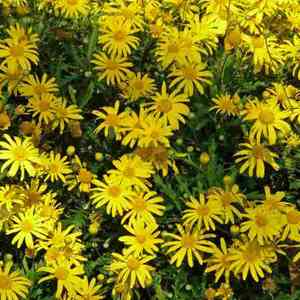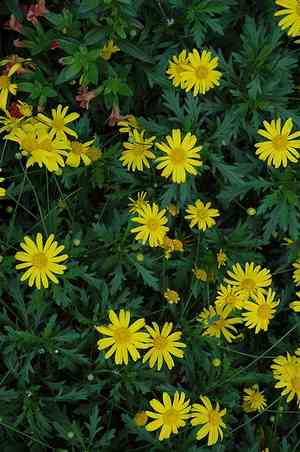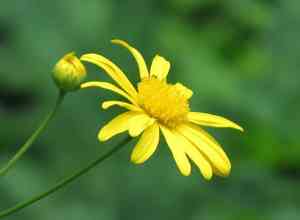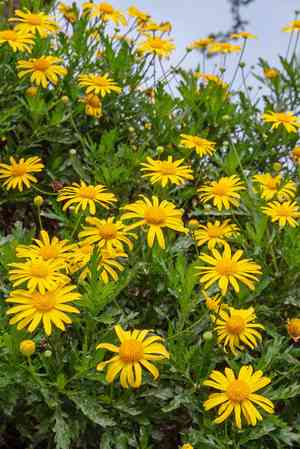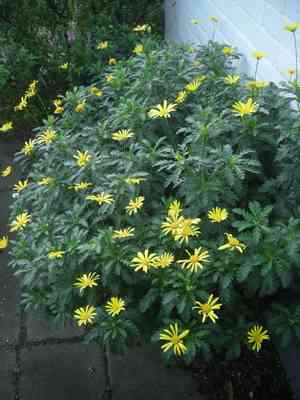
African bush daisy(Euryops chrysanthemoides)

African bush daisy (Euryops chrysanthemoides)

Also known as: African Bush Daisy, Resin Bush, Golden Daisy Bush

The African bush daisy, an evergreen shrub originating from Southern Africa, is often known as the "Daisy Bush."

Attributes of African bush daisy

Lifespan
Perennial
Plant Type
Herb, Shrub
Plant Height
50 cm to 2 m
Spread
20 cm to 30 cm
Leaf Color
Green
Flower Size
3 cm to 4 cm
Flower Color
Yellow

PlantJoy - Identify plants with a snap

Identify and diagnose plants, get toxicity alerts, and explore safety guides for all types of fungi.

Try for Free

Images of African bush daisy

African bush daisy(Euryops chrysanthemoides)

Quickly Identify African bush daisy

1
Compact, mound-like evergreen sub-shrub reaching 3-5 feet tall and wide.
2
Deeply lobed, dark glossy-green leaves clustered near branch tips.
3
Vibrant 2-inch wide composite flowers with yellow ray petals and golden centers.
4
Flowers bloom profusely from fall through spring on 3-5 inch long stems.
5
Lower stems may be bare but usually hidden by dense foliage above.

Scientific Classification of African bush daisy

Phylum
Vascular plants
Class
Dicotyledons
Order
Asterales
Family
Daisy
Genus
Paris daisy
Species
African bush daisy

Planting and Growing of African bush daisy

Care Difficulty
Easy
Watering Schedule
Every 3 days
Sunlight Requirements
Full sun
Sunshine Duration
4-8 hours
Ideal Temperature
65-75℉
Soil Type
Potting Mix, Peat Mix
Soil pH
6.5-7.5
Fertilizer Type
Balanced
Pruning Season
Spring, Summer
Pruning Area
Branches, Leaves
Pruning Frequency
2 times a year
Repotting Season
Spring
Pot Type
Ceramic, Plastic

water icon How to Water African bush daisy?

Euryops chrysanthemoides needs a steady supply of water; however, it thrives best when the soil is allowed to dry out slightly between waterings. Water until the top inch of soil is moist but not soggy. Aim to provide around 500 ml per watering session, ensuring the water reaches the roots without pooling in the pot.
What are the symptoms of an underwatered African bush daisy?
What should I do if my African bush daisy is not getting enough water?
What are the symptoms of an overwatered African bush daisy?
How to save an overwatered African bush daisy?

sunlight icon What Are the Sunlight Requirements for African bush daisy?

Sunlight Requirements: Full sun, Partial sun
Duration of light: 6-8 hours daily
Euryops chrysanthemoides prefers full to partial sun, requiring around 6-8 hours of sunlight for optimal growth. Ideal light conditions enhance flowering and overall plant health, supporting vigorous growth patterns.
Why is full sun ideal for Euryops chrysanthemoides?
How to ensure optimal sunlight exposure?
Benefits of ideal light for Euryops chrysanthemoides?
More About Sunlight Requirements Techniques

temperature icon What Is the Ideal Temperature Range for African bush daisy?

Ideal Temperature: 65 ~ 75℉
The ideal temperature range for Euryops chrysanthemoides is between 65°F and 75°F. This range provides optimal conditions for growth and flowering. Within these temperatures, the plants can efficiently photosynthesize and metabolize nutrients, leading to robust growth.

soil icon What Soil is Best for African bush daisy?

Soil type: Sandy loam, Loam
Soil PH: 6.5 ~ 7.5
Euryops chrysanthemoides thrives in well-drained soils that prevent water from stagnating. This drainage efficiency aids in avoiding root rot, ensuring the plant can absorb essential nutrients without risk of waterlogging. This plant benefits from soils enriched with organic matter, which supplies vital nutrients, improving its growth and flowering. A nutrient-rich base fosters a robust plant structure and abundant blooms by providing essential sustenance. The soil should have moderate moisture retention to maintain hydration without becoming waterlogged. This balance ensures that the plant's roots stay moist yet not oversaturated, supporting healthy growth and resilience.

fertilize icon How to Fertilize African bush daisy?

Fertilizer type: Balanced
Euryops chrysanthemoides, commonly known as the African Bush Daisy, requires a careful balance of nutrients to thrive. Generally, you'll want to provide about half the recommended dosage of a typical 10-10-10 liquid fertilizer per application when watering. For slow-release fertilizers, a small amount, just enough to lightly cover the soil surface, should suffice.

prune icon How to Prune African bush daisy?

Pruning Time: Spring, Summer, Autumn
Begin by removing any spent blooms. This not only keeps the plant looking tidy but also encourages further flowering by redirecting energy towards new growth instead of seed production. Trim to shape by cutting back any excessively long or unruly branches. Aim to maintain a balanced form, which promotes even growth and allows light to reach all parts of the plant. Periodically thin out crowded areas within the plant. This improves air circulation, reducing the risk of fungal infections and ensuring that remaining foliage receives adequate sunlight. More About Pruning Techniques

propagate icon How to Propagate African bush daisy plant?

Propagate Time: Early spring, Late spring, Summer
1
Select healthy, non-flowering stems from the parent plant and use sharp shears to cut 4-6 inch segments. Remove the lower leaves to expose nodes for rooting and reduce moisture loss.
2
Fill seed trays with a well-draining potting mix, ensuring they are clean and free of old soil. Sow the seeds evenly, covering with a thin layer of soil to allow light penetration for the seeds to germinate.
3
Dip the cut end of the stem into rooting hormone to stimulate root growth. Place the cutting into a pot with moist potting mix, firming the soil around the cutting to ensure it remains upright.
More About Propagating Techniques

repot icon How to Repot African bush daisy plant?

Repotting frequency: Every 2-3 years
1
Euryops chrysanthemoides typically requires repotting every 2-3 years, or when you notice the roots becoming overcrowded. A clear sign is when you see roots growing out of the drainage holes or when the soil dries much faster than usual after watering.
2
Select a pot that is just one size larger than its current home. It should have sufficient drainage holes to prevent waterlogging. The right pot not only accommodates root growth but also prevents root rot, ensuring optimal plant health.
3
Opt for a well-draining potting mix, preferably one designed for perennials. This type of soil allows excess water to escape, reducing the risk of root rot while maintaining adequate moisture levels for healthy plant growth.
More About Repotting Techniques

PlantJoy - Identify plants with a snap

Find the best spots for them to optimize their health, simply using your phone.

Try for Free

Toxicity of African bush daisy

Is African bush daisy toxic to cat?

The African bush daisy poses a toxic threat to cats, particularly if they ingest its leaves. Should a cat inadvertently consume any portion of the african bush daisy, it might exhibit signs of poisoning that may manifest as physical discomfort, illness, or general distress. Considering the serious health risks involved, it is essential to pursue immediate veterinary assistance if a cat is believed to have eaten african bush daisy, ensuring the best possible care for the impacted feline.

Is African bush daisy toxic to dog?

The African bush daisy is regarded as poisonous for dogs. Canines might unintentionally consume sections of this plant, especially the leaves, which are identified as toxic. Should a dog ingest any part of the African bush daisy, it may show symptoms including vomiting, diarrhea, lethargy, or potentially more severe reactions based on the quantity eaten. It is vital for dog owners to keep a close eye on their pets and restrict their access to the African bush daisy to prevent accidental poisonings. If a dog does manage to consume this plant, prompt veterinary assistance is crucial to ascertain appropriate care and treatment.

Identify toxic plants for your safety

Learn which plants are harmful to you and your pets, and make informed choices for a safer home!

Try for Free
WARNING
The judgment on toxicity and danger is for reference only. We DO NOT GUARANTEE any accuracy of such judgment. Therefore, you SHALL NOT rely on such judgment. It is IMPORTANT TO SEEK PROFESSIONAL ADVICE in advance when necessary.
More About Toxic Techniques