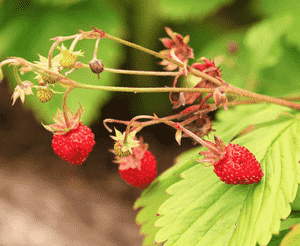
Wild strawberry (Fragaria virginiana)
Also known as: Mountain strawberry, Scarlet strawberry
The wild strawberry (Fragaria virginiana) is one of the two species used to develop the domestic strawberry. While the wild variety is indeed edible, its fruit is significantly smaller and more flavorful compared to the larger, often milder fruit of the domestic strawberry. Fragaria virginiana is native to North America and was crossed with the Chilean Fragaria chiloensis to create the modern strawberry.
In This Article
Attributes of Wild strawberry
Lifespan
Perennial
Plant Type
Herb
Plant Height
10 cm
Spread
30 cm to 60 cm
Leaf Color
Green
Flower Size
1 cm to 2 cm
Flower Color
White
Images of Wild strawberry
Quickly Identify Wild strawberry
1
Low-growing habit up to 5 inches (13 cm) tall and spreading 2 feet (60 cm) wide.
2
Trifoliate leaves with toothed margins and oval-shaped leaflets.
3
White flowers with five round petals in flat clusters, each 3/4 inch (1.9 cm) wide.
4
Small, red, juicy fruit with a distinct aroma, 1/2 inch (1.27 cm) in diameter.
5
Distinct veination on leaves, 3 obovate leaflets each 1-2 inches (2.5-5 cm) long.
Scientific Classification of Wild strawberry
Phylum
Vascular plants
Class
Dicotyledons
Order
Rosales
Family
Rose
Genus
Strawberries
Species
Wild strawberry
Planting and Growing of Wild strawberry
Care Difficulty
Easy
Watering Schedule
Every 8 days
Sunlight Requirements
Full sun
Sunshine Duration
8-12 hours
Ideal Temperature
60-75℉
Soil Type
Potting Mix, Peat Mix
Soil pH
6-7.5
Fertilizer Type
Balanced
Pruning Season
Spring, Summer
Pruning Area
Branches, Leaves
Pruning Frequency
2 times a year
Repotting Season
Spring
Pot Type
Plastic, Ceramic
 How to Water Wild strawberry?
The amount of water for Fragaria virginiana should be substantial enough to keep the soil evenly moist but not waterlogged. Ideally, water around 250 ml per session. This ensures the soil is moist but not drenched, maintaining an optimal moisture balance for healthy growth.
More About Watering Techniques→
What are the symptoms of an underwatered Wild strawberry?
›
What should I do if my Wild strawberry is not getting enough water?
›
What are the symptoms of an overwatered Wild strawberry?
›
How to save an overwatered Wild strawberry?
›
 What Are the Sunlight Requirements for Wild strawberry?
Fragaria virginiana ideally requires full sun to partial sun for 6 to 8 hours daily, promoting robust growth and fruitful yields resulting from optimal photosynthesis.
More About Sunlight Requirements Techniques→
Optimal Light Conditions
›
Solutions for Ideal Light Exposure
›
Benefits of Ideal Lighting
›
 What Is the Ideal Temperature Range for Wild strawberry?
Fragaria virginiana thrives best in temperatures ranging from 60°F to 75°F. This range provides the optimal conditions for growth, including good flowering and fruit production. Cooler temperatures can lead to slower growth, while too much warmth may inhibit fruit development.
 What Soil is Best for Wild strawberry?
Fragaria virginiana thrives in well-drained soil that prevents waterlogging and root rot, ensuring healthy root development and optimal nutrient uptake. Soil enriched with organic matter like compost provides essential nutrients, improving soil structure and promoting vigorous growth and fruit production in Fragaria virginiana. A soil that retains moisture well helps maintain consistent hydration, which is crucial for Fragaria virginiana to flourish and produce juicy, flavorful strawberries.
More About Soil→
 How to Fertilize Wild strawberry?
For Fragaria virginiana, use a balanced liquid fertilizer at half the recommended strength to avoid nutrient burn. Apply approximately 1 tablespoon of liquid fertilizer mixed in one gallon of water. For solid fertilizers, use a slow-release formula, applying about 2-3 teaspoons per plant per application, ensuring even distribution around the plant.
More About Fertilizing Techniques→
 How to Prune Wild strawberry?
Begin by removing any dead or decaying leaves and stems from the plant. This not only tidies up the plant's appearance but also reduces disease potential and pest harboring. Identify areas of the plant that are overly crowded and remove excess stems and foliage to improve air circulation and light penetration. This helps in minimizing mold and mildew problems. After the blooming period is over, carefully trim the stems that have already flowered to encourage the plant to focus its energy on new growth and fruiting. Look for the small buds indicating the formation of fruit and avoid cutting those.
More About Pruning Techniques→
 How to Propagate Wild strawberry plant?
1
To propagate by seeds, collect ripe berries and extract seeds by gently mashing the fruit on a sieve and rinsing with water. Ensure seeds are clean for optimal germination.
2
Select healthy runners and use sharp pruners to trim them. Ensure each cutting has at least a couple of nodes, which will be crucial for root development.
3
In spring, divide the plant by separating the crown with a sharp tool, ensuring each section contains a healthy root system and foliage, promoting robust regrowth in new locations.
 How to Repot Wild strawberry plant?
1
Fragaria virginiana, or the Virginian strawberry, should be considered for repotting when you notice visual roots circling the pot base or piercing through the drainage holes. Additionally, a slowdown in growth or a requirement for excessively frequent watering may indicate it's time for repotting. The optimal periods are spring and autumn when the plant is not in its active fruiting phase, reducing stress and promoting healthy root development.
2
When selecting the right pot for Fragaria virginiana, aim for one that is slightly larger than the current size, ideally 1-2 inches in diameter wider. This ensures ample space for root expansion but prevents water from being retained due to excessive soil. For enhanced root aeration, opt for pots with multiple drainage holes, and choose materials like terracotta that offer breathability, further aiding in healthier plant growth.
3
For repotting Fragaria virginiana, an ideal soil mix is loamy and well-draining, enriched with organic matter like compost. This kind of soil structure retains moisture adequately yet allows excess water to drain, reducing the risk of root rot. The inclusion of organic matter boosts the nutrient content, supporting vigorous strawberry growth and fruiting.



