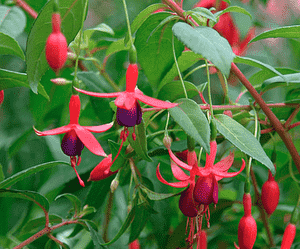
Hardy fuchsia (Fuchsia magellanica)
Also known as: Hummingbird fuchshia
The hardy fuchsia is an excellent addition to any garden due to its striking colors and elegant form. Unlike other fuchsia varieties, it is more tolerant of cold, making it versatile enough for both container planting and permanent garden locations. Whether used in window boxes, along borders, or as shrubs, its adaptability to different settings makes it a standout choice for gardeners.
In This Article
Attributes of Hardy fuchsia
Lifespan
Perennial
Plant Type
Shrub, Vine
Plant Height
1.2 m to 3.5 m
Spread
1.2 m to 3 m
Leaf Color
Green
Flower Size
2.5 cm to 5 cm
Flower Color
Red Purple White Pink
Images of Hardy fuchsia
Quickly Identify Hardy fuchsia
1
Distinct pendulous teardrop flowers in vibrant red color.
2
Medium green oval leaves with dentate edges, whorled arrangement.
3
Thin, red-brown stem with a smooth texture, slender with red hue.
4
Small, drooping, tubular magenta to red flowers with prominent stamens.
5
Smooth, purple to black elongated berries, not edible for humans.
Scientific Classification of Hardy fuchsia
Phylum
Vascular plants
Class
Dicotyledons
Order
Myrtle order
Family
Evening primrose
Genus
Fuchsias
Species
Hardy fuchsia
Planting and Growing of Hardy fuchsia
Care Difficulty
Easy
Watering Schedule
Every 8 days
Sunlight Requirements
Partial sun
Sunshine Duration
4-8 hours
Ideal Temperature
60-70℉
Soil Type
Potting Mix, Peat Mix
Soil pH
6-7
Fertilizer Type
Balanced
Pruning Season
Spring, Summer
Pruning Area
Branches, Leaves
Pruning Frequency
2 times a year
Repotting Season
Spring
Pot Type
Plastic, Ceramic
 How to Water Hardy fuchsia?
For Fuchsia magellanica, it's crucial to ensure that the soil is evenly moist, but not waterlogged. Each watering session should allow for approximately 500ml of water, ensuring that water permeates the root zone and excess water drains away, preventing root rot.
More About Watering Techniques→
What are the symptoms of an underwatered Hardy fuchsia?
›
What should I do if my Hardy fuchsia is not getting enough water?
›
What are the symptoms of an overwatered Hardy fuchsia?
›
How to save an overwatered Hardy fuchsia?
›
 What Are the Sunlight Requirements for Hardy fuchsia?
Partial sun exposure ensures Fuchsia magellanica receives enough light for growth while protecting it from overheating. Ideal light conditions promote abundant flowering and robust plant health.
More About Sunlight Requirements Techniques→
What is the best location for Fuchsia magellanica?
›
How do I protect Fuchsia magellanica from intense light?
›
Why is balanced lighting important for Fuchsia magellanica?
›
 What Is the Ideal Temperature Range for Hardy fuchsia?
Fuchsia magellanica thrives best in temperatures ranging from 60 to 70 degrees Fahrenheit. This range provides optimal conditions for photosynthesis and nutrient absorption, promoting robust growth and flowering. During this temperature range, the plant efficiently processes resources, ensuring a healthy lifecycle.
 What Soil is Best for Hardy fuchsia?
Fuchsia magellanica requires soil that provides excellent drainage to prevent root rot. The presence of good drainage ensures the roots stay healthy and the plant thrives without being waterlogged. This plant favors nutrient-rich soil, which aids in its robust flowering and vibrant foliage. A fertile soil supplies the necessary nutrients that support its vigorous growth and stunning blooms. Keeping the soil consistently moist, but not soggy, is key for Fuchsia magellanica. This moisture level supports its growth and flowering cycles, encouraging lush blossoms and healthy foliage.
More About Soil→
 How to Fertilize Hardy fuchsia?
For Fuchsia magellanica, apply a balanced liquid fertilizer with an N-P-K ratio such as 10-10-10, diluting it to half the recommended strength. Ensure the plant is well-watered before fertilization to avoid root burn, delivering no more than 1/4 gallon per application.
More About Fertilizing Techniques→
 How to Prune Hardy fuchsia?
Start by identifying and removing any deadwood. Dead stems are often darker and brittle, making them distinct from the healthier parts of the plant. Cutting these away helps improve air circulation and light penetration, crucial for stimulating new growth. Focus on trimming your Fuchsia magellanica to encourage a pleasing shape. This involves cutting back any unruly or overlapping branches to maintain a balanced form. Careful shaping will help prevent damage from wind and ensure an even distribution of flowers. To promote bushier growth and more blooms, cut back branches by about one-third. This stimulates the plant to produce new shoots, ensuring a fuller appearance. Be mindful to prune just above a node or bud, which will encourage new branches to develop.
More About Pruning Techniques→
 How to Propagate Hardy fuchsia plant?
1
Select healthy stems and cut them approximately 10-15 cm long. Ensure the cutting has several leaves but remove the ones that are close to the cut end.
2
Dip the cut end of your stem into rooting hormone powder and place it into the potting mix. Make sure it is secure in an upright position and not too deep in the soil.
3
Gently water the cutting and cover it with a plastic bag or a propagation dome to maintain humidity, reducing the watering frequency but ensuring the soil remains moist.
 How to Repot Hardy fuchsia plant?
1
Fuchsia magellanica signals its need for repotting when the roots start to encircle the pot's edges or visibly grow through the drainage holes. Another indicator is when you notice reduced flowering or stunted growth, signaling the pot's constraints. Spring is ideal as it aligns with the plant’s active growth phase, helping it adapt to the new environment efficiently.
2
Select a pot that is about 2 inches larger in diameter than the current one, ensuring it has ample drainage holes. This prevents water logging, which can lead to root rot. Preferably, use a pot made of breathable material like terracotta, which allows soil to aerate, keeping the roots healthy and free from excessive moisture.
3
Opt for a well-draining potting mix, rich in organic matter, such as compost or peat moss blended with perlite. This blend retains essential moisture and nutrients while preventing water from lingering excessively. The rich organic content promotes robust growth and vibrant blooms typical of healthy Fuchsia plants.
Learn More About Hardy fuchsia Diseases
Anthracnose
Bacterial Leaf Spot
Bacterial Soft Rot
Bacterial Wilt
Black Spot
Chemical Injury
Crown Gall
Damping-off
Downy Mildew
Drought Stress
Fusarium Wilt
Gray Mold
Leaf Curl
Leaf Spot
Mosaic
Nutrient Deficiency
Nutrient Toxicity
Powdery Mildew
Root Rot
Root-knot Nematode
Rusts
Sooty Mold
Spider Mites
Temperature Stress
Thrips Damage
White Mold



