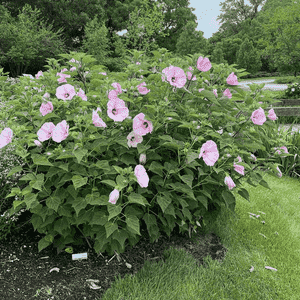
Swamp rose mallow (Hibiscus moscheutos)
Also known as: Rose-mallow
Swamp Rose Mallow (Hibiscus moscheutos) is a popular ornamental plant. This hardy perennial flourishes in moist soils and features striking white to pink blooms that attract pollinators. Additionally, it serves as a larval host for several butterfly and moth species.
In This Article
Attributes of Swamp rose mallow
Lifespan
Perennial
Plant Type
Shrub
Plant Height
1 m to 2.5 m
Spread
50 cm to 1.2 m
Leaf Color
Green
Flower Size
10 cm to 22 cm
Flower Color
White Pink Red
Images of Swamp rose mallow




Quickly Identify Swamp rose mallow
1
Dinner-plate-sized blooms with overlapping petals in white, pink, red, or burgundy.
2
Robust stature ranging from 2 to 6 feet (60 to 180 cm) in height.
3
Oval fruit capsule maturing to brown, housing dark brown, kidney-shaped seeds.
4
Ovate to lanceolate leaves, green with whitish, hairy underside.
5
Woody basal stem transitioning to green, hairy new growth, sparse branching.
Scientific Classification of Swamp rose mallow
Phylum
Vascular plants
Class
Dicotyledons
Order
Malvales
Family
Mallow
Genus
Hibiscus
Species
Swamp rose mallow
Planting and Growing of Swamp rose mallow
Care Difficulty
Easy
Watering Schedule
Every 8 days
Sunlight Requirements
Full sun
Sunshine Duration
6-8 hours
Ideal Temperature
68-77℉
Soil Type
Potting Mix, Peat Mix
Soil pH
6-7
Fertilizer Type
Balanced
Pruning Season
Spring, Summer
Pruning Area
Branches, Leaves
Pruning Frequency
2 times a year
Repotting Season
Spring
Pot Type
Plastic, Ceramic
 How to Water Swamp rose mallow?
For Hibiscus moscheutos, water the plant until you see water starting to drain from the bottom of the pot. This ensures the entire root system is nourished, following the principle of deep and thorough watering rather than small frequent ones.
More About Watering Techniques→
What are the symptoms of an underwatered Swamp rose mallow?
›
What should I do if my Swamp rose mallow is not getting enough water?
›
What are the symptoms of an overwatered Swamp rose mallow?
›
How to save an overwatered Swamp rose mallow?
›
 What Are the Sunlight Requirements for Swamp rose mallow?
Hibiscus moscheutos thrives best in full sun, receiving 6-8 hours of light daily. This range facilitates optimal photosynthesis, maximizing bloom quality and quantity, and promoting healthier, more vigorous growth.
More About Sunlight Requirements Techniques→
What is the best sunlight condition for Hibiscus moscheutos?
›
How to ensure optimal sun exposure for Hibiscus moscheutos?
›
What are the benefits of providing ideal sunlight to Hibiscus moscheutos?
›
 What Is the Ideal Temperature Range for Swamp rose mallow?
Hibiscus moscheutos thrives best in a warm environment. Maintaining a temperature range between 68°F and 77°F is crucial for optimal growth. This range supports their metabolic functions and encourages vibrant flower production.
 What Soil is Best for Swamp rose mallow?
Hibiscus moscheutos thrives in soil that retains moisture without becoming waterlogged. This helps in maintaining a consistent moisture level crucial for its blooming process. Rich in organic matter, the soil should provide ample nutrients to support the rapid growth and flowering of the plant, ensuring it has vibrant and large blooms. Well-aerated soil allows the roots of Hibiscus moscheutos to breathe, enabling efficient nutrient uptake and promoting robust health and resilience against diseases.
More About Soil→
 How to Fertilize Swamp rose mallow?
For Hibiscus moscheutos, using 1/2 to 1 tablespoon of liquid fertilizer per gallon of water is ideal. When applying slow-release granules, use about 1/4 to 1/2 cup per plant, depending on its size. Avoid over-application to reduce risks of nutrient burn.
More About Fertilizing Techniques→
 How to Prune Swamp rose mallow?
Start by identifying dead or diseased stems and remove them completely. Cut back any spindly or crossing branches to improve air circulation and sunlight penetration. Aim to create an open center to the plant, which encourages healthy growth and makes your hibiscus look fuller and more balanced. After identifying the main stems, trim them back by up to one-third. This pruning encourages bushier growth and results in a profusion of flowers. It's important to cut back each branch just above a leaf node to encourage a new branch in the same spot.
More About Pruning Techniques→
 How to Propagate Swamp rose mallow plant?
1
To propagate Hibiscus moscheutos by seeds, start by soaking the seeds overnight to enhance germination. Then, plant them in seedling trays filled with moist, well-draining soil, ensuring they are lightly covered.
2
Choose healthy stems and use sharp shears to take 4-6 inch long cuttings. Strip the lower leaves and dip the cut end in rooting hormone before planting it in a pot with a suitable rooting medium.
3
When dividing, carefully dig up the parent plant in spring. Use a sharp knife to separate the root ball into sections, ensuring each has roots attached, then replant them at the same depth in a prepared bed.
 How to Repot Swamp rose mallow plant?
1
Hibiscus moscheutos generally needs repotting when roots start to circle the pot's interior or begin growing through the drainage holes, indicating root-bound distress. Another signal is when water rushes out quickly during watering, suggesting the soil volume is mostly occupied by roots. These signs usually appear every 2 to 3 years and repotting during early spring before new growth begins will minimize stress.
2
Choose a pot that is one size larger than the current one, ideally with a diameter that is 1-2 inches larger. This encourages steady growth without overwhelming the plant with too much soil, which can retain excess moisture. Ensure the pot has adequate drainage holes to prevent root rot caused by waterlogged soil, maintaining a healthy root environment.
3
Opt for a rich, well-drained loam with organic material to retain moisture yet offer good drainage. This type of soil promotes healthy root growth while preventing waterlogging, which can be detrimental to Hibiscus moscheutos. Additionally, the organic content helps in supporting nutrient uptake, essential for vibrant blooms.
Learn More About Swamp rose mallow Diseases
Anthracnose
Bacterial Leaf Spot
Bacterial Wilt
Black Spot
Chemical Injury
Crown Gall
Damping-off
Drought Stress
Fusarium Wilt
Gray Mold
Leaf Curl
Leaf Spot
Mosaic
Nutrient Deficiency
Nutrient Toxicity
Powdery Mildew
Root Rot
Root-knot Nematode
Rusts
Sooty Mold
Spider Mites
Temperature Stress
Thrips Damage
White Mold



