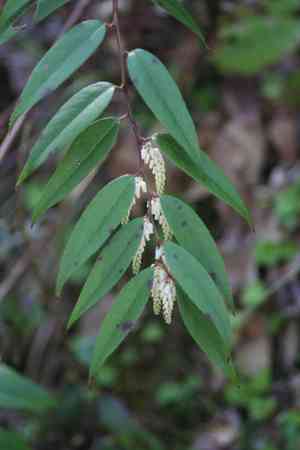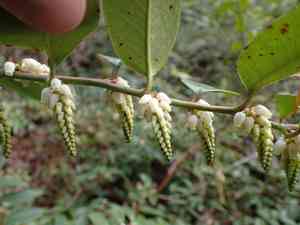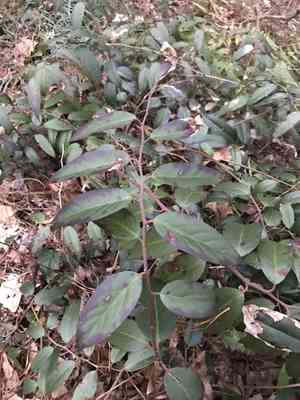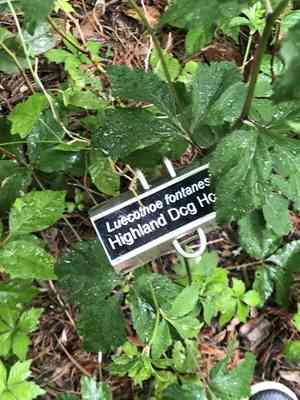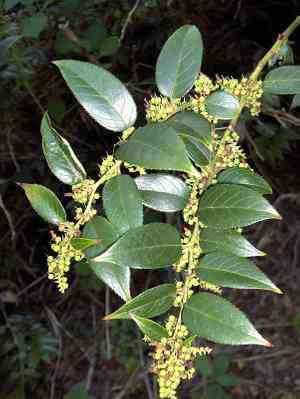
Mountain doghobble(Leucothoe fontanesiana)

Mountain doghobble (Leucothoe fontanesiana)

Also known as: Drooping leucothoe, Switch ivy, Drooping laurel

Mountain doghobble (Leucothoe fontanesiana) is a native shrub from the southeastern United States. Popular as an ornamental plant, it produces charming strings of urn-shaped flowers in the spring.

Attributes of Mountain doghobble

Lifespan
Perennial
Plant Type
Shrub
Plant Height
61 cm to 1.8 m
Spread
1.2 m to 2.5 m
Leaf Color
Green
Flower Size
2.5 cm to 8 cm
Flower Color
White

PlantJoy - Identify plants with a snap

Identify and diagnose plants, get toxicity alerts, and explore safety guides for all types of fungi.

Try for Free

Images of Mountain doghobble

Mountain doghobble(Leucothoe fontanesiana)

Quickly Identify Mountain doghobble

1
Leaves glossy, lanceolate, up to 5 inches (13 cm) long, serrate margins, sharp pointed apex.
2
Small, waxy, urn-shaped white flowers, fragrant to ill-scented, in drooping racemes.
3
Globular, 5-lobed fruit capsule, ripening into dry fruit, distinct lobes, modest size.
4
Durable stem with red new growth, smooth texture, arching branching pattern.
5
Evergreen shrub, 3-6 feet (91-183 cm) tall, broadleaf leaves, thrives in moist environments.

Scientific Classification of Mountain doghobble

Phylum
Vascular plants
Class
Dicotyledons
Order
Ericales
Family
Heath
Genus
Doghobbles
Species
Mountain doghobble

Planting and Growing of Mountain doghobble

Care Difficulty
Easy
Watering Schedule
Every 4 days
Sunlight Requirements
Partial sun
Sunshine Duration
6-8 hours
Ideal Temperature
60-75℉
Soil Type
Potting Mix, Peat Mix
Soil pH
5-6.5
Fertilizer Type
Balanced
Pruning Season
Spring, Summer
Pruning Area
Branches, Leaves
Pruning Frequency
2 times a year
Repotting Season
Spring
Pot Type
Plastic, Ceramic

water icon How to Water Mountain doghobble?

Leucothoe fontanesiana requires a consistent watering routine to thrive. When watering, ensure the soil is moist but not waterlogged. A good rule of thumb is to provide about 500 ml of water per occasion. This ensures that moisture reaches the root zone without drowning the plant in excess water.
What are the symptoms of an underwatered Mountain doghobble?
What should I do if my Mountain doghobble is not getting enough water?
What are the symptoms of an overwatered Mountain doghobble?
How to save an overwatered Mountain doghobble?

sunlight icon What Are the Sunlight Requirements for Mountain doghobble?

Sunlight Requirements: Partial sun, Full shade
Duration of light: 2-6 hours daily
Partial sun to full shade is recommended, as it mimics its native environment. Ideal lighting conditions ensure robust health, promote vibrant foliage, and reduce stress owing to improper light exposure.
How much light does Leucothoe fontanesiana need?
What is the solution to provide ideal lighting?
Benefits if Leucothoe fontanesiana gets ideal light?

temperature icon What Is the Ideal Temperature Range for Mountain doghobble?

Ideal Temperature: 60 ~ 75℉
Leucothoe fontanesiana thrives best in a temperate climate where temperatures range from 60°F to 75°F. This temperature range supports healthy photosynthesis and growth. By maintaining consistent temperatures within this range, you can ensure that the plant can absorb nutrients effectively and produce vibrant foliage.

soil icon What Soil is Best for Mountain doghobble?

Soil type: Loam, Acidic soil, Sandy loam
Soil PH: 5 ~ 6.5
Leucothoe fontanesiana thrives in moist, well-drained soil. This environment ensures that the roots receive constant hydration while preventing waterlogging, which could lead to root rot. Soil enriched with organic matter supports the robust growth of Leucothoe fontanesiana by providing essential nutrients. It enhances soil structure, boosting aeration and water retention capabilities. This plant prefers an acidic soil environment, which aligns with its natural habitat and supports optimal nutrient absorption. An acidic pH level helps in maintaining its vibrant foliage.

fertilize icon How to Fertilize Mountain doghobble?

Fertilizer type: Balanced
For Leucothoe fontanesiana, use a balanced, water-soluble fertilizer diluted to half strength during its growing season. Each application should use approximately 1/4 cup per gallon of water. Avoid using a strong concentration, as it might damage the roots.

prune icon How to Prune Mountain doghobble?

Pruning Time: Spring, Summer
Begin by examining the Leucothoe fontanesiana for any dead or damaged branches, as these should be removed first. You’ll want to make your cuts at a 45-degree angle, just above a leaf node, to ensure healthy regrowth. Focus on maintaining the plant’s natural shape while removing no more than one-third of the overall foliage to prevent shock. Leucothoe fontanesiana naturally takes on an arching shape. During pruning, work to enhance this form by selectively cutting branches that seem out of place. Thin out the inner branches to increase sunlight penetration and air circulation, which helps maintain a lush and healthy plant.

propagate icon How to Propagate Mountain doghobble plant?

Propagate Time: Spring, Early spring, Late spring
1
Choose healthy stems from the parent plant, about 4-6 inches long, and cut just below a node. Remove leaves from the lower part to increase root formation.
2
Use a well-draining potting mix, ideally a mix of peat and perlite or sand. This ensures that excess water drains away reducing the risk of rot.
3
Dip cuttings into rooting hormone and plant them in the prepared soil mix, leaving half of the cutting above soil. Gently firm the soil around it.

repot icon How to Repot Mountain doghobble plant?

Repotting frequency: every 2-3 years
1
You should consider repotting Leucothoe fontanesiana when roots start circling the pot or they outgrow the container, showing signs of needing more space. Other indicators include soil that dries out too quickly due to root-bound conditions or poor growth performance. Spring and autumn are ideal as these seasons provide moderate temperatures that minimize stress during the transition.
2
Select a pot that's one size larger than the current one, ensuring it has drainage holes to prevent waterlogging. This allows roots to expand comfortably, encourages better growth, and prevents root rot. A pot too large can hold excessive moisture, while a too-small pot restricts growth, making it crucial to find a balanced size.
3
Opt for an acidic, well-draining soil mix to mimic its natural habitat, allowing roots to access nutrients efficiently without retaining excess moisture. A well-draining mix helps prevent root rot, balances pH levels for optimal nutrient absorption, and provides a stable environment for root development.

PlantJoy - Identify plants with a snap

Find the best spots for them to optimize their health, simply using your phone.

Try for Free

Toxicity of Mountain doghobble

Is Mountain doghobble toxic to humans?

Mountain doghobble is a highly toxic plant that can have dire consequences if consumed. Its flowers and leaves contain andromedotoxin, which may result in excessive salivation, nasal discharge, headaches, muscle weakness, lowered blood pressure, a tingling sensation, profuse sweating, and gastrointestinal problems such as abdominal pain, vomiting, and diarrhea. In severe cases, ingestion can lead to a comatose state or even death. Owing to its high toxicity, only a small quantity of leaves or flowers is needed to trigger serious side effects.

Is Mountain doghobble toxic to cat?

Mountain doghobble is highly toxic to felines. The risk arises when a cat consumes any part of this plant, as all its components are deemed harmful. Following ingestion, cats can suffer from severe physical distress, potentially leading to life-threatening conditions. It is crucial that if a cat has been exposed to mountain doghobble, pet owners must obtain prompt veterinary assistance to maximize the likelihood of recovery.

Is Mountain doghobble toxic to dog?

Mountain doghobble presents a significant toxicity threat to dogs. Consumption of any part of this plant can result in poisoning. Dog owners must remain alert since all components of mountain doghobble are harmful, and ingestion may occur unintentionally during outdoor excursions. Poisoning symptoms can manifest as vomiting, diarrhea, excessive salivation, lethargy, and in severe instances, seizures or unconsciousness. It is essential for dog owners to closely supervise their pets and ensure they cannot access mountain doghobble. Should a dog be suspected of ingesting any portion of mountain doghobble, prompt veterinary care is vital for the animal's health and safety.

Identify toxic plants for your safety

Learn which plants are harmful to you and your pets, and make informed choices for a safer home!

Try for Free
WARNING
The judgment on toxicity and danger is for reference only. We DO NOT GUARANTEE any accuracy of such judgment. Therefore, you SHALL NOT rely on such judgment. It is IMPORTANT TO SEEK PROFESSIONAL ADVICE in advance when necessary.