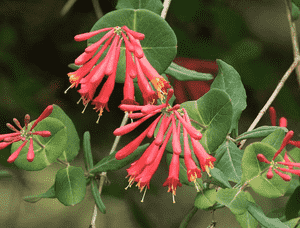
Trumpet honeysuckle(Lonicera sempervirens)

Trumpet honeysuckle (Lonicera sempervirens)

Also known as: Scarlet honeysuckle

Trumpet honeysuckle (Lonicera sempervirens) is a native vine in the eastern United States. Known for attracting hummingbirds, butterflies, and bees, it is commonly cultivated for its ornamental value. This plant is frequently chosen as a non-invasive alternative to Japanese honeysuckle.

Attributes of Trumpet honeysuckle

Lifespan
Perennial
Plant Type
Vine
Plant Height
6 m
Spread
90 cm to 1.8 m
Leaf Color
Green Blue
Flower Size
2.5 cm to 5 cm
Flower Color
Red Orange Yellow

PlantJoy - Identify plants with a snap

Identify and diagnose plants, get toxicity alerts, and explore safety guides for all types of fungi.

Try for Free

Images of Trumpet honeysuckle

Trumpet honeysuckle(Lonicera sempervirens)

Quickly Identify Trumpet honeysuckle

1
Twining growth habit with climbing vine structure.
2
Showy trumpet-shaped flowers in red, coral, yellow, or orange hues.
3
Oval blue-green leaves, 1-3 inches (2.5-7.6 cm) long.
4
Fruit as small, red berries less than 1 inch (2.54 cm) in diameter.
5
Opposite, simple leaves; ovate to oblong-ovate, dark bluish-green.

Scientific Classification of Trumpet honeysuckle

Phylum
Vascular plants
Class
Dicotyledons
Order
Honeysuckles, moschatels and allies
Family
Honeysuckle
Genus
Honeysuckles
Species
Trumpet honeysuckle

Planting and Growing of Trumpet honeysuckle

Care Difficulty
Easy
Watering Schedule
Every 2 days
Sunlight Requirements
Full sun
Sunshine Duration
6-10 hours
Ideal Temperature
60-75℉
Soil Type
Potting Mix, Peat Mix
Soil pH
6.5-7.5
Fertilizer Type
Balanced
Pruning Season
Spring, Summer
Pruning Area
Branches, Leaves
Pruning Frequency
2 times a year
Repotting Season
Spring
Pot Type
Plastic, Ceramic

water icon How to Water Trumpet honeysuckle?

For Lonicera sempervirens, watering should be thorough, ensuring the soil is moist but not waterlogged. The roots need consistent moisture, stop watering once you notice water draining from the bottom of the pot. Each session should typically involve around 500ml of water depending on pot size and weather conditions.
What are the symptoms of an underwatered Trumpet honeysuckle?
What should I do if my Trumpet honeysuckle is not getting enough water?
What are the symptoms of an overwatered Trumpet honeysuckle?
How to save an overwatered Trumpet honeysuckle?

sunlight icon What Are the Sunlight Requirements for Trumpet honeysuckle?

Sunlight Requirements: Full sun, Partial sun
Duration of light: 6-8 hours daily
For optimal growth, placing Lonicera sempervirens in a location that offers full sun exposure with at least 6-8 hours daily ensures vibrant flowers and robust health.
What is the ideal type of sunlight?
How can you achieve this optimal sunlight condition?
What are the benefits of achieving ideal sunlight?

temperature icon What Is the Ideal Temperature Range for Trumpet honeysuckle?

Ideal Temperature: 60 ~ 75℉
Lonicera sempervirens thrives in moderate climates with temperatures between 60°F and 75°F. These conditions provide optimal growth and vigor, ensuring lush foliage and vibrant flowers. Maintaining these temperatures helps reduce plant stress and promotes strong, healthy growth.

soil icon What Soil is Best for Trumpet honeysuckle?

Soil type: Sandy loam, Loam
Soil PH: 6.5 ~ 7.5
Lonicera sempervirens thrives in well-draining soil that prevents water from pooling around its roots. This helps avoid root rot and allows the plant to absorb nutrients efficiently, supporting robust growth and vibrant blooms. This plant prefers soil with moderate fertility, which provides essential nutrients without overwhelming the root system. The balanced nutrient supply encourages healthy foliage and enhances the overall vigor of the plant. Soils that retain adequate moisture but remain light and airy suit Lonicera sempervirens best. This balance ensures that the plant receives enough water without developing waterlogged conditions that can harm its roots.

fertilize icon How to Fertilize Trumpet honeysuckle?

Fertilizer type: Balanced
For Lonicera sempervirens, ensure to provide a balanced fertilizer with a ratio such as 10-10-10. Apply approximately half a cup per plant for liquid fertilizers. This ensures the plant is getting a well-rounded nutrient supply without overwhelming its roots.

prune icon How to Prune Trumpet honeysuckle?

Pruning Time: Spring, Summer, Autumn
Begin by identifying and removing any dead, diseased, or weak growth. Doing so will allow the healthy parts of the plant to receive more nutrients and sunlight, boosting overall plant health. Prune to shape and maintain the desired form. This vine can become unruly if left unpruned, so consider its growing space and structure. Remove stray shoots growing in undesired directions. Trim just above a bud facing the direction where you desire the new growth to appear. This will encourage blooms and create a fuller, lusher appearance the following growing season.

propagate icon How to Propagate Trumpet honeysuckle plant?

Propagate Time: Late spring,Early summer
1
Select healthy, non-flowering shoots and make a clean cut just below a node. The optimal length is about 6 inches. Remove the lower leaves to expose the stem where roots can form.
2
Dip the cut end of the stem in rooting hormone to encourage faster and more robust root development. Tap off any excess powder to avoid over-application.
3
Insert the treated cuttings into a pot with moist, well-draining potting mix. Ensure that at least a third of the cutting is buried to provide stability and enough area for root growth.

repot icon How to Repot Trumpet honeysuckle plant?

Repotting frequency: Every 2-3 years
1
Lonicera sempervirens will show it's time to repot when the roots begin to grow out of the drainage holes or the growth becomes stunted. If you notice that watering seems less effective, that's a cue the plant has outgrown its pot. The best time to repot this vine is in early to mid-Spring, just before its rapid growth phase.
2
Select a pot that is only one size larger than the current one, providing enough room for growth without overwhelming the plant. Ensure the new pot has ample drainage holes to prevent waterlogging, which could rot the roots. Clay pots are an excellent choice as they enhance air circulation around the roots.
3
Opt for a well-draining, loamy soil mixture that is rich in organic matter to support growth. Soil that offers good drainage but retains enough moisture contributes to healthy root development and prevents root rot. An ideal mix contains peat, compost, and a bit of perlite.

PlantJoy - Identify plants with a snap

Find the best spots for them to optimize their health, simply using your phone.

Try for Free

Toxicity of Trumpet honeysuckle

Is Trumpet honeysuckle toxic to humans?

Similar to various honeysuckle species, trumpet honeysuckle may have toxic characteristics that could pose risks to individuals who consume it in significant quantities. The effects of ingesting this plant are generally mild and stem from the toxins that might be present throughout all its parts. Common symptoms include abdominal pain, a burning sensation, diarrhea, vomiting, and abnormal heart rhythms. In severe instances, it can lead to respiratory difficulties or even loss of consciousness. It is advisable to avoid planting this species in areas accessible to children who might unknowingly consume its harmful components.

Is Trumpet honeysuckle toxic to cat?

Trumpet honeysuckle poses a toxicity risk to cats. If felines consume this plant, particularly its fruits, they may suffer from poisoning. Pet owners must remain watchful since these plants can be visually appealing, potentially leading to accidental ingestion by cats. After consuming the plant, cats might display signs of physical distress or illness, which require urgent veterinary intervention. To protect feline health, it is essential to restrict access to this plant and seek immediate care at a veterinary clinic should poisoning be suspected.

Is Trumpet honeysuckle toxic to dog?

Trumpet honeysuckle is regarded as toxic to dogs. If dogs accidentally ingest this plant, particularly its fruits, which are the harmful components, they can suffer from poisoning. Symptoms following the consumption of trumpet honeysuckle may include vomiting, diarrhea, abdominal discomfort, or more severe reactions depending on the quantity ingested. It is essential for dog owners to watch over their pets and prohibit access to trumpet honeysuckle to prevent unintended consumption. Should a dog consume any part of trumpet honeysuckle, especially the fruits, it is critical to obtain prompt veterinary assistance to guarantee appropriate treatment and management of any possible poisoning.

Identify toxic plants for your safety

Learn which plants are harmful to you and your pets, and make informed choices for a safer home!

Try for Free
WARNING
The judgment on toxicity and danger is for reference only. We DO NOT GUARANTEE any accuracy of such judgment. Therefore, you SHALL NOT rely on such judgment. It is IMPORTANT TO SEEK PROFESSIONAL ADVICE in advance when necessary.

