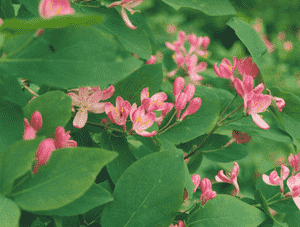
Tatarian honeysuckle(Lonicera tatarica)

Tatarian honeysuckle (Lonicera tatarica)

Also known as: Tatarian Honeysuckle

Originating from Siberia and East Asia, the Tatarian honeysuckle made its way to North America in 1752 as an ornamental species. Today, it is recognized as an invasive plant across the continent. Despite their appealing appearance, the small fruits are not safe for human consumption.

Attributes of Tatarian honeysuckle

Lifespan
Perennial
Plant Type
Shrub
Plant Height
3 m
Spread
3 m to 3.5 m
Leaf Color
Green Blue
Flower Size
1.8 cm to 2.5 cm
Flower Color
White Pink Red

PlantJoy - Identify plants with a snap

Identify and diagnose plants, get toxicity alerts, and explore safety guides for all types of fungi.

Try for Free

Images of Tatarian honeysuckle

Tatarian honeysuckle(Lonicera tatarica)

Quickly Identify Tatarian honeysuckle

1
Trumpet-shaped flowers in pairs, 0.7-1 inch (1.8-2.5 cm), red to white, blooming May-June.
2
Distinct bluish-green leaves, ovate, 1-2 inches (2.5-5 cm) long, with pinnate veins.
3
Small, round berries, 0.25 inches (6.35 mm), orange to red, often in pairs.
4
Robust, shrubby form, twigs hollow, 10 feet (3 meters) tall, ovate leaves.
5
Distinctive bark with smooth to rugged texture, gray to brown, peeling in vertical strips.

Scientific Classification of Tatarian honeysuckle

Phylum
Vascular plants
Class
Dicotyledons
Order
Dipsacales
Family
Honeysuckle
Genus
Honeysuckles
Species
Tatarian honeysuckle

Planting and Growing of Tatarian honeysuckle

Care Difficulty
Easy
Watering Schedule
Every 3 days
Sunlight Requirements
Full sun
Sunshine Duration
6-10 hours
Ideal Temperature
60-75℉
Soil Type
Potting Mix, Peat Mix
Soil pH
6.5-7.5
Fertilizer Type
Balanced
Pruning Season
Spring, Summer
Pruning Area
Branches, Leaves
Pruning Frequency
2 times a year
Repotting Season
Spring
Pot Type
Plastic, Terracotta

water icon How to Water Tatarian honeysuckle?

Lonicera tatarica, commonly known as the Tatarian honeysuckle, appreciates a moderate watering regime. It requires around 500 milliliters of water per session, just enough to soak the soil and allow moisture to reach the roots without causing waterlogging. Ensure the top layer of soil has dried before the next watering session, as this plant prefers a balance between dry and moist conditions.
What are the symptoms of an underwatered Tatarian honeysuckle?
What should I do if my Tatarian honeysuckle is not getting enough water?
What are the symptoms of an overwatered Tatarian honeysuckle?
How to save an overwatered Tatarian honeysuckle?

sunlight icon What Are the Sunlight Requirements for Tatarian honeysuckle?

Sunlight Requirements: Full sun, Partial sun
Duration of light: 4 to 8 hours
Lonicera tatarica prefers full to partial sun, thriving with 4 to 8 hours of sun daily. This promotes healthy foliage, abundant flowering, and robust growth, optimizing its aesthetic appeal and garden significance.
What are the ideal lighting conditions?
How can I achieve ideal lighting for Lonicera tatarica?
What are the benefits of ideal lighting for this plant?

temperature icon What Is the Ideal Temperature Range for Tatarian honeysuckle?

Ideal Temperature: 60 ~ 75℉
The ideal temperature range for growing Lonicera tatarica, commonly known as Tatarian honeysuckle, is between 60 and 75 degrees Fahrenheit. Within this temperature range, the plant can efficiently carry out photosynthesis and other metabolic processes, promoting healthy growth and vibrant flowering. Maintaining this environment ensures the plant thrives and remains resilient against common pests and diseases.

soil icon What Soil is Best for Tatarian honeysuckle?

Soil type: Loam, Sand soil, Sandy loam
Soil PH: 6.5 ~ 7.5
Lonicera tatarica thrives in well-drained soils as they prevent root rot and other water-related diseases. Ensuring proper drainage allows the plant's roots to access necessary nutrients while avoiding waterlogging, promoting healthy growth. This plant prefers soils rich in organic matter that provide essential nutrients. Incorporating compost or organic matter boosts soil fertility, resulting in robust plant development and increased resilience to pests and diseases. Lonicera tatarica does best in moist conditions; however, excessive moisture can harm its roots. It’s crucial to maintain moisture balance in the soil to support optimal growth and prevent stress.

fertilize icon How to Fertilize Tatarian honeysuckle?

Fertilizer type: Balanced
When fertilizing Lonicera tatarica, it is important to use a measured approach. For liquid fertilizer, use a balanced 10-10-10 NPK solution diluted to half strength, applying approximately 200 ml per plant. For slow-release fertilizer, apply about 50 grams per plant annually, distributing evenly around the root zone.

prune icon How to Prune Tatarian honeysuckle?

Pruning Time: Spring, Summer
Begin by removing any dead or damaged branches to maintain plant health. Next, focus on thinning the plant by cutting older stems at the base to encourage new growth. You should also trim excessive flowering stems to shape the plant and maintain a neat appearance.

propagate icon How to Propagate Tatarian honeysuckle plant?

Propagate Time: Spring,Early spring
1
Choose healthy, non-flowering stems for cuttings and mature seeds for sowing. The selected material should be disease-free and from a robust parent plant to ensure successful propagation.
2
For cuttings, prepare a well-draining potting mix with equal parts peat moss and perlite. For seeds, use a seed-starting mix. Both mediums should be moist but not waterlogged.
3
Sow seeds evenly in the tray's surface and cover lightly with soil. For cuttings, remove lower leaves and insert them into the medium ensuring at least one node is buried. Water gently afterward.

repot icon How to Repot Tatarian honeysuckle plant?

Repotting frequency: Every 2-3 years
1
You should consider repotting Lonicera tatarica when you notice it becomes root-bound, which is when roots emerge from the drainage holes or coil around the inside of the pot. If the soil dries out very quickly after watering or the growth has stalled, it's a strong sign that it's time to repot. Typically, early spring or late summer are ideal times for this process as the plant is gearing up for growth.
2
Selecting a suitable pot for Lonicera tatarica is crucial to its growth and health. Opt for a pot that is 2-3 inches larger in diameter than the current one to provide ample room for root expansion. Ensure the pot has sufficient drainage holes to prevent waterlogging, as excess water can lead to root rot. The material of the pot can vary, but terracotta pots are excellent for their breathability and stability.
3
For Lonicera tatarica, a well-draining potting mix is essential. The ideal soil should be light and aerated to facilitate root growth and moisture management. A mix containing peat moss, perlite, and a bit of sand will work well, primarily if you aim to balance moisture retention with proper drainage. This type of soil ensures that the roots have access to air and nutrients while preventing over-saturation.

PlantJoy - Identify plants with a snap

Find the best spots for them to optimize their health, simply using your phone.

Try for Free

Toxicity of Tatarian honeysuckle

Is Tatarian honeysuckle toxic to humans?

Tatarian honeysuckle possesses toxic characteristics that can become evident when ingested by humans. Consumption of this plant may lead to mild adverse reactions. The berries, known for containing toxic saponins, are the components responsible for inducing symptoms such as diarrhea, abdominal pain, and vomiting. Given that these plants thrive in wooded regions and gardens near residences, they are often easily accessible to individuals who might be curious and tempted to consume the vibrant berries without recognizing the associated risks.

Is Tatarian honeysuckle toxic to cat?

Tatarian honeysuckle presents a mild toxicity risk for cats. This exposure usually arises when felines ingest substantial amounts of the plant's fruits or leaves. Following consumption, cats may show signs of physical discomfort, underscoring the importance of pet owners vigilantly observing their pets for any indicators of illness. Should a cat consume tatarian honeysuckle, it is essential to promptly seek veterinary assistance to reduce possible health consequences. Immediate care at a veterinary facility can safeguard the welfare of the impacted cat.

Is Tatarian honeysuckle toxic to dog?

Tatarian honeysuckle presents a mild toxicity risk for dogs. Canines might experience poisoning primarily through excessive consumption of its fruits or leaves. If ingested, dogs can show symptoms such as gastrointestinal discomfort, vomiting, or diarrhea. It is vital for dog owners to keep a vigilant eye on their pets and restrict access to tatarian honeysuckle, particularly during the fruiting season when the likelihood of ingestion increases. Should a dog consume tatarian honeysuckle, it is essential to seek prompt veterinary assistance to ensure appropriate treatment and management of any possible poisoning.

Identify toxic plants for your safety

Learn which plants are harmful to you and your pets, and make informed choices for a safer home!

Try for Free
WARNING
The judgment on toxicity and danger is for reference only. We DO NOT GUARANTEE any accuracy of such judgment. Therefore, you SHALL NOT rely on such judgment. It is IMPORTANT TO SEEK PROFESSIONAL ADVICE in advance when necessary.

