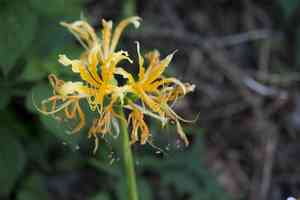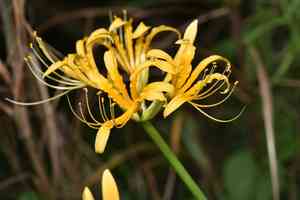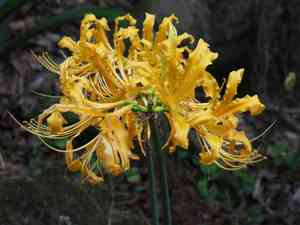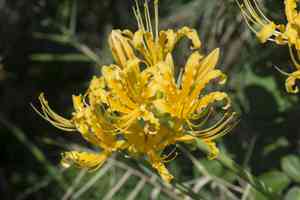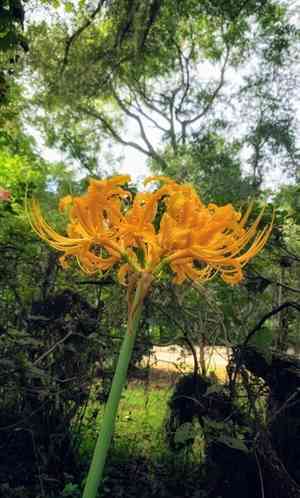
Golden spider-lily(Lycoris aurea)

Golden spider-lily (Lycoris aurea)

Also known as: Golden Spider Lily, Golden Magic Lily

The golden spider-lily, native to Japan and China, features vibrant yellow flowers that bloom from leafless stems, typically attracting butterflies. This plant usually flourishes in late summer or early fall, often giving the impression of emerging suddenly from the soil. It is commonly found in subtropical grasslands and at the edges of forests.

Attributes of Golden spider-lily

Lifespan
Perennial
Plant Type
Herb
Plant Height
45 cm to 60 cm
Spread
10 cm to 15 cm
Leaf Color
Green
Flower Size
20 cm
Flower Color
Yellow Gold

PlantJoy - Identify plants with a snap

Identify and diagnose plants, get toxicity alerts, and explore safety guides for all types of fungi.

Try for Free

Images of Golden spider-lily

Golden spider-lily(Lycoris aurea)

Quickly Identify Golden spider-lily

1
Vibrant yellow-orange flowers with spidery, upward-facing blooms in clusters.
2
Tall, smooth, green stems reaching up to 3 feet (90 cm) with no leaves.
3
Basal, strap-like leaves growing to 12-18 inches (30-45 cm) in length, glossy and green.
4
Capsule fruit transitioning from green to brownish, modest in size with textured surface.
5
Blooms in late summer with bursts of color, requiring arid rest phase for dormancy.

Scientific Classification of Golden spider-lily

Phylum
Vascular plants
Class
Monocotyledons
Order
Asparagus and allies
Family
Amaryllis
Genus
Spider Lilies
Species
Golden spider-lily

Planting and Growing of Golden spider-lily

Care Difficulty
Easy
Watering Schedule
Every 2 days
Sunlight Requirements
Full sun
Sunshine Duration
6-10 hours
Ideal Temperature
65-77℉
Soil Type
Potting Mix, Peat Mix
Soil pH
6.5-7.5
Fertilizer Type
Balanced
Pruning Season
Spring, Summer
Pruning Area
Branches, Leaves
Pruning Frequency
2 times a year
Repotting Season
Spring
Pot Type
Plastic, Ceramic

water icon How to Water Golden spider-lily?

For Lycoris aurea, water generously so the soil remains consistently damp, but not waterlogged. The plant thrives when its roots can access moisture, but they should not be submerged. A thorough soak ensures that the water reaches the deeper root structures, and about 500 ml should suffice for a typical pot. Adjust based on the pot size and drainage.
What are the symptoms of an underwatered Golden spider-lily?
What should I do if my Golden spider-lily is not getting enough water?
What are the symptoms of an overwatered Golden spider-lily?
How to save an overwatered Golden spider-lily?

sunlight icon What Are the Sunlight Requirements for Golden spider-lily?

Sunlight Requirements: Full sun, Partial sun
Duration of light: 4-6 hours minimum
The ideal light range for Lycoris aurea is full to partial sunlight. This range maximizes blooming potential and ensures robust, vibrant foliage, contributing significantly to the plant's longevity.
What is the ideal lighting condition?
How can I achieve ideal lighting?
What are the benefits of ideal lighting?

temperature icon What Is the Ideal Temperature Range for Golden spider-lily?

Ideal Temperature: 65 ~ 77℉
The ideal temperature range for growing Lycoris aurea is between 65°F to 77°F. This range provides the optimal conditions for growth and blooming, ensuring that the plant maintains its vibrant foliage and produces beautiful flowers. Maintaining this range helps minimize stress and maximizes photosynthesis efficiency.

soil icon What Soil is Best for Golden spider-lily?

Soil type: Loam, Sandy loam
Soil PH: 6.5 ~ 7.5
Lycoris aurea thrives in nutrient-rich soil, which provides essential nutrients for robust growth. This promotes vibrant flowers and lush foliage, enhancing the overall aesthetic appeal. This plant requires well-draining soil to prevent root rot. Good drainage ensures excess water doesn't accumulate, helping the roots stay healthy and support vigorous growth. Soil that retains moderate moisture is ideal. It supplies consistent hydration to the roots without becoming waterlogged, promoting healthy development throughout the growing season.

fertilize icon How to Fertilize Golden spider-lily?

Fertilizer type: Balanced
Lycoris aurea requires careful attention to fertilizer amounts as they are sensitive to both underfeeding and overfeeding. Use about half the recommended amount on the label for liquid fertilizers to avoid any nutrient burn. Slow-release fertilizers should be applied sparingly, roughly a teaspoon around the base of the plant each time.

prune icon How to Prune Golden spider-lily?

Pruning Time: Spring
Start your pruning task by ensuring you have a sharp pair of sterilized pruning shears. It's important to avoid tearing or damaging the tissues of the plant. Dress in gardening gloves to protect your hands from any irritation caused by plant sap. Begin by carefully examining the plant for any yellowed, dead, or damaged leaves. These are the prime candidates for removal, as they can harbor disease and sap energy from the plant that could be better used for new growth. Gently remove any leaves that appear to be weighing down the plant or causing congestion of light and air. Trimming these away can boost airflow and sunlight penetration, encouraging the healthy growth of foliage and flowers. Once you have removed the necessary leaves, clean up any fallen debris around the base of the plant. This reduces the chances of disease and gives the plant a fresh start for its growing season.

propagate icon How to Propagate Golden spider-lily plant?

Propagate Time: Late summer, Early autumn
1
Before division, water the Lycoris aurea well to ensure the bulbs are plump and hydrated. This step is vital as it makes the bulbs easier to handle and divides without causing too much stress to the plant.
2
Using a garden trowel, carefully dig around the bulbs to lift them from the soil. Avoid damaging the roots and ensure to lift the entire clump to identify which bulbs are suitable for division.
3
With a sharp knife, separate the bulbs by cutting through the offsets. Ensure each new section has a portion of the root system intact to support new growth, and allow the cuts to dry briefly before replanting.

repot icon How to Repot Golden spider-lily plant?

Repotting frequency: every 2-3 years
1
Repotting Lycoris aurea should be considered when the bulbs outgrow their container or when their growth slows down, indicating restricted roots. Ideally, repot during their dormancy period which occurs in spring or summer to minimize stress and maximize growth efficiency.
2
Select a pot that is 1-2 inches larger in diameter than the current one. This provides ample space for root expansion without overwhelming the plant, which could lead to waterlogging issues. Make sure the pot has adequate drainage holes to prevent root rot.
3
Opt for a well-draining, sandy loam to ensure proper aeration and moisture management, vital for Lycoris aurea. This composition supports robust root development by preventing water stagnation, which can lead to bulb rot, especially crucial in warm growing seasons.

PlantJoy - Identify plants with a snap

Find the best spots for them to optimize their health, simply using your phone.

Try for Free

Toxicity of Golden spider-lily

Is Golden spider-lily toxic to humans?

The Golden spider-lily is a popular garden plant featuring vibrant golden blossoms. Its roots possess low toxicity if ingested. The likelihood of intentional consumption is low as only the roots harbor the toxic alkaloid lycorine. Accidental ingestion is also improbable since the roots do not resemble any edible varieties. Symptoms of poisoning may include nausea, vomiting, diarrhea, abdominal discomfort, excessive salivation, and shivering; however, these effects are generally mild and not life-threatening.

Identify toxic plants for your safety

Learn which plants are harmful to you and your pets, and make informed choices for a safer home!

Try for Free
WARNING
The judgment on toxicity and danger is for reference only. We DO NOT GUARANTEE any accuracy of such judgment. Therefore, you SHALL NOT rely on such judgment. It is IMPORTANT TO SEEK PROFESSIONAL ADVICE in advance when necessary.