Japanese black pine(Pinus thunbergii)

Japanese black pine (Pinus thunbergii)

Also known as: Black pine

The Japanese Black Pine (Pinus thunbergii) is exceptionally tolerant of sand and salt spray, making it highly suitable for coastal landscaping. Interestingly, these trees tend to grow larger when planted inland compared to their coastal counterparts.

Attributes of Japanese black pine

Lifespan
Perennial
Plant Type
Tree
Plant Height
40 m
Spread
3.5 m to 6 m
Leaf Color
Green
Flower Size
2.5 cm to 8 cm
Flower Color
Yellow Orange Gold

PlantJoy - Identify plants with a snap

Identify and diagnose plants, get toxicity alerts, and explore safety guides for all types of fungi.

Try for Free

Images of Japanese black pine

Japanese black pine(Pinus thunbergii)

Quickly Identify Japanese black pine

1
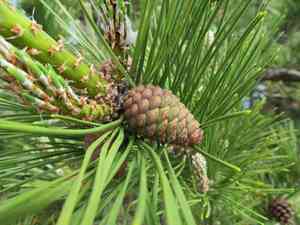
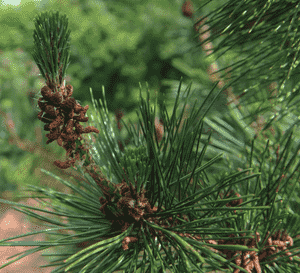
Needles twisted, dark green, 2.5 to 4.25 inches (6.35 to 10.8 cm) long, with stomata lines on all sides.
2
Black-gray, furrowed bark with deep longitudinal fissures and irregular scales, contributing to a rough texture.
3
Male flowers reddish-yellow, clustered at branch ends, 0.2 to 0.4 inches (5 to 10 mm) wide.
4
Egg-shaped, woody cones, shiny light brown, 1.6 to 2.8 inches (4 to 7 cm) long, often in pairs.
5
Flat-topped, asymmetrical crown lacking a dominant leader, with pendulous branches contributing to a distinctive outline.

Scientific Classification of Japanese black pine

Phylum
Vascular plants
Class
Conifers
Order
Pines and allies
Family
Pine
Genus
Pines
Species
Japanese black pine

Planting and Growing of Japanese black pine

Care Difficulty
Moderate
Watering Schedule
Every 2 days
Sunlight Requirements
Full sun
Sunshine Duration
4-8 hours
Ideal Temperature
50-77℉
Soil Type
Potting Mix, Peat Mix
Soil pH
5.5-7.5
Fertilizer Type
Balanced
Pruning Season
Spring, Summer
Pruning Area
Branches, Leaves
Pruning Frequency
2 times a year
Repotting Season
Spring
Pot Type
Plastic, Ceramic

water icon How to Water Japanese black pine?

For Pinus thunbergii, water deeply until the soil is moist but not waterlogged. Aim for about 750 ml per watering session, ensuring that the water reaches the roots without causing standing water. This helps maintain a balanced moisture level, allowing the roots to breathe and absorb nutrients effectively.
What are the symptoms of an underwatered Japanese black pine?
What should I do if my Japanese black pine is not getting enough water?
What are the symptoms of an overwatered Japanese black pine?
How to save an overwatered Japanese black pine?

sunlight icon What Are the Sunlight Requirements for Japanese black pine?

Sunlight Requirements: Full sun, Partial sun
Duration of light: 6-8 hours daily
Pinus thunbergii prefers full sun to partial sun, thriving best with 6-8 hours of sunlight daily. This range supports optimal growth, promoting dense foliage and strong root systems for overall health.
What is the ideal light condition for Pinus thunbergii?
How can you achieve ideal lighting conditions for Pinus thunbergii?
What benefits can be expected from ideal lighting for Pinus thunbergii?

temperature icon What Is the Ideal Temperature Range for Japanese black pine?

Ideal Temperature: 50 ~ 77℉
Pinus thunbergii thrives best in temperatures ranging from 50°F to 77°F. This temperature range allows for optimal growth and development by providing the necessary warmth while avoiding extreme heat or cold. Maintaining this ideal temperature range ensures that the plant's metabolic processes function efficiently, promoting robust health and vitality.

soil icon What Soil is Best for Japanese black pine?

Soil type: Sandy soil, Loam, Sandy loam
Soil PH: 5.5 ~ 7.5
Pinus thunbergii thrives in well-drained soil to prevent root rot. Ensuring adequate drainage allows roots to receive oxygen and prevents waterlogging, which can lead to plant stress and disease. This plant favors a soil pH between 5.5 and 7.5. This range is optimal for nutrient uptake and microorganism activity, supporting healthy growth and needle production. A sandy texture is preferred by Pinus thunbergii as it allows excess moisture to drain quickly while retaining enough humidity for nutrient absorption, thus maintaining a balanced growth environment.

fertilize icon How to Fertilize Japanese black pine?

Fertilizer type: Balanced
For Pinus thunbergii, use a balanced fertilizer like a 10-10-10 formula. Apply liquid fertilizer at half-strength to prevent overfeeding, especially for younger trees. Each application should be enough to moisten the soil without causing runoff.

prune icon How to Prune Japanese black pine?

Pruning Time: Spring, Summer, Autumn
Start by removing any dead or diseased branches using clean, sharp pruning shears. Look for branches that cross each other and remove the weaker one to prevent damage and allow better air circulation. Trim back long branches to maintain a balanced shape, cutting just above a bud to promote new growth. During late spring, observe the new growth called 'candles'. Pinch back these candles by up to two-thirds using your fingers. This encourages bushier growth and helps maintain a compact form. Avoid using clippers for this task to prevent damaging the needles.

propagate icon How to Propagate Japanese black pine plant?

Propagate Time: Spring, Early spring
1
Collect mature seeds from Pinus thunbergii cones during early spring. Gently extract the seeds and soak them in water for 24 hours to break dormancy and enhance germination rates.
2
Prepare a well-draining potting mix by combining equal parts of sand, peat moss, and perlite. This mixture ensures adequate aeration and moisture retention for seedling development.
3
Sow the seeds at a depth of one centimeter in prepared trays. Maintain consistent moisture by gently watering the surface, ensuring the soil remains moist but not waterlogged.

repot icon How to Repot Japanese black pine plant?

Repotting frequency: Every 3-4 years
1
Pinus thunbergii needs repotting when the roots start circling the pot or escaping through drainage holes. Early autumn or spring is ideal due to less stress on the plant. Repot before new growth starts for best results.
2
Select a pot with excellent drainage and slightly larger than the current one to accommodate growth. A wider pot base offers stability to support the tree's expanding roots and ensures proper anchoring.
3
Choose a soil that is loamy and well-draining, ideal for bonsai Pines. Incorporate perlite or pumice to improve drainage and sand for aeration. This encourages strong root growth and prevents waterlogging.

PlantJoy - Identify plants with a snap

Find the best spots for them to optimize their health, simply using your phone.

Try for Free

Toxicity of Japanese black pine

Is Japanese black pine toxic to humans?

Japanese black pine presents a mild toxicity risk to humans, primarily through allergic reactions that occur upon contact and the potential for toxicity if ingested. The toxic component of the Japanese black pine is its resin, which can lead to human poisoning. Upon skin contact, the resin may provoke allergic reactions, which can manifest as symptoms including skin irritation, redness, and itching. If the resin is inadvertently ingested, it may result in gastrointestinal distress, characterized by symptoms such as nausea, vomiting, and diarrhea. These manifestations illustrate the mild toxicity level associated with Japanese black pine; while not typically fatal, they can indeed cause considerable discomfort. It is crucial for individuals to avoid inadvertently swallowing the resin and to handle Japanese black pine cautiously to avert allergic reactions.

Identify toxic plants for your safety

Learn which plants are harmful to you and your pets, and make informed choices for a safer home!

Try for Free
WARNING
The judgment on toxicity and danger is for reference only. We DO NOT GUARANTEE any accuracy of such judgment. Therefore, you SHALL NOT rely on such judgment. It is IMPORTANT TO SEEK PROFESSIONAL ADVICE in advance when necessary.