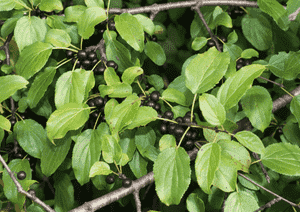
Common buckthorn(Rhamnus cathartica)

Common buckthorn (Rhamnus cathartica)

Also known as: Purging buckthorn

Rhamnus cathartica, commonly called common buckthorn, is a rapidly growing deciduous shrub or small tree originating from Europe. All parts of this plant are mildly toxic to both humans and most animals. In various regions of North America, common buckthorn is regarded as an invasive species.

Attributes of Common buckthorn

Lifespan
Perennial
Plant Type
Shrub
Plant Height
1 m to 10 m
Spread
4.5 m to 6 m
Leaf Color
Green Yellow
Flower Size
2.5 cm
Flower Color
Yellow Green

PlantJoy - Identify plants with a snap

Identify and diagnose plants, get toxicity alerts, and explore safety guides for all types of fungi.

Try for Free

Images of Common buckthorn

Common buckthorn(Rhamnus cathartica)

Quickly Identify Common buckthorn

1
Elliptical leaves with serrated margins and prominent veins
2
Yellowish green flowers with clusters and distinct male/female characteristics
3
Glossy black drupes, 1/4 to 1/2 inch (6-13 mm) in diameter with 2-4 seeds
4
Crooked stem with thorny texture, brown color, and irregular branching pattern
5
Dark brown to gray bark with peeling texture, revealing vibrant orange inner layer

Scientific Classification of Common buckthorn

Phylum
Vascular plants
Class
Dicotyledons
Order
Rosales
Family
Buckthorn
Genus
Buckthorns
Species
Common buckthorn

Planting and Growing of Common buckthorn

Care Difficulty
Easy
Watering Schedule
Every 2 days
Sunlight Requirements
Full sun
Sunshine Duration
4-8 hours
Ideal Temperature
59-77℉
Soil Type
Potting Mix, Peat Mix
Soil pH
6-8
Fertilizer Type
Balanced
Pruning Season
Spring, Summer
Pruning Area
Branches, Leaves
Pruning Frequency
2 times a year
Repotting Season
Spring
Pot Type
Plastic, Terracotta

water icon How to Water Common buckthorn?

Rhamnus cathartica prefers deeply saturated soil; thus, each watering should aim for approximately 500 ml, sufficient to moisten the soil to a depth of 15-20 cm. Ensure water reaches the root zone without leaving the roots waterlogged.
What are the symptoms of an underwatered Common buckthorn?
What should I do if my Common buckthorn is not getting enough water?
What are the symptoms of an overwatered Common buckthorn?
How to save an overwatered Common buckthorn?
More About Watering Techniques

sunlight icon What Are the Sunlight Requirements for Common buckthorn?

Sunlight Requirements: Full sun, Partial sun
Duration of light: 6 to 8 hours daily
Ideal light exposure for Rhamnus cathartica ranges between full sun to partial sun, allowing 6 to 8 hours of sunlight daily. This range fosters optimal growth, enhancing leaf coloration and robust development while preventing sunburn and insufficient growth issues.
Best Time for Sunlight
Positioning for Maximum Light
Seasonal Adjustments
More About Sunlight Requirements Techniques

temperature icon What Is the Ideal Temperature Range for Common buckthorn?

Ideal Temperature: 59 ~ 77℉
Rhamnus cathartica thrives best in an environment where temperatures range between 59°F and 77°F. This range provides optimal conditions for photosynthesis, nutrient uptake, and overall growth. Temperatures within this span ensure the plant remains hardy and less susceptible to diseases.

soil icon What Soil is Best for Common buckthorn?

Soil type: Loam, Sandy loam, Acidic soil, Calcareous soil
Soil PH: 6 ~ 8
Rhamnus cathartica thrives in well-drained soil that prevents waterlogging. This helps the plant's root system to develop properly and avoid root rot, ensuring healthier growth. Rich, loamy soil provides vital nutrients for Rhamnus cathartica, promoting vigorous growth and abundant foliage. Applying organic matter like compost can enhance soil fertility and plant vitality. Rhamnus cathartica can adapt to varying pH levels, from slightly acidic to slightly alkaline. This flexibility helps it to grow in diverse environments, providing an advantage in nutrient uptake. More About Soil

fertilize icon How to Fertilize Common buckthorn?

Fertilizer type: Balanced
For Rhamnus cathartica, an appropriate volume of fertilizer can significantly contribute to its robust growth. When using a balanced liquid fertilizer, a concentration of 1 tablespoon per gallon of water is suitable. This should be sufficient to nourish the plant without overwhelming it. Ensure to apply evenly throughout the root zone, and avoid applying directly onto the leaves. More About Fertilizing Techniques

prune icon How to Prune Common buckthorn?

Pruning Time: Spring, Autumn
Begin by removing any dead, dying, or diseased branches. Carefully cut these back to healthy wood to prevent any disease from spreading further. Cut back overcrowded branches to improve air circulation and light penetration. This helps in reducing disease pressure and promotes a more vigorous plant overall. Prune to shape the plant aesthetically, maintaining its natural form. Remove any branches that grow in awkward directions or cross over each other. If the plant is becoming overgrown, selectively prune back the branch tips to manage its size, ensuring it does not overshadow neighboring plants. More About Pruning Techniques

propagate icon How to Propagate Common buckthorn plant?

Propagate Time: Spring, Early summer
1
Harvest seeds from mature Rhamnus cathartica berries in autumn when the fruit is ripe. Clean and dry the seeds properly before storage to prevent mold growth and ensure viability.
2
Place seeds in a moist sand or peat mix and store them in a refrigerator for 90-120 days. This stratification process mimics natural winter conditions, breaking seed dormancy for better germination rates.
3
Select healthy, non-flowering stems and make a clean diagonal cut just below a node. Remove lower leaves, and dip the cut end in rooting hormone to stimulate root development before planting in a suitable growing medium.
More About Propagating Techniques

repot icon How to Repot Common buckthorn plant?

Repotting frequency: Every 2-3 years
1
Rhamnus cathartica should be repotted when you notice roots emerging from the drainage holes or the plant seems cramped. Early spring or summer is ideal, as it aligns with their growth phase.
2
Choose a pot that's 2 inches larger than the current one to allow root expansion. Opt for clay pots as they offer superior drainage, helping prevent waterlogging and root rot, ensuring your plant thrives.
3
Select a well-drained loamy soil that maintains moisture without becoming soggy. This soil mix mimics the plant's natural habitat and promotes healthy root growth, reducing stress after repotting.

PlantJoy - Identify plants with a snap

Find the best spots for them to optimize their health, simply using your phone.

Try for Free

Toxicity of Common buckthorn

Is Common buckthorn toxic to humans?

The fruits and foliage of the common buckthorn are known to harbor toxic glycosides that exert a range of unpleasant effects on humans. Consumption of a significant quantity of buckthorn berries or leaves can lead to severe gastrointestinal reactions, including nausea, excessive salivation, vomiting, colic, and diarrhea. Furthermore, these glycosides have been shown to induce progressive liver damage over time, commencing with inflammation and jaundice, and potentially culminating in necrosis or even fatality. It is essential to keep young children away from this tree, while ensuring that older children are aware of the poisonous nature of the fruits.

Is Common buckthorn toxic to cat?

Common buckthorn presents a low toxicity threat to cats, particularly when its berries or foliage are eaten in considerable amounts. Although the specific toxic compounds remain unidentified, pet owners must remain alert, as consumption may result in symptoms of discomfort or illness. It is essential for cat guardians to observe their pets for any abnormal behaviors or signs of distress following the ingestion of common buckthorn and to promptly consult a veterinary professional. Acting swiftly is vital to mitigate any toxic effects and to secure a favorable result for the animal.

Is Common buckthorn toxic to dog?

Common buckthorn presents a mild toxicity risk for dogs. While small amounts occasionally consumed may not lead to significant harm, ingesting larger quantities can result in poisoning. The fruits and leaves of this plant are particularly hazardous if eaten by dogs. Symptoms of poisoning can vary but may include vomiting, diarrhea, abdominal discomfort, and lethargy. It is essential for dog owners to observe their pets and prevent them from consuming large portions of common buckthorn. Should a dog ingest a considerable amount of common buckthorn, it is crucial to seek prompt veterinary assistance to safeguard the animal's health and well-being.

Identify toxic plants for your safety

Learn which plants are harmful to you and your pets, and make informed choices for a safer home!

Try for Free
WARNING
The judgment on toxicity and danger is for reference only. We DO NOT GUARANTEE any accuracy of such judgment. Therefore, you SHALL NOT rely on such judgment. It is IMPORTANT TO SEEK PROFESSIONAL ADVICE in advance when necessary.
More About Toxic Techniques

