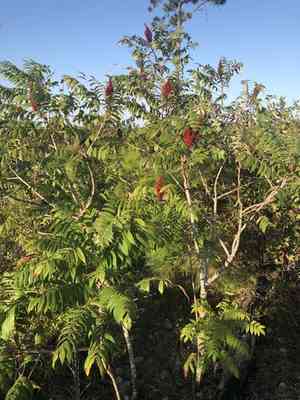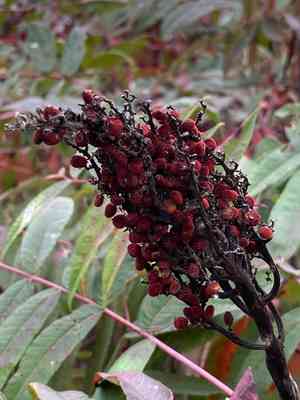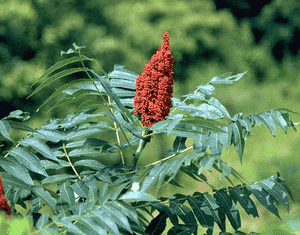
Smooth sumac(Rhus glabra)

Smooth sumac (Rhus glabra)

Also known as: Upland sumac, Vinegar-tree

Smooth sumac (Rhus glabra) is a distinctive shrub that displays vibrant red foliage in the autumn. This plant is known to attract wildlife such as deer, opossums, and a variety of birds. Its leaves and wood are suitable for making black ink. Smooth sumac is dioecious, with only female plants bearing berries.

Attributes of Smooth sumac

Lifespan
Perennial
Plant Type
Tree, Shrub
Plant Height
3 m to 5 m
Spread
2.5 m to 4.5 m
Leaf Color
Green
Flower Size
2.5 cm
Flower Color
Green Yellow White

PlantJoy - Identify plants with a snap

Identify and diagnose plants, get toxicity alerts, and explore safety guides for all types of fungi.

Try for Free

Images of Smooth sumac

Smooth sumac(Rhus glabra)

Quickly Identify Smooth sumac

1
Compound leaves with red fall color, 16-24 inches (40-60 cm) long, composed of 11-31 leaflets.
2
Hairless stem with whitish waxy coating, 0.5-1 inch (1.3-2.5 cm) thick, branching extensively.
3
Dioecious plant with separate male and female flowers; female plants bear vivid red, 1/4 inch (0.6 cm) flowers.
4
Small red berries in dense clusters, only on female plants, 1/4 inch (6.35 mm) in diameter.
5
Distinct bark: young smooth trunk, older warty texture; major branches with slight ridges, brownish-gray to reddish-brown.

Scientific Classification of Smooth sumac

Phylum
Vascular plants
Class
Dicotyledons
Order
Sapindales
Family
Cashew
Genus
Sumacs
Species
Smooth sumac

Planting and Growing of Smooth sumac

Care Difficulty
Easy
Watering Schedule
Every 4 days
Sunlight Requirements
Full sun
Sunshine Duration
6-10 hours
Ideal Temperature
50-80℉
Soil Type
Potting Mix, Peat Mix
Soil pH
5.5-7.5
Fertilizer Type
Balanced
Pruning Season
Spring, Summer
Pruning Area
Branches, Leaves
Pruning Frequency
2 times a year
Repotting Season
Spring
Pot Type
Plastic, Ceramic

water icon How to Water Smooth sumac?

Rhus glabra, also known as smooth sumac, generally prefers dry to moderately moist conditions. The key principle for watering is to simulate its natural habitat, where occasional rainfall saturates the soil. Ideally, you should water this plant until the soil is moist to a depth of about 6 inches. Avoid letting the root zone stand in water, as too much moisture can be detrimental.
What are the symptoms of an underwatered Smooth sumac?
What should I do if my Smooth sumac is not getting enough water?
What are the symptoms of an overwatered Smooth sumac?
How to save an overwatered Smooth sumac?

sunlight icon What Are the Sunlight Requirements for Smooth sumac?

Sunlight Requirements: Full sun, Partial sun
Duration of light: 6 to 8 hours
Rhus glabra prefers a light range of full to partial sun. Ideal light conditions enable vigorous growth and enhance the plant's aesthetic appeal with bright leaves and flowers.
What is the best light condition for Rhus glabra?
How can ideal lighting conditions be ensured for Rhus glabra?
What benefits does Rhus glabra gain from ideal light conditions?
More About Sunlight Requirements Techniques

temperature icon What Is the Ideal Temperature Range for Smooth sumac?

Ideal Temperature: 50 ~ 80℉
Rhus glabra thrives best in temperatures ranging from 50°F to 80°F. This range facilitates optimal growth and provides conditions where the plant can maintain its natural metabolic activities without stress. Staying within this range helps ensure vibrant foliage and healthy development.

soil icon What Soil is Best for Smooth sumac?

Soil type: Sandy loam, Loam, Sandy soil
Soil PH: 5.5 ~ 7.5
Rhus glabra thrives in well-drained soils that prevent waterlogging, a condition that can lead to root rot. Ensuring proper drainage enhances root health and supports vigorous growth. This plant prefers soils with moderate fertility, which provide essential nutrients without overwhelming the roots. Balanced nutrient levels keep the plant robust and maintain its natural resilience. Rhus glabra flourishes in soils that receive ample sunlight, as this light exposure facilitates photosynthesis and supports overall plant health, resulting in vibrant foliage.

fertilize icon How to Fertilize Smooth sumac?

Fertilizer type: Balanced
Rhus glabra, commonly known as smooth sumac, requires moderate feeding. You should use a balanced, general-purpose fertilizer. For liquid fertilizers, a concentration of half the recommended label rate is suitable to prevent over-fertilization.

prune icon How to Prune Smooth sumac?

Pruning Time: Spring, Summer
Take care to properly dispose of any pruned materials, particularly if there are signs of pests or disease, to prevent spreading. Never compost infected limbs. Additionally, be mindful of the surrounding plant life; avoid damage to nearby plants or root systems during the pruning process. Take care to not remove more than one-third of the plant in a single pruning session. Over-pruning can stress the plant, leading to diminished growth and increased vulnerability to environmental stressors. Maintain a balance to promote healthy recovery and continuous growth. More About Pruning Techniques

propagate icon How to Propagate Smooth sumac plant?

Propagate Time: Spring, Early Spring, Late Spring
1
Collect viable seeds from mature Rhus glabra plants. Clean and dry them to avoid mold. Scarify or stratify the seeds to break dormancy and enhance germination.
2
Select healthy stems and cut sections roughly 6 inches long. Remove leaves from the lower halves and dip them into rooting hormone to encourage root growth.
3
Carefully dig up mature plants and divide their root systems into sections. Ensure each division has sufficient roots and shoot system for successful transplantation.
More About Propagating Techniques

repot icon How to Repot Smooth sumac plant?

Repotting frequency: Every 2-3 years
1
Rhus glabra, commonly known as Smooth Sumac, signals the need for repotting when its roots are circling the pot's perimeter or protruding through drainage holes. This typically indicates root-bound conditions. Spring and Autumn are ideal, as the plant experiences reduced stress during these mild periods.
2
Select a pot that is one to two sizes larger than the current pot. Ensure it has sufficient drainage holes to prevent waterlogging. The increased size allows room for root expansion, promoting healthier growth and reducing the need for frequent repotting.
3
Opt for a well-draining, sandy loam soil that mimics the plant's natural habitat. This type of soil prevents root rot by allowing excess water to escape quickly, thus creating an environment conducive to healthy root development.

PlantJoy - Identify plants with a snap

Find the best spots for them to optimize their health, simply using your phone.

Try for Free

Toxicity of Smooth sumac

Is Smooth sumac toxic to humans?

In contrast to various other members of the sumac family, such as poison ivy, poison oak, and several other types of sumac, the smooth sumac is generally not harmful to the majority of individuals. However, this particular species can provoke allergic responses in those who have cashew allergies, as cashews also belong to the sumac family. The severity of these reactions will vary depending on the individual's allergic sensitivity, with potential symptoms including itchy skin, swelling in the throat, and difficulty in breathing. For everyone else, the smooth sumac poses no threat.

Identify toxic plants for your safety

Learn which plants are harmful to you and your pets, and make informed choices for a safer home!

Try for Free
WARNING
The judgment on toxicity and danger is for reference only. We DO NOT GUARANTEE any accuracy of such judgment. Therefore, you SHALL NOT rely on such judgment. It is IMPORTANT TO SEEK PROFESSIONAL ADVICE in advance when necessary.
More About Toxic Techniques