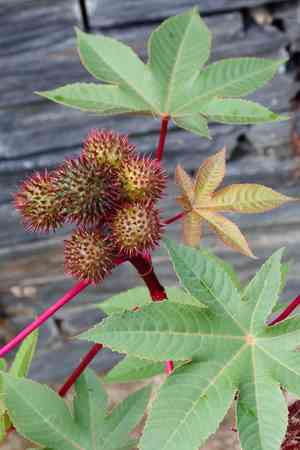
Castor bean(Ricinus communis)

Castor bean (Ricinus communis)

Also known as: Maple weed, Palm of christ

The castor bean is valued for its oil, which finds use in lubricants, biodiesel, and as a rodent repellent, among other applications. While castor plants are commercially cultivated worldwide, India is the leading producer, accounting for approximately 85-90% of global castor oil production. It's important to note that castor beans are inedible due to the presence of a potent toxin that is released when the seeds are broken.

Attributes of Castor bean

Lifespan
Annual, Perennial, Biennial
Plant Type
Herb
Plant Height
5 m to 12 m
Spread
1.2 m to 2.5 m
Leaf Color
Green Red Purple
Flower Size
1 cm to 1.5 cm
Flower Color
Yellow Red White

PlantJoy - Identify plants with a snap

Identify and diagnose plants, get toxicity alerts, and explore safety guides for all types of fungi.

Try for Free

Images of Castor bean

Castor bean(Ricinus communis)

Quickly Identify Castor bean

1
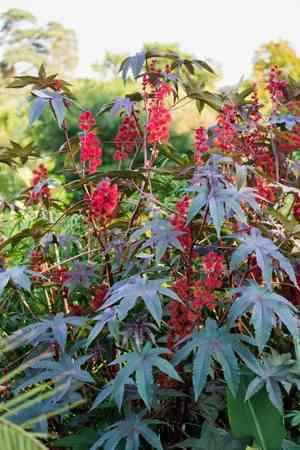
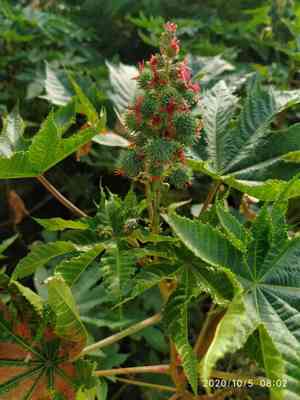
Star-shaped glossy leaves with 5-11 lobes and serrated edges, 6-30 inches (15-76 cm) wide.
2
Stems in vibrant red, green, or purple hues, reaching 1 inch (2.5 cm) in diameter.
3
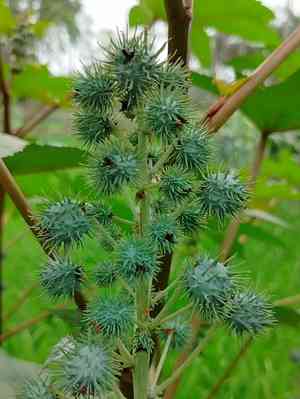
Fruit as spiny capsules, 0.5-1 inch (1.3-2.5 cm) in diameter, with mottled smooth seeds.
4
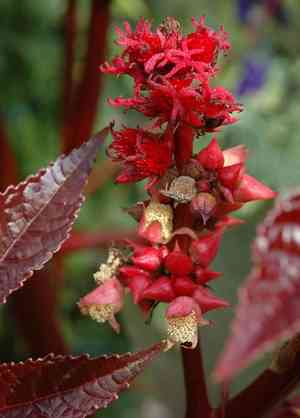
Yellowish-green non-petaled flowers in clusters on 18-inch (46 cm) spikes, blooming from August to November.
5
Distinct trunk variations with semi-woody structure or herbaceous growth, reaching up to 1 foot (30 cm) in diameter.

Scientific Classification of Castor bean

Phylum
Vascular plants
Class
Dicotyledons
Order
Nances, spurges, willows and allies
Family
Spurge
Genus
Castor Bean
Species
Castor bean

Planting and Growing of Castor bean

Care Difficulty
Hard
Watering Schedule
Every 2 days
Sunlight Requirements
Full sun
Sunshine Duration
4-8 hours
Ideal Temperature
68-77℉
Soil Type
Potting Mix, Peat Mix
Soil pH
5-8.5
Fertilizer Type
Balanced
Pruning Season
Spring, Summer
Pruning Area
Branches, Leaves
Pruning Frequency
2 times a year
Repotting Season
Spring
Pot Type
Plastic, Ceramic

water icon How to Water Castor bean?

For Ricinus communis, watering should be deep enough to allow water to reach the root zone thoroughly, ideally about 500 ml per plant. The soil should feel consistently moist but never waterlogged, allowing the roots to breathe and absorb nutrients optimally.
What are the symptoms of an underwatered Castor bean?
What should I do if my Castor bean is not getting enough water?
What are the symptoms of an overwatered Castor bean?
How to save an overwatered Castor bean?

sunlight icon What Are the Sunlight Requirements for Castor bean?

Sunlight Requirements: Full sun, Partial sun
Duration of light: 6 to 8 hours
In its ideal environment, Ricinus communis benefits from full sun to partial sun exposure. Optimal lighting supports robust growth, ensuring that the plant maintains its vigor, produces vibrant foliage, and aids in the production of its characteristic seeds.
What is the best sunlight exposure for Ricinus communis?
How can you achieve ideal lighting for Ricinus communis if indoors?
What are the benefits of optimal lighting for Ricinus communis?

temperature icon What Is the Ideal Temperature Range for Castor bean?

Ideal Temperature: 68 ~ 77℉
The ideal temperature range for Ricinus communis, commonly known as the castor bean plant, is between 68°F and 77°F. This temperature range provides the optimal conditions for growth, flowering, and seed production, as Ricinus communis thrives in warm climates.

soil icon What Soil is Best for Castor bean?

Soil type: Sandy loam, Loam
Soil PH: 5 ~ 8.5
Ricinus communis thrives in soils with excellent drainage. Good drainage prevents waterlogging, which can lead to root rot, thus ensuring healthy growth and vibrant foliage. The plant benefits from nutrient-rich soil, providing essential minerals and organic matter that support robust growth and aid in producing its distinctive castor oil seeds. While good drainage is crucial, the soil should also retain moderate moisture to sustain the plant's growth without causing desiccation, particularly during dry spells.

fertilize icon How to Fertilize Castor bean?

Fertilizer type: Balanced
For Ricinus communis, use a balanced fertilizer, such as a 10-10-10 NPK formula. When applying liquid fertilizer, mix at a rate of 1 tablespoon per gallon of water. For slow-release granules, distribute 1-2 pounds per 100 square feet.

prune icon How to Prune Castor bean?

Pruning Time: Spring, Summer
The sap and seeds of Ricinus communis are toxic, so it’s important to wear gloves and a long-sleeved shirt during pruning. Avoid touching your face and wash your tools and hands after finishing the pruning. Prune during the early morning or late afternoon to avoid the midday sun, which can stress the plant further. Additionally, pruning when the plant is not flowering can help focus its energy on growth.

propagate icon How to Propagate Castor bean plant?

Propagate Time: Early spring, Spring
1
Ricinus communis seeds have a hard outer shell that can impede germination. To improve germination rates, gently scarify the seeds by nicking or sanding the outer layer. This process helps water penetrate the seed coat more easily, initiating the germination process.
2
After scarification, sow the seeds in the seed starting tray filled with potting mix. Place the seeds about 1 inch deep and cover them lightly with soil. Maintain a temperature of around 70 to 75 degrees Fahrenheit (21 to 24 degrees Celsius) for optimal seed germination.
3
Cover the seed starting tray with a plastic dome or clear plastic wrap to maintain high humidity, which helps in the germination process. Ensure that the potting mix remains consistently moist but not waterlogged, as excess moisture can cause seeds to rot.

repot icon How to Repot Castor bean plant?

Repotting frequency: Every 1-2 years
1
Ricinus communis should be repotted when roots outgrow the pot or the plant starts to droop despite regular watering. These are signs that the plant has outgrown its current living conditions and needs more room to expand.
2
A suitable pot should be about 2-3 inches larger in diameter than the current one. It must have drainage holes to prevent waterlogging. This ensures that excess water drains away efficiently, preventing root rot and promoting healthy growth.
3
Select a well-draining loamy soil mix, enriched with organic matter. This choice provides adequate aeration and retains the necessary nutrients and moisture without compacting, ensuring optimal growth conditions for Ricinus communis.

PlantJoy - Identify plants with a snap

Find the best spots for them to optimize their health, simply using your phone.

Try for Free

Toxicity of Castor bean

Is Castor bean toxic to humans?

The castor bean holds the grim title of the most toxic plant to humans globally, where consuming even a single bean can lead to death within mere minutes. This is attributed to the plant's significant concentration of the carbohydrate-binding protein known as ricin. Ricin presents a poisoning risk through various routes: inhalation, ingestion, or injection. Fortunately, fatalities linked to the castor bean plant are relatively rare, with the majority stemming from the consumption of its berries. Such ingestion can provoke severe symptoms like vomiting and diarrhea, as well as intense dehydration and low blood pressure. Furthermore, if ricin—often a byproduct of processing castor oil—comes into contact with skin or eyes, it can result in irritation and discomfort. Inhalation of ricin can lead to a range of serious symptoms, including fever, coughing, nausea, breathing difficulties, chest tightness, profuse sweating, fluid accumulation in the lungs, reduced blood pressure, and potential respiratory failure.

Is Castor bean toxic to cat?

Every component of the castor bean (Ricinus communis) plant poses a significant toxicity risk to both cats and dogs, with the seeds being the most hazardous portion. The onset of symptoms may be delayed for as long as two days following ingestion. Commonly observed reactions include extreme weakness and vomiting, and without prompt treatment, fatality can result. Immediate veterinary intervention is essential.

Is Castor bean toxic to dog?

The castor bean plant harbors a highly lethal toxin; if you observe your pet nibbling on this plant, seek veterinary care immediately. While all parts of the plant are toxic, the seeds contain the most concentrated levels of poison. Symptoms may manifest between 6 to 42 hours post-ingestion and can include bloody diarrhea, vomiting, excessive salivation, tremors, and even collapse.

Identify toxic plants for your safety

Learn which plants are harmful to you and your pets, and make informed choices for a safer home!

Try for Free
WARNING
The judgment on toxicity and danger is for reference only. We DO NOT GUARANTEE any accuracy of such judgment. Therefore, you SHALL NOT rely on such judgment. It is IMPORTANT TO SEEK PROFESSIONAL ADVICE in advance when necessary.
More About Toxic Techniques