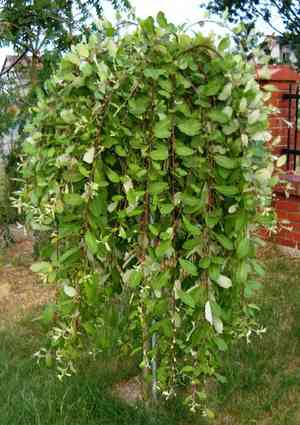
Goat willow (Salix caprea)
Also known as: Goat willow, Pussy willow
Goat Willow (Salix caprea), commonly known as pussy willow, is a small deciduous tree or large shrub originating from Europe and parts of western and central Asia. Its wood is fragile, making it unsuitable for timber. The name "caprea" translates to "goat." This species is also prone to diseases caused by insects and microbes.
In This Article
Attributes of Goat willow
Lifespan
Perennial
Plant Type
Shrub
Plant Height
8 m to 13 m
Spread
8 m
Leaf Color
Green
Flower Size
8 mm to 1.6 cm
Flower Color
Green Yellow Silver Pink
Images of Goat willow

Quickly Identify Goat willow
1
Oval to round leaves with soft texture, dark green color, 2-4 inches (5-10 cm) long.
2
Showy male catkins in early spring, 1-2 inches (2.5-5 cm) long, densely packed with yellow stamens.
3
Prominent catkins are silver or yellow depending on the gender, appearing before leaves.
4
Upper leaf surface glossy and smooth, lower surface gray and pubescent.
5
Fine serrated leaf edges, visible veins, oval shape with pointed tip and rounded base.
Scientific Classification of Goat willow
Phylum
Vascular plants
Class
Dicotyledons
Order
Malpighiales
Family
Willow
Genus
Willows
Species
Goat willow
Planting and Growing of Goat willow
Care Difficulty
Easy
Watering Schedule
Every 4 days
Sunlight Requirements
Full sun
Sunshine Duration
4-8 hours
Ideal Temperature
59-77℉
Soil Type
Potting Mix, Peat Mix
Soil pH
6.5-7.5
Fertilizer Type
Balanced
Pruning Season
Spring, Summer
Pruning Area
Branches, Leaves
Pruning Frequency
2 times a year
Repotting Season
Spring
Pot Type
Plastic, Ceramic
 How to Water Goat willow?
For Salix caprea, also known as the Goat Willow, it's essential to maintain the soil consistently moist. When watering, aim for about 500 ml per session. This ensures the roots receive adequate hydration but avoid waterlogging.
More About Watering Techniques→
What are the symptoms of an underwatered Goat willow?
›
What should I do if my Goat willow is not getting enough water?
›
What are the symptoms of an overwatered Goat willow?
›
How to save an overwatered Goat willow?
›
 What Are the Sunlight Requirements for Goat willow?
Ideal light conditions for Salix caprea range from full sun to partial sun, translating to six to eight hours of daily light. Proper light significantly contributes to photosynthetic efficiency, aiding vigorous growth and beautiful flowering.
More About Sunlight Requirements Techniques→
Optimal Lighting for Salix caprea
›
Achieving Ideal Light with Positioning
›
Benefits of Proper Lighting Conditions
›
 What Is the Ideal Temperature Range for Goat willow?
For Salix caprea, the ideal temperature range for optimal growth is between 59°F and 77°F. Within this range, the plant can efficiently carry out essential physiological processes such as photosynthesis and nutrient absorption. Providing a stable temperature within this range promotes robust growth and vibrant foliage.
 What Soil is Best for Goat willow?
Salix caprea thrives in well-draining soil, which prevents waterlogging that can cause root rot. This ensures that the roots get the necessary oxygen, promoting healthier growth and development of the plant. Although it prefers well-draining soil, maintaining some moisture is crucial. This helps the plant remain hydrated, which is especially important during dry spells, ensuring continuous growth and vitality. Soil rich in organic matter is ideal for Salix caprea as it provides essential nutrients that promote vigorous growth, enhance foliage color, and support the overall health of the plant.
More About Soil→
 How to Fertilize Goat willow?
For Salix caprea, a balanced approach is necessary. When using liquid fertilizer, a dilution ratio of 1:2 (fertilizer to water) is ideal. For slow-release fertilizers, apply about 2 to 4 tablespoons per plant, depending on its size and age, to ensure nutrient sufficiency without overwhelming the plant.
More About Fertilizing Techniques→
 How to Prune Goat willow?
The first step in pruning Salix caprea is to look for deadwood and diseased branches. These parts can be identified by their dark, brittle appearance and should be removed to improve the plant's health. Use clean and sharp pruning shears to make clean cuts, which also help prevent the spread of disease. Salix caprea can become quite bushy when it's left unchecked. Thin out overcrowded areas by removing some of the older branches. This will ensure that sunlight and air can penetrate through the entire plant, promoting better overall health. Aim to keep the central area less congested.
More About Pruning Techniques→
 How to Propagate Goat willow plant?
1
Choose a healthy and mature Salix caprea plant for propagation. The plant should be disease-free with vigorous growth, as this increases the chances of successful propagation.
2
A well-draining soil mix combined with sand or perlite works best for propagation. Sterilized soil helps avoid infections that can hinder root development.
3
Insert the cuttings or place the seeds into the prepared medium. For cuttings, cover at least a couple of inches of the stem while ensuring it's upright and stable.
 How to Repot Goat willow plant?
1
Observe Salix caprea for signals such as roots growing out of the drainage holes, slowed growth, or compacted soil. These signs indicate the plant needs more space and fresh nutrients, making spring or autumn ideal times for repotting.
2
Select a pot about 2-3 inches larger in diameter than the current one. Ensure it has adequate drainage holes to prevent waterlogging, which helps maintain healthy roots by allowing excess water to escape.
3
Opt for a loamy, well-draining soil rich in organic matter. This type of soil retains moisture while allowing excess water to drain, ensuring roots are not suffocated and receive necessary nutrients and oxygen.



