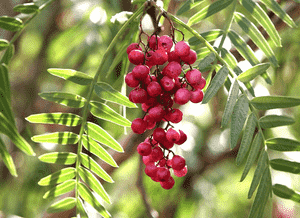
Peruvian peppertree (Schinus molle)
Also known as: Pink peppercorn, Escobilla
The **Peruvian peppertree (Schinus molle)** is indigenous to the Andes Mountains in South America. This tree is utilized for its culinary and herbal benefits and was historically employed as a textile dye. Although the peppercorns are safe to eat, the rest of the plant is toxic to both livestock and children.
In This Article
Attributes of Peruvian peppertree
Lifespan
Perennial
Plant Type
Tree
Plant Height
15 m
Spread
15 m
Leaf Color
Green
Flower Size
2.5 cm
Flower Color
White Yellow
Images of Peruvian peppertree
Quickly Identify Peruvian peppertree
1
Wide, weeping tree habit reaching 25-40 feet (7.6-12.2 meters) tall.
2
Pinnately compound leaves with numerous 1-2 inch (2.54-5.08 cm) leaflets.
3
Fragrant whitish-yellow flowers in pendulous panicles during summer.
4
Rough, twisted dark gray bark distinguishable even at a distance.
5
Produces 1/3 inch (0.85 cm) wide red berries in fall to winter.
Scientific Classification of Peruvian peppertree
Phylum
Vascular plants
Class
Dicotyledons
Order
Sapindales
Family
Cashew
Genus
Schinus
Species
Peruvian peppertree
Planting and Growing of Peruvian peppertree
Care Difficulty
Easy
Watering Schedule
Every 2 days
Sunlight Requirements
Full sun
Sunshine Duration
4-8 hours
Ideal Temperature
68-86℉
Soil Type
Potting Mix, Peat Mix
Soil pH
6.5-7.5
Fertilizer Type
Balanced
Pruning Season
Spring, Summer
Pruning Area
Branches, Leaves
Pruning Frequency
2 times a year
Repotting Season
Spring
Pot Type
Terracotta, Plastic
 How to Water Peruvian peppertree?
Schinus molle, commonly known as the Peruvian pepper tree, benefits from a generous soaking once or twice a month. Each watering should provide around 1000 milliliters of water. This ensures that the root system receives enough moisture to penetrate deeply, encouraging strong and healthy growth. The soil should be moist but not waterlogged, and it should be allowed to dry out slightly between waterings to mimic its natural, arid environment.
More About Watering Techniques→
What are the symptoms of an underwatered Peruvian peppertree?
›
What should I do if my Peruvian peppertree is not getting enough water?
›
What are the symptoms of an overwatered Peruvian peppertree?
›
How to save an overwatered Peruvian peppertree?
›
 What Are the Sunlight Requirements for Peruvian peppertree?
Schinus molle thrives best in full to partial sun, where it can revel in 6 to 8 hours of light. This optimal range supports vigorous growth, vibrant foliage, and the development of aromatic oils that enhance its natural scent.
More About Sunlight Requirements Techniques→
How much direct sunlight does Schinus molle need?
›
What solutions ensure Schinus molle gets ideal lighting?
›
What benefits does ideal lighting offer Schinus molle?
›
 What Is the Ideal Temperature Range for Peruvian peppertree?
Schinus molle thrives best in a warm, temperate environment where temperatures range between 68°F and 86°F. This range allows the tree to undergo optimal physiological activities, such as respiration and photosynthesis, thus promoting healthy growth and vitality. Ensuring a consistent temperature within this range helps the plant maintain its biological processes efficiently, leading to increased foliage and resistance to pests and diseases.
 What Soil is Best for Peruvian peppertree?
Schinus molle thrives in well-drained soils as waterlogged conditions can lead to root rot. This characteristic ensures proper root aeration and avoids diseases, promoting healthy growth. Although not particularly nutrient-demanding, Schinus molle benefits from a soil enriched with organic matter. This boosts its growth by providing essential nutrients without the risk of over-fertilization. Schinus molle can tolerate low fertility conditions, which makes it suitable for less cultivated soils. This resilience means it can adapt to various environments with minimal human intervention.
More About Soil→
 How to Fertilize Peruvian peppertree?
When fertilizing Schinus molle, it is essential to use a balanced fertilizer. A good rule of thumb is to apply around half a pound of a general-purpose 10-10-10 fertilizer per inch of trunk diameter. This ensures the plant receives adequate nutrients without the risk of over-fertilization.
More About Fertilizing Techniques→
 How to Prune Peruvian peppertree?
Begin by identifying and cutting back any dead or diseased branches to the main trunk or base of the plant. This prevents the spread of any pathogens. Strategically prune to control the overall size and shape by selectively cutting branches back to the node or base. Consider the natural shape of the Schinus molle and enhance it rather than drastically altering it. Remove any low-hanging or crossing branches that cause obstructions or pose a safety hazard. Ensure the public pathways are clear of any branches which could be dangerous.
More About Pruning Techniques→
 How to Propagate Peruvian peppertree plant?
1
Harvest seeds from ripe berries in late autumn. Clean and dry the seeds thoroughly before storage to enhance their viability for future planting.
2
Select mature, healthy branches for cuttings. Cut at a 45-degree angle and remove the lower leaves to reduce water loss and promote root growth.
3
Dip the cut end into rooting hormone to stimulate root development. Plant the cutting in a potting mix, ensuring it stays moist but not waterlogged.
 How to Repot Peruvian peppertree plant?
1
Repot Schinus molle when you notice the roots are circling the pot or emerging from drainage holes. Spring and autumn are the ideal seasons, as the plant is actively growing, facilitating recovery from repotting stress.
2
Select a pot that's 1-2 inches larger in diameter than the current one, with good drainage. This provides enough space for root growth, ensuring the tree doesn't become root-bound too quickly, which aids healthy development.
3
Opt for a well-draining sandy loam mix to ensure excess water doesn't drown the roots. This type of soil ensures adequate aeration, preventing root rot while allowing roots to obtain moisture and nutrients efficiently.
Toxicity
Ingestion
WARNING
The judgment on toxicity and danger is for reference only. We DO NOT GUARANTEE any accuracy of such judgment. Therefore, you SHALL NOT rely on such judgment. It is IMPORTANT TO SEEK PROFESSIONAL ADVICE in advance when necessary.



