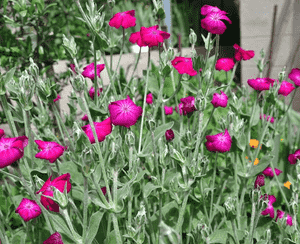
Rose campion(Silene coronaria)

Rose campion (Silene coronaria)

Also known as: Dusty miller, Lamp-flower

The rose campion, an ornamental plant native to Asia and Europe, is well-regarded and has earned the Royal Horticultural Society's Award of Garden Merit. Often used in garlands, its Latin name is Silene coronaria, though it is also known as Lychnis coronaria in the United Kingdom.

Attributes of Rose campion

Lifespan
Perennial, Biennial, Annual
Plant Type
Herb
Plant Height
61 cm to 91 cm
Spread
60 cm
Leaf Color
Green White Silver Gray
Flower Size
4 cm to 5 cm
Flower Color
Pink Red White Purple

PlantJoy - Identify plants with a snap

Identify and diagnose plants, get toxicity alerts, and explore safety guides for all types of fungi.

Try for Free

Images of Rose campion

Rose campion(Silene coronaria)

Quickly Identify Rose campion

1
Dense white wooly hairs cover leaves and stems, giving a distinctive grayish-green appearance.
2
Stout, erect stems with grayish-green hue and woolly texture, reaching 16-40 inches (40-102 cm).
3
Purplish-pink flowers with floppy, overlapping petals, approximately 1-inch across.
4
Basal leaves are lanceolate, spoon-shaped, silvery green, 3-5 inches (7.6-12.7 cm) long.
5
Fruit capsules ellipsoid to ovoid, 0.5 inches (1.27 cm) long, segmenting with five teeth.

Scientific Classification of Rose campion

Phylum
Vascular plants
Class
Dicotyledons
Order
Caryophyllales
Family
Pink
Genus
Campions
Species
Rose campion

Planting and Growing of Rose campion

Care Difficulty
Easy
Watering Schedule
Every 4 days
Sunlight Requirements
Full sun
Sunshine Duration
6-10 hours
Ideal Temperature
60-70℉
Soil Type
Potting Mix, Peat Mix
Soil pH
6.5-7.5
Fertilizer Type
Balanced
Pruning Season
Spring, Summer
Pruning Area
Branches, Leaves
Pruning Frequency
2 times a year
Repotting Season
Spring
Pot Type
Plastic, Ceramic

water icon How to Water Rose campion?

When watering Silene coronaria, it's essential to ensure that the soil is evenly moist but not waterlogged. This plant prefers its soil to be on the drier side between waterings. As a general rule, aim for about 200ml of water per session, allowing the topsoil to dry out before giving another drink.
What are the symptoms of an underwatered Rose campion?
What should I do if my Rose campion is not getting enough water?
What are the symptoms of an overwatered Rose campion?
How to save an overwatered Rose campion?
More About Watering Techniques

sunlight icon What Are the Sunlight Requirements for Rose campion?

Sunlight Requirements: Full sun, Partial sun
Duration of light: 6 to 8 hours daily
Silene coronaria prefers full sun to partial sun conditions. By ensuring it receives 6-8 hours of light, you help the plant to thrive, resulting in lush growth and prolific flowering.
What is the ideal light condition?
How can I achieve these ideal conditions?
Why is ideal light important?
More About Sunlight Requirements Techniques

temperature icon What Is the Ideal Temperature Range for Rose campion?

Ideal Temperature: 60 ~ 70℉
Silene coronaria thrives in a mild climate with temperatures ranging from 60°F to 70°F. These temperatures provide optimal growth conditions by supporting essential physiological processes such as photosynthesis and transpiration. Consistent temperatures within this range result in healthy foliage and abundant flowering.

soil icon What Soil is Best for Rose campion?

Soil type: Sandy loam, Loam
Soil PH: 6.5 ~ 7.5
Silene coronaria thrives in well-draining soil, allowing excess water to flow away. This prevents root rot and ensures that the roots have access to necessary oxygen, promoting healthy growth. Air in the soil is as crucial as water. Loamy or sandy loam soil offers the perfect combination of air spaces and stability, ensuring the roots can breathe without being soggy or compacted. While Silene coronaria is not overly demanding, a soil rich in organic matter supports optimal growth. It helps in retaining moisture and provides essential nutrients for a vibrant display. More About Soil

fertilize icon How to Fertilize Rose campion?

Fertilizer type: Balanced
For Silene coronaria, use a balanced fertilizer with equal parts nitrogen, phosphorus, and potassium. Apply liquid fertilizer at half the recommended strength on the label to avoid over-fertilization. The target is to nourish without overwhelming the plant. More About Fertilizing Techniques

prune icon How to Prune Rose campion?

Pruning Time: Spring, Summer
Begin by sanitizing your pruning shears to prevent the spread of any pathogens. Inspect the plant for any dead or diseased stems, cutting them away to maintain plant health. This initial step sets the stage for a healthy and flourishing plant. Silene coronaria benefits greatly from deadheading spent flowers. This encourages more blooms throughout the growing season. To do this, simply snip the flower stem back to the nearest pair of healthy leaves as flowers fade. Post-bloom, trim back the plant by one-third to one-half its size to shape and control its growth. This keeps the plant compact and encourages new, vigorous growth for the next flowering season. More About Pruning Techniques

propagate icon How to Propagate Rose campion plant?

Propagate Time: Spring, Early summer
1
Collect seeds from mature Silene coronaria plants and dry them thoroughly. You can sow these seeds in a well-draining seed compost mix, gently pressing them into the soil surface.
2
Use a sharp knife or pruners to cut a healthy stem from the mother plant, ideally choosing a non-flowering shoot. Remove leaves from the lower part to expose the nodes for rooting.
3
The best time for dividing is when the plant is dormant in early spring. Carefully dig up the plant, ensuring minimal root disturbance, and divide it into smaller clumps using a sharp knife.
More About Propagating Techniques

repot icon How to Repot Rose campion plant?

Repotting frequency: Every 2-3 years
1
Silene coronaria signals its need for repotting when its roots begin to circle the pot or emerge from the drainage holes. Additionally, reduced growth or water retention might indicate it's time for a bigger pot.
2
Select a pot that is one to two inches larger in diameter than the current one. Ensure it has adequate drainage holes to prevent waterlogging, which can lead to root rot. A slightly larger pot provides room for growth.
3
Opt for a well-draining potting mix with a mix of sand and compost. The sand enhances drainage, preventing waterlogged roots, while the compost adds nutrients for healthy growth.

PlantJoy - Identify plants with a snap

Find the best spots for them to optimize their health, simply using your phone.

Try for Free

Toxicity of Rose campion

Is Rose campion toxic to cat?

Rose campion exhibits a mild level of toxicity for cats. If felines consume significant amounts of this plant, they may suffer from poisoning. Every component of rose campion is deemed toxic, posing a threat if ingested by cats. After consumption, a cat may display symptoms that suggest physical distress or illness. Due to the possible health hazards, it is essential for cat owners to monitor for any indications of poisoning and to swiftly seek veterinary attention if their pet is believed to have ingested any portion of rose campion.

Is Rose campion toxic to dog?

Rose campion carries a mild risk of toxicity for dogs. Although the plant is not extremely poisonous, consuming it in significant amounts can result in negative health effects. Any part of the rose campion plant can be harmful if ingested, as all sections contain toxic compounds. Symptoms that may arise after ingestion include gastrointestinal disturbances like vomiting and diarrhea, as well as potential lethargy or other signs of distress. If you believe your dog has eaten rose campion, it is crucial to respond promptly and obtain care from a veterinary clinic to secure the best possible outcome for your pet's well-being.

Identify toxic plants for your safety

Learn which plants are harmful to you and your pets, and make informed choices for a safer home!

Try for Free
WARNING
The judgment on toxicity and danger is for reference only. We DO NOT GUARANTEE any accuracy of such judgment. Therefore, you SHALL NOT rely on such judgment. It is IMPORTANT TO SEEK PROFESSIONAL ADVICE in advance when necessary.
More About Toxic Techniques

