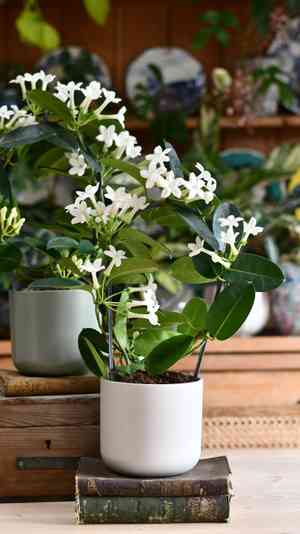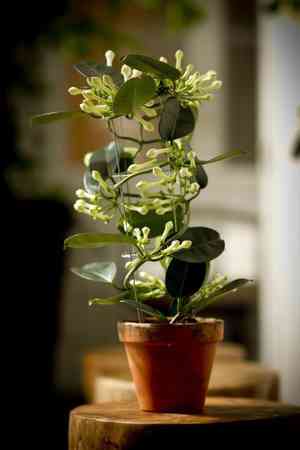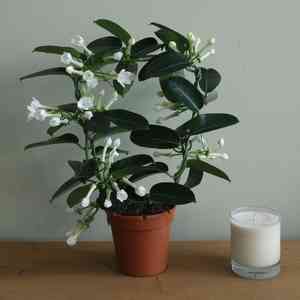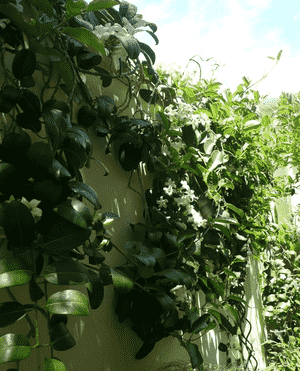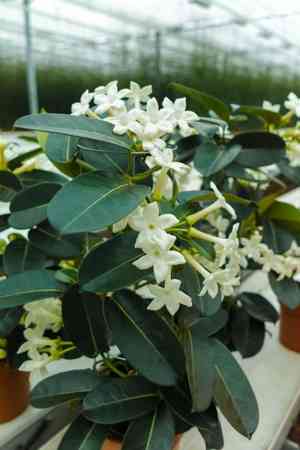
Madagascar jasmine(Stephanotis floribunda)

Madagascar jasmine (Stephanotis floribunda)

Also known as: Waxflower

Madagascar jasmine (Stephanotis floribunda) is a climbing vine that will grow to 3 m tall. Large, leathery oval-shaped green leaves grow to about 10 cm long. Blooms most often in spring and summer when grown outdoors. When grown indoors with enough bright light it can bloom year around. Clusters of waxy white, star-shaped tubular flowers are very fragrant.

In This Article
Care Tips Toxicity

Attributes of Madagascar jasmine

Lifespan
Perennial
Plant Type
Vine
Plant Height
6 m
Spread
1 m
Leaf Color
Green
Flower Size
2.5 cm
Flower Color
White

PlantJoy - Identify plants with a snap

Identify and diagnose plants, get toxicity alerts, and explore safety guides for all types of fungi.

Try for Free

Images of Madagascar jasmine

Madagascar jasmine(Stephanotis floribunda)

Quickly Identify Madagascar jasmine

1
Climbing habit, reaching 15-20 feet (4.5-6 meters) in height and width.
2
Dark green, oval-shaped, leathery leaves in opposite pairs, 3-4 inches (7.5-10 cm) long.
3
Fragrant, pure white, trumpet-shaped flowers in clusters, blooming late spring to fall.
4
Robust, woody stem with diameter 0.2-0.4 inches (0.5-1 cm), dark green color.
5
Smooth, fleshy fruit, 2.7-3.9 inches (7-10 cm), splitting to reveal wind-dispersed seeds.

Scientific Classification of Madagascar jasmine

Phylum
Vascular plants
Class
Dicotyledons
Order
Gentianales
Family
Dogbane
Genus
Stephanotis
Species
Madagascar jasmine

Toxicity of Madagascar jasmine

Is Madagascar jasmine toxic to humans?

Madagascar jasmine is not considered poisonous in itself. While it is not fit for consumption, it poses no toxic threat. Nevertheless, its fragrance and appearance are quite similar to many other jasmines, several of which are harmful to humans. It is commonly confused with night-blooming jasmine, which is toxic in every part and can lead to digestive disturbances, fever, and increased heart rate. Carolina jasmine, another lookalike, contains highly irritating sap. Consumption of any type of jasmine should be avoided, especially by small children and individuals with cognitive impairments, who may attempt to ingest it. Even if you can identify your plant as Madagascar jasmine, it is prudent to keep it out of reach of those who are vulnerable.


Identify toxic plants for your safety

Learn which plants are harmful to you and your pets, and make informed choices for a safer home!

Try for Free
WARNING
The judgment on toxicity and danger is for reference only. We DO NOT GUARANTEE any accuracy of such judgment. Therefore, you SHALL NOT rely on such judgment. It is IMPORTANT TO SEEK PROFESSIONAL ADVICE in advance when necessary.