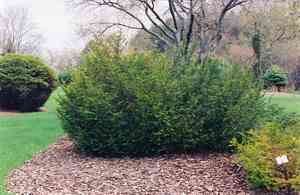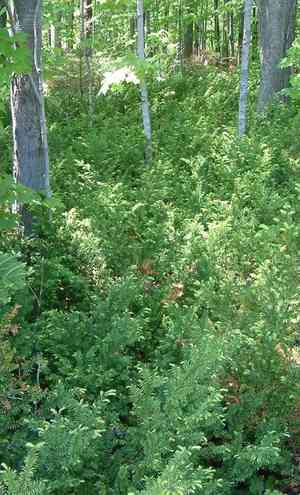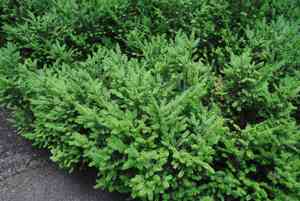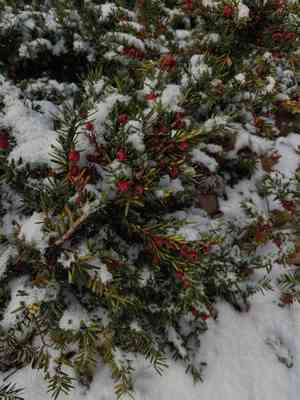
Canada yew(Taxus canadensis)

Canada yew (Taxus canadensis)

Also known as: Pacific yew, Yew

The Canada yew (Taxus canadensis) is a conifer native to northeastern North America. It contains toxic compounds known as taxanes, making all parts of the plant poisonous.

Attributes of Canada yew

Lifespan
Perennial
Plant Type
Shrub
Plant Height
2.5 m
Spread
1.8 m to 2.5 m
Leaf Color
Green
Flower Size
Not applicable, as yew plants produce small, inconspicuous flowers
Flower Color
Gold Yellow Cream

PlantJoy - Identify plants with a snap

Identify and diagnose plants, get toxicity alerts, and explore safety guides for all types of fungi.

Try for Free

Images of Canada yew

Canada yew(Taxus canadensis)

Quickly Identify Canada yew

1
Dark glossy green needle-like foliage arranged spirally on thin stems.
2
Open habit with low, spreading form; mature height 1-6 feet (30-180 cm).
3
Distinctive bright red arils around 3/8 inch (1 cm) in length, revealing solitary seed.
4
3/8- to 1-inch (1 to 2.5 cm) dark green needles with flattened appearance projecting laterally.
5
Hairless twigs with stems measuring 0.1-0.2 inches (2.5-5 mm) in thickness; alternate branching pattern.

Scientific Classification of Canada yew

Phylum
Vascular plants
Class
Conifers
Order
Pinales
Family
Yew
Genus
Yews
Species
Canada yew

Planting and Growing of Canada yew

Care Difficulty
Easy
Watering Schedule
Every 3 days
Sunlight Requirements
Partial sun
Sunshine Duration
6-10 hours
Ideal Temperature
50-64℉
Soil Type
Potting Mix, Peat Mix
Soil pH
5.5-6.8
Fertilizer Type
Balanced
Pruning Season
Spring, Summer
Pruning Area
Branches, Leaves
Pruning Frequency
Once a year
Repotting Season
Spring
Pot Type
Plastic, Ceramic

water icon How to Water Canada yew?

The watering amount for Taxus canadensis should be around 500 ml per watering session. It’s essential to ensure that the soil is moistened deeply but not waterlogged. This plant thrives on a moist but not soggy environment, so adjusting according to the weather conditions is crucial. Make sure the water reaches the root zone but doesn’t leave any standing puddles.
What are the symptoms of an underwatered Canada yew?
What should I do if my Canada yew is not getting enough water?
What are the symptoms of an overwatered Canada yew?
How to save an overwatered Canada yew?

sunlight icon What Are the Sunlight Requirements for Canada yew?

Sunlight Requirements: Partial sun, Full shade
Duration of light: 2 to 4 hours
Taxus canadensis prefers areas with partial sun to full shade, ideally receiving 2 to 4 hours of filtered sunlight daily. This lighting supports optimal photosynthesis, contributing to healthy foliage, robust growth, and increased resilience.
What is the best lighting condition for Taxus canadensis?
How can you ensure appropriate lighting for this plant indoors?
What are the benefits of providing ideal lighting to Taxus canadensis?
More About Sunlight Requirements Techniques

temperature icon What Is the Ideal Temperature Range for Canada yew?

Ideal Temperature: 50 ~ 64℉
Taxus canadensis thrives best within a temperature range of 50 to 64°F. Maintaining this range ensures optimal growth and foliage health. Specifically, its physiological processes such as photosynthesis and nutrient uptake are most efficient between these temperatures. When temperatures are kept stable in this range, the plant's metabolic rate is well-balanced, preventing undue stress and promoting vigorous growth.

soil icon What Soil is Best for Canada yew?

Soil type: Loam, Sandy loam, Acidic soil, Peat soil
Soil PH: 5.5 ~ 6.8
Taxus canadensis prefers soils with good moisture retention. This quality helps the plant to maintain hydration during dry periods, crucial for its growth and development, especially in less frequent watering schedules. Rich in organic matter, loamy soils provide essential nutrients that help this species thrive. Adequate nutrients promote healthy foliage and support the overall health and vigor of the plant. It is vital that the soil drains well to prevent waterlogging which can lead to root rot. Well-drained soil assists Taxus canadensis roots in accessing oxygen necessary for healthy growth. More About Soil

fertilize icon How to Fertilize Canada yew?

Fertilizer type: Balanced
For Taxus canadensis, the fertilizer amount should be moderate. Use a balanced 10-10-10 NPK fertilizer for young plants. Apply about 0.1 pounds per plant for mature shrubs, taking care to avoid direct contact with the foliage to prevent burning.

prune icon How to Prune Canada yew?

Pruning Time: Spring, Summer, Autumn
First, identify dead, diseased or overlapping branches. These should be the primary focus to enhance sunlight penetration and air circulation. Cut branches at a 45-degree angle, just above a node, to promote regrowth. This technique encourages healthier new branches to develop.

propagate icon How to Propagate Canada yew plant?

Propagate Time: Spring,Early summer
1
Select healthy branches from the parent plant, ideally semi-hardwood cuttings around 4-6 inches long. Make a clean cut just below a node and remove the lower leaves to prevent decay in the rooting medium.
2
Dip the cut end of the cutting into rooting hormone. This step is crucial as it stimulates root development and increases the probability of successful rooting in the propagation process.
3
Plant the treated cuttings in a prepared pot with a well-draining soil mix. Ensure the cuttings are inserted deep enough to stand upright and keep the medium consistently moist but not waterlogged.
More About Propagating Techniques

repot icon How to Repot Canada yew plant?

Repotting frequency: Every 2-3 years
1
Taxus canadensis signals its need for repotting when roots start poking out of the drainage holes, or the growth seems stunted. Ideal times for repotting are early spring before new growth or autumn after the growing season has ended, providing the yew ample time to settle in.
2
Select a pot that is 2-3 inches larger in diameter than the current one with good drainage. The choice of an appropriately sized pot helps prevent root rot by ensuring adequate moisture drainage, while also accommodating future growth, allowing the plant to establish a strong root system.
3
Opt for a well-draining, loamy soil mix ideal for Taxus canadensis. This mix provides essential nutrients while preventing waterlogging, closely mimicking the plant's native woodland conditions and supporting robust growth and health.

PlantJoy - Identify plants with a snap

Find the best spots for them to optimize their health, simply using your phone.

Try for Free

Toxicity of Canada yew

Is Canada yew toxic to humans?

The Canada yew is highly toxic to humans if any part of it is ingested. Consuming even small amounts of the plant—including its bark, needles, berries, or seeds—can lead to severe health issues. Symptoms of poisoning may manifest as headaches, nausea, vomiting, diarrhea, irregular heartbeats, and in severe cases, can escalate to coma, cardiac arrest, or even death. Although Canada yews are often used for ornamental purposes, gardeners and landscapers typically do not need to worry about having skin reactions from handling them. However, close supervision of children around Canada yews is essential, as they may be drawn to the vibrant red berries.

Is Canada yew toxic to cat?

Every component of the Canada yew (Taxus canadensis) is regarded as toxic to cats and can be lethal with just a few small bites. Signs of yew poisoning in felines may include vomiting, diarrhea, widening of the pupils, and difficulty breathing. In severe instances, it can lead to coma or even fatality. If you suspect your cat has consumed any portion of a yew plant, contact a veterinarian without delay.

Is Canada yew toxic to dog?

This tree poses a significant poisoning risk to dogs. Every part of the tree is toxic when ingested, with the cones, seeds, and needles being the most hazardous components. The symptoms of poisoning from this tree can be severe and necessitate urgent medical care, including shaking, difficulty breathing, seizures, vomiting, and potentially sudden death from cardiac failure. If you suspect that your dog has consumed any part of this tree, it is crucial to seek advice from your veterinarian immediately.

Identify toxic plants for your safety

Learn which plants are harmful to you and your pets, and make informed choices for a safer home!

Try for Free
WARNING
The judgment on toxicity and danger is for reference only. We DO NOT GUARANTEE any accuracy of such judgment. Therefore, you SHALL NOT rely on such judgment. It is IMPORTANT TO SEEK PROFESSIONAL ADVICE in advance when necessary.
More About Toxic Techniques