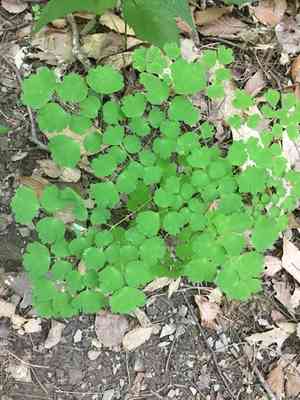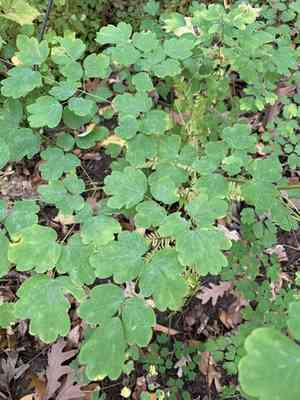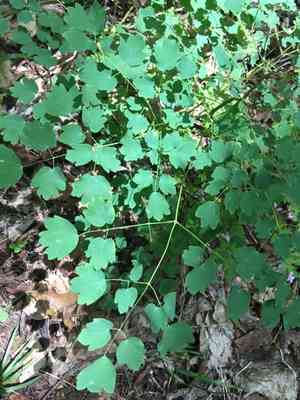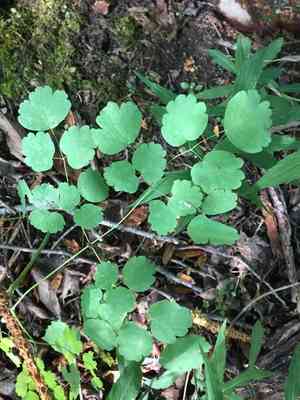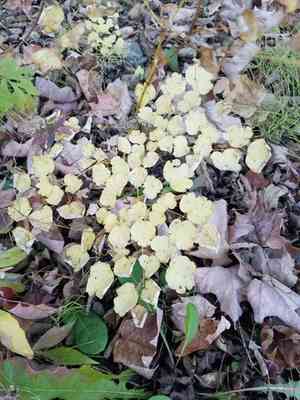
Early Meadow Rue(Thalictrum dioicum)

Early Meadow Rue (Thalictrum dioicum)

Also known as: Quicksilver Weed

Early Meadow Rue (Thalictrum dioicum) is a perennial herb that typically reaches heights of 20 to 76 centimeters. Blooming from spring to early summer, this plant features separate male and female flowers. Male flowers exhibit pale yellow tips that darken over time, while female flowers are greenish-white. Post-bloom, female plants produce clusters of seeds.

Attributes of Early Meadow Rue

Lifespan
Perennial
Plant Type
Herb
Plant Height
30 cm to 61 cm
Spread
30 cm to 60 cm
Leaf Color
Green Gray Silver
Flower Size
2.5 cm
Flower Color
Green White Purple Yellow

PlantJoy - Identify plants with a snap

Identify and diagnose plants, get toxicity alerts, and explore safety guides for all types of fungi.

Try for Free

Images of Early Meadow Rue

Early Meadow Rue(Thalictrum dioicum)

Quickly Identify Early Meadow Rue

1
Compound leaves with feathery, lacy texture resembling Columbine or Maidenhair Fern.
2
Distinct male and female flowers on separate plants; male flowers with yellow stamens and female flowers with purple pistils.
3
Elongated achene fruit tapering to points, clustered ribbed texture, measuring 0.2 inches (5 mm).
4
Cylindrical stem, pale green to pale purplish-green, slender at 0.1-0.2 inches (2.5-5 mm) diameter.
5
Delicate, gray-green compound leaves with oval, serrated leaflets, approximately 4 inches (10 cm) in length.

Scientific Classification of Early Meadow Rue

Phylum
Vascular plants
Class
Dicotyledons
Order
Ranunculales
Family
Buttercup
Genus
Meadow-rues
Species
Early Meadow Rue

Planting and Growing of Early Meadow Rue

Care Difficulty
Easy
Watering Schedule
Every 4 days
Sunlight Requirements
Partial sun
Sunshine Duration
4-6 hours
Ideal Temperature
60-75℉
Soil Type
Potting Mix, Peat Mix
Soil pH
6-7.5
Fertilizer Type
Balanced
Pruning Season
Spring, Summer
Pruning Area
Branches, Leaves
Pruning Frequency
2 times a year
Repotting Season
Spring
Pot Type
Terracotta, Plastic

water icon How to Water Early Meadow Rue?

When watering Thalictrum dioicum, aim for approximately 300 milliliters per session. The goal is to moisten the soil thoroughly without leaving it waterlogged. Ensure the water reaches the root zone but doesn't pool on the surface. A consistent watering strategy will maintain the plant's health and encourage vibrant growth.
What are the symptoms of an underwatered Early Meadow Rue?
What should I do if my Early Meadow Rue is not getting enough water?
What are the symptoms of an overwatered Early Meadow Rue?
How to save an overwatered Early Meadow Rue?

sunlight icon What Are the Sunlight Requirements for Early Meadow Rue?

Sunlight Requirements: Partial sun
Duration of light: 3 to 6 hours
Partial sun is ideal, simulating natural understory light. This range fosters lush foliage and abundant flowering, reflecting its woodland origins by mimicking the dappled light environment.
What is the best location?
How to achieve ideal sunlight?
Why is ideal sunlight important?

temperature icon What Is the Ideal Temperature Range for Early Meadow Rue?

Ideal Temperature: 60 ~ 75℉
Thalictrum dioicum thrives in temperatures between 60°F and 75°F. This range supports optimal metabolic functions, including photosynthesis and respiration, thus promoting robust growth and healthy development of foliage and flowers.

soil icon What Soil is Best for Early Meadow Rue?

Soil type: Loam, Sandy loam, Acidic soil
Soil PH: 6 ~ 7.5
Thalictrum dioicum thrives best in well-draining soils. This ensures that the roots receive sufficient air, preventing root rot and promoting healthy growth. Although it prefers well-drained soils, Thalictrum dioicum benefits from soil that can retain some moisture. This helps keep the plant hydrated during dry spells, encouraging lush foliage. Incorporating rich organic matter into the soil provides essential nutrients, enhancing plant vigor and bloom. This mimics its native forest environment where leaf litter enriches the soil.

fertilize icon How to Fertilize Early Meadow Rue?

Fertilizer type: Balanced
For Thalictrum dioicum, it's important to use a balanced fertilizer, like a 10-10-10 NPK formula. For liquid fertilizers, dilute to half the recommended strength to avoid overfeeding. Typically, use about 1/4 cup of diluted liquid fertilizer per plant.

prune icon How to Prune Early Meadow Rue?

Pruning Time: Spring, Summer
Start by removing dead or damaged stems and leaves as the plant begins waking from dormancy. Focus on cutting right above a healthy node to encourage new growth. Aim for early spring before the plant fully leafs out to allow it ample time for recovery. In late summer, assess the plant's shape and remove any spindly or overly lengthy stems to maintain a balanced appearance. Also, cut away the faded flower heads to prevent self-seeding if you do not wish for new growth in nearby areas.

propagate icon How to Propagate Early Meadow Rue plant?

Propagate Time: Spring, Early spring
1
To propagate Thalictrum dioicum by seeds, collect the seeds from mature plants in late summer. Make sure the seeds are dry and store them in a cool, dark place until ready to plant.
2
Fill seed trays with a mix of peat and perlite. Scatter the seeds thinly over the surface and cover lightly with the same mix. Water gently but thoroughly and maintain moisture levels until germination.
3
In early spring, when new growth begins, dig up mature clumps of Thalictrum dioicum. Divide the clumps into smaller sections, ensuring each section has at least one bud. Replant these immediately into well-draining soil.

repot icon How to Repot Early Meadow Rue plant?

Repotting frequency: Every 2-3 years
1
Thalictrum dioicum should be repotted when it shows signs of restricted growth, roots growing out of the drainage holes, or when the soil becomes compacted and doesn’t retain moisture well. Ideally, repotting is best done in spring or autumn to give the plant the best chance to establish before the hot summer or cold winter.
2
Select a pot that is one size larger than the existing one, ideally with a depth that allows adequate root growth. The pot should also have drainage holes to prevent waterlogging. Choosing the right pot ensures the plant has room to grow and reduces the risk of root rot, promoting healthier growth.
3
Opt for a well-draining loamy soil mix, enriched with organic matter to provide adequate nutrition. This type of soil allows for proper aeration and moisture balance, crucial for the healthy growth of Thalictrum dioicum. It helps prevent root rot and ensures nutrients reach the plant effectively.

PlantJoy - Identify plants with a snap

Find the best spots for them to optimize their health, simply using your phone.

Try for Free

Toxicity of Early Meadow Rue

Is Early Meadow Rue toxic to cat?

Early Meadow Rue is recognized as having a moderate level of toxicity for cats. If a cat consumes any portion of early Meadow Rue, which is toxic throughout, it may display symptoms of physical distress or illness. Although the exact toxic compounds present in early Meadow Rue remain unspecified, the potential impact on feline health is substantial enough to raise concerns. Pet owners should closely observe their cats for any atypical behaviors or signs of illness and should seek immediate veterinary assistance if they suspect their cat has ingested any part of early Meadow Rue. Timely medical intervention is essential to address the toxicity and safeguard the well-being of the affected feline.

Is Early Meadow Rue toxic to dog?

Early Meadow Rue presents a moderate level of toxicity risk for dogs. Should a dog consume any portion of the plant, as all its parts are toxic, they may face the danger of poisoning. Symptoms of toxicity can differ but could manifest as vomiting, diarrhea, excessive salivation, or more serious reactions such as tremors or seizures. It is essential for dog owners to keep their pets from ingesting early Meadow Rue, and in cases of suspected poisoning, they must seek prompt veterinary attention to secure the best possible outcome for their furry companions.

Identify toxic plants for your safety

Learn which plants are harmful to you and your pets, and make informed choices for a safer home!

Try for Free
WARNING
The judgment on toxicity and danger is for reference only. We DO NOT GUARANTEE any accuracy of such judgment. Therefore, you SHALL NOT rely on such judgment. It is IMPORTANT TO SEEK PROFESSIONAL ADVICE in advance when necessary.