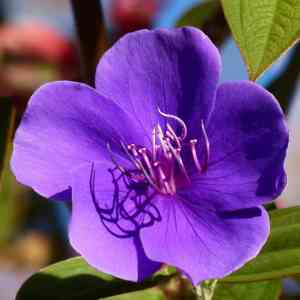
Princess flower (Tibouchina urvilleana)
Also known as: Lasiandra, Purple glory tree
The Princess Flower (Tibouchina urvilleana), native to Brazil, thrives in sunny locations. It features hairy leaves and can be trained to climb trellises or other vertical supports, making it a great option for adding height and visual interest to your garden.
In This Article
Attributes of Princess flower
Lifespan
Perennial
Plant Type
Shrub
Plant Height
3 m to 6 m
Spread
2 m to 3 m
Leaf Color
Green
Flower Size
10 cm
Flower Color
Purple Pink Violet
Images of Princess flower
Quickly Identify Princess flower
1
Large bright purple flowers with 5 obovate petals, measuring 3-4 inches (7.5 cm) in diameter.
2
Distinctly 4-sided stem, green with short fine hairs, typically 0.2-0.4 inches (0.5-1 cm) in diameter.
3
Lush semi-evergreen shrub or small tree reaching 6-8 feet (183-244 cm), sometimes extending up to 15 feet (457 cm).
4
Lanceolate to ovate leaves, dark green with pinnate venation and greyish green overall, measuring 4-6 inches (10-15 cm) long.
5
Trunk with smooth light green to tan bark, developing slightly flaking surface with diameters up to 4 inches (10 cm).
Scientific Classification of Princess flower
Phylum
Vascular plants
Class
Dicotyledons
Order
Myrtales
Family
Melastome
Genus
Glory trees
Species
Princess flower
Planting and Growing of Princess flower
Care Difficulty
Easy
Watering Schedule
Every 4 days
Sunlight Requirements
Partial sun
Sunshine Duration
4-6 hours
Ideal Temperature
65-75℉
Soil Type
Potting Mix, Peat Mix
Soil pH
6.5-7.5
Fertilizer Type
Balanced
Pruning Season
Spring, Summer
Pruning Area
Branches, Leaves
Pruning Frequency
2 times a year
Repotting Season
Spring
Pot Type
Plastic, Ceramic
 How to Water Princess flower?
Tibouchina urvilleana prefers to have its soil kept moderately moist. Watering should aim to thoroughly moisten the root zone until water begins to drain from the bottom of the pot, indicating saturation. This soaking ensures roots have access to adequate moisture without being waterlogged.
More About Watering Techniques→
What are the symptoms of an underwatered Princess flower?
›
What should I do if my Princess flower is not getting enough water?
›
What are the symptoms of an overwatered Princess flower?
›
How to save an overwatered Princess flower?
›
 What Are the Sunlight Requirements for Princess flower?
Partial to full sun exposure is the ideal range for Tibouchina urvilleana, allowing it to photosynthesize efficiently while maintaining robust bloom cycles. Ideal lighting promotes healthy growth, vibrant leaves, and extended flowering periods.
More About Sunlight Requirements Techniques→
What is the ideal light setting for Tibouchina urvilleana?
›
How can one ensure Tibouchina urvilleana receives consistent light?
›
What are the effects of optimal sunlight exposure?
›
 What Is the Ideal Temperature Range for Princess flower?
The ideal temperature range for Tibouchina urvilleana, commonly known as the Princess Flower, is between 65°F and 75°F. These temperatures support optimal growth and flowering by providing a stable environment without extremes that could stress the plant.
 What Soil is Best for Princess flower?
Tibouchina urvilleana prefers well-drained soil to prevent root rot. Proper drainage ensures that the roots receive adequate oxygen and nutrients, promoting healthy growth and vibrant blooms. This plant thrives in soil that retains adequate moisture without becoming waterlogged. Consistent moisture levels help maintain lush foliage and increase the number of blooms. A loamy soil rich in organic matter provides essential nutrients, supporting robust growth and enhancing the plant's natural color and flowering capability.
More About Soil→
 How to Fertilize Princess flower?
For Tibouchina urvilleana, use a balanced liquid fertilizer diluted to half strength, typically applying about 1 to 2 teaspoons per gallon of water. This ensures the plant receives adequate nutrients without risking over-fertilization, which can harm its roots.
More About Fertilizing Techniques→
 How to Prune Princess flower?
Before starting, observe your plant’s natural growth habit. Tibouchina urvilleana typically grows in an upright, bushy manner with potentially wide-spreading branches. Knowing the natural form will help you decide which branches to cut in order to encourage a fuller rounded shape. Look for stems that have finished flowering or are growing out of bounds. Use clean, sharp pruning shears to make cuts at a 45-degree angle, just above a set of leaves or side growth. This will encourage the plant to heal quickly and direct nutrients effectively to these points for bushier growth. When pruning, focus on achieving balance and symmetry in your Tibouchina bush. Aim for an even distribution of branches by trimming more where growth is denser. This will help optimize light penetration and air circulation, which are critical for healthy growth and reducing the risk of disease.
More About Pruning Techniques→
 How to Propagate Princess flower plant?
1
Select a healthy branch from the Tibouchina urvilleana that is free from disease and pests. The cutting should be about 10-15 cm long with at least two to three nodes.
2
Dip the cut end of the cutting into rooting hormone to encourage quicker root development. Ensure that the excess is shaken off to prevent the hormone from clumping.
3
Place the cutting into a pot filled with a moist, well-draining potting mix. Ensure at least one node is below the soil surface to support root development.
 How to Repot Princess flower plant?
1
Tibouchina urvilleana signals its need for repotting when roots start sneaking out of drainage holes or when the plant becomes top-heavy and unstable. Spring and summer, during active growth, are ideal.
2
Select a pot just 2 inches larger in diameter than the current one. This promotes healthy root development and prevents waterlogging. Opt for a pot with ample drainage holes to ensure excess water escapes, mimicking its natural habitat.
3
Choose a well-draining, acidic soil mix rich in organic matter. A blend of peat, pine bark, and perlite works wonders. Such a mix maintains moisture without becoming waterlogged, protecting the roots from rot.
Learn More About Princess flower Diseases
Anthracnose
Bacterial Leaf Spot
Black Spot
Chemical Injury
Crown Gall
Damping-off
Downy Mildew
Drought Stress
Fusarium Wilt
Gray Mold
Leaf Curl
Leaf Spot
Mosaic
Nutrient Deficiency
Nutrient Toxicity
Powdery Mildew
Root Rot
Root-knot Nematode
Rusts
Sooty Mold
Spider Mites
Temperature Stress
Thrips Damage
White Mold



