Optimal Fertilizer for Growing Prayer plant: What You Need to Know
1
Liquid feed solutions are typically simpler to manage and administer for houseplants such as the Prayer plant.
2
For Prayer plants, numerous, small doses of plant food are more advantageous than large, infrequent applications.
3
Ensure your Prayer plant is watered prior to applying fertilizer to prevent root damage from concentrated nutrients.
Understanding Your Prayer Plant's Nutrient Requirements
What nutrients are vital for Prayer plant well-being?
The Prayer plant flourishes with a well-rounded intake of essential nutrients. Key among these are Nitrogen (N), Phosphorus (P), and Potassium (K). These major nutrients are crucial for overall plant health—Nitrogen boosts lush, green foliage; Phosphorus aids strong root development; and Potassium improves flower and fruit production, alongside general resilience. Also, trace elements such as Iron, Magnesium, and Calcium, though required in smaller quantities, are critical for preventing deficiencies that could hinder growth or lead to leaf discoloration.
Role of macro and micro-elements in Prayer plant vitality
Macronutrients like Nitrogen, Phosphorus, and Potassium serve as the fundamental components supporting the primary functions of the Prayer plant. Nitrogen is especially important for leaf development, assisting in the creation of chlorophyll—the pigment that gives plants their green color and enables photosynthesis. Phosphorus is essential for energy transfer and storage, key processes for root growth and blooming. Potassium helps regulate water absorption and enhances the plant’s resistance to diseases. Micronutrients, including Iron, Calcium, and Magnesium, despite being needed in tiny amounts, play vital roles in various physiological processes and are necessary to avoid issues such as chlorosis (leaf yellowing) or stunted development.
Selecting the Appropriate Fertilizer for Your Prayer Plant
Organic versus synthetic fertilizers: Which is superior?
When choosing between organic and synthetic fertilizers for your Prayer plant, it's important to consider the benefits and drawbacks of each. Organic fertilizers, derived from natural sources like compost, manure, and bone meal, release nutrients slowly, providing a sustained and consistent feeding method. They enhance soil health and structure, fostering better water retention and microbial activity. Synthetic fertilizers, conversely, are chemically formulated to deliver nutrients quickly and precisely, allowing for faster visual results. They are easy to measure and apply but can lead to salt accumulation in the soil over time, potentially harming plant roots. For indoor Prayer plants, a balanced approach using both types often yields the best outcomes.
How to decipher and comprehend fertilizer labels
Interpreting fertilizer labels is essential for supplying the correct nutrients to your Prayer plant. Fertilizer packaging displays a trio of numbers, known as the N-P-K ratio, indicating the percentages of Nitrogen (N), Phosphorus (P), and Potassium (K) present. For instance, a fertilizer marked 10-10-10 contains 10% of each nutrient. Additional labels might also specify the inclusion of micronutrients like Magnesium or Iron, and the recommended application method, such as slow-release or water-soluble. Understanding these labels ensures you select a balanced fertilizer appropriate for your Prayer plant's specific needs.
Optimal Practices for Fertilizing Your Prayer Plant
When and how often should fertilization occur?
The best time to fertilize your Prayer plant is during its period of active growth, typically the summer months. At this time, the plant’s metabolic rate is high, allowing it to efficiently utilize the nutrients provided. Fertilize every two weeks throughout the summer using a balanced, water-soluble fertilizer diluted to half strength. Conversely, during the autumn and winter, decrease feeding frequency to once a month or stop entirely, as the plant’s growth rate significantly diminishes.
Techniques for effective fertilizer application
Successful fertilization requires precision and attention. Always begin by thoroughly watering your Prayer plant before applying any fertilizer. This practice helps prevent nutrient burn caused by overly high fertilizer concentrations. When using liquid fertilizers, mix them at half the recommended strength and distribute the solution evenly over the soil, avoiding direct contact with the leaves. Another method is to use slow-release fertilizer granules, which break down over time, gradually supplying nutrients. Scatter the granules uniformly on the soil surface and water thoroughly to activate them.
Observing Your Prayer Plant After Fertilization
Indicators of sufficient nourishment
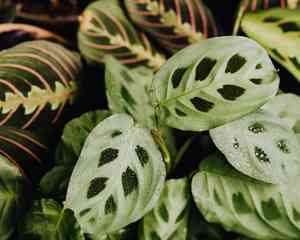
Following fertilization of your Prayer plant, monitor it closely for signs of adequate nutrition. Healthy Prayer plants display vibrant, uniformly green leaves with distinct red or purple patterns, vigorous growth, and new leaves unfurling regularly. Consistent growth and appearance without discoloration or stunted development signify that the plant is receiving the correct amount of nutrients and thriving.
Recognizing symptoms of excessive fertilization
Over-fertilization can harm your Prayer plant, making it crucial to identify and address symptoms promptly. Common signs include leaf burn or scorch, characterized by brown leaf edges, yellowing foliage, and stunted growth. Furthermore, a white crust accumulating on the soil surface can indicate excessive salts from over-fertilization. If these symptoms appear, flush the soil with ample water to wash out surplus salts and discontinue fertilization until the plant shows signs of recovery.



